
Side-by-Side IQ Profile: Boxer vs. Boston Terrier
The Cosmic Pet Pet IQ Lab employs five key dimensions to evaluate canine intelligence, offering a nuanced understanding of each breed's cognitive architecture. For the Boxer, a robust Problem Solving score of 3/5 indicates a capacity for navigating moderately complex challenges, reflecting their history as versatile working dogs. Their Training Speed, also at 3/5, suggests they grasp new commands and routines at a steady pace, neither exceptionally quick nor particularly slow. Where Boxers truly shine is in Social Intelligence, earning a perfect 5/5, highlighting their exceptional ability to understand human cues, intentions, and emotional states, fostering deep bonds. An Instinctive Drive of 4/5 points to strong inherent urges for protection, prey drive, or specific tasks, demanding outlets for these natural behaviors. Finally, their Memory at 3/5 means they retain learned information and experiences adequately over time.
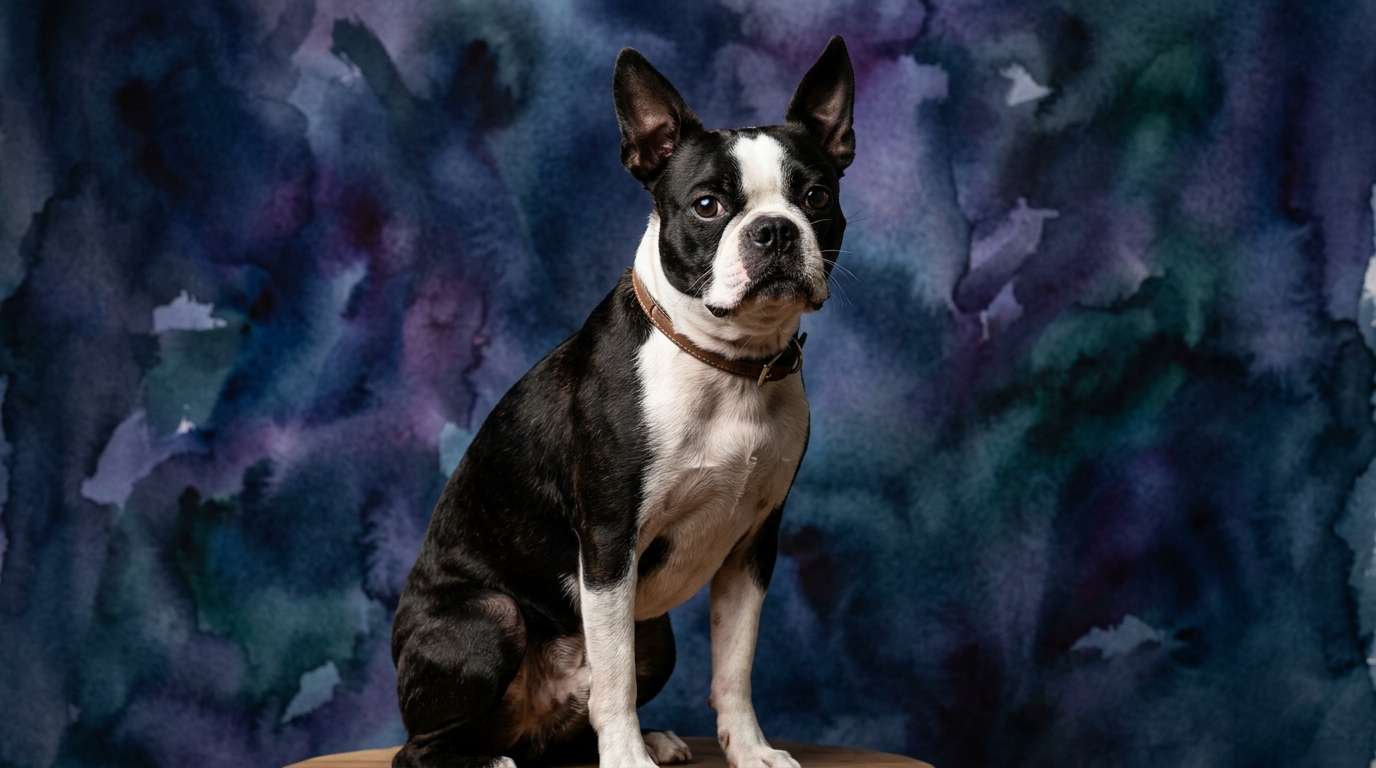
In contrast, the Boston Terrier presents a subtly different cognitive blueprint. Their Problem Solving ability matches the Boxer at 3/5, indicating a similar aptitude for tackling moderate mental puzzles. Training Speed also aligns at 3/5, suggesting a comparable pace for acquiring new skills. The Boston Terrier's Social Intelligence, while respectable at 4/5, is slightly less pronounced than the Boxer's, meaning they connect well with humans but might interpret nuances less acutely. A significant divergence appears in Instinctive Drive, rated at 2/5, signifying a much lower propensity for strong innate working behaviors compared to their Boxer counterparts, making them generally less driven by primal urges. Their Memory, like the Boxer's, stands at 3/5, allowing for adequate retention of training and experiences.
Where the Boxer Wins Cognitively
The Boxer's cognitive profile demonstrates clear advantages in two crucial areas: Social Intelligence and Instinctive Drive. With a perfect 5/5 in Social Intelligence, Boxers possess an unparalleled capacity for understanding and responding to human communication, emotions, and subtle body language. This superior social acumen means they are often acutely aware of their owner's mood, intent, and expectations, making them exceptionally attuned companions. This isn't just about being friendly; it's a sophisticated ability to interpret social cues that strengthens the human-animal bond and facilitates cooperation.
Furthermore, their Instinctive Drive of 4/5, while requiring careful management, represents a cognitive win in terms of purpose-driven mental energy. This strong drive equips them with the mental fortitude and focus for tasks requiring persistence, whether it's protection, advanced scent work, or agility, tapping into a deeper well of inherent motivation that the Boston Terrier simply doesn't possess to the same degree. This drive translates into a powerful, focused mind when directed.
Where the Boston Terrier Wins Cognitively
While the Boston Terrier's raw scores might not surpass the Boxer's in any single category, their cognitive profile offers a distinct advantage in the context of domestic adaptability due to their significantly lower Instinctive Drive (2/5 compared to the Boxer's 4/5). This reduced innate drive means Boston Terriers are generally less predisposed to intense working behaviors like persistent guarding, strong prey chase instincts, or an incessant need for highly structured tasks. Cognitively, this translates to a mind that is often less “busy” with primal urges, making them naturally more content in a home environment with moderate mental stimulation.
Their comparable Problem Solving (3/5) and Training Speed (3/5) to the Boxer, combined with this lower drive, means they offer similar intellectual engagement without the potential for the more demanding cognitive redirection often required by a dog with a strong working drive. Essentially, their cognitive “win” is in their efficient mental design for a companion role, requiring less mental effort from owners to manage strong inherent behaviors.
Which is Easier to Train and Why
Assessing which breed is "easier" to train requires a nuanced look at their cognitive dimensions, as both Boxers and Boston Terriers share a Training Speed score of 3/5. For the Boxer, their exceptional 5/5 Social Intelligence can be a significant asset in training; they are often highly motivated to please their human companions and quickly pick up on cues related to approval and disapproval, which can accelerate cooperative learning. However, this is balanced by their 4/5 Instinctive Drive, which means they might have strong innate urges that need consistent redirection and management during training, such as an impulse to chase squirrels or guard perceived territory, demanding a handler who can channel this drive effectively.
The Boston Terrier, with its 4/5 Social Intelligence, is still very capable of forming strong bonds and responding to human interaction, though perhaps with slightly less intensity than a Boxer. Crucially, their 2/5 Instinctive Drive means they are typically less burdened by powerful, distracting urges. This lower drive can make them more straightforward to train for basic obedience in a typical home setting, as there are fewer deeply ingrained behaviors to counteract or redirect, leading to a potentially smoother, though not necessarily faster, training journey focused on foundational manners rather than complex working tasks. Therefore, while both learn at a similar pace, the Boston Terrier might be "easier" for owners seeking a less demanding cognitive challenge in managing innate behaviors.
Which Suits Active Owners vs. Relaxed Owners
The cognitive profiles of the Boxer and Boston Terrier provide clear indicators for their suitability with different owner lifestyles. Boxers, with their 4/5 Instinctive Drive and 5/5 Social Intelligence, are naturally predisposed to an active and engaged lifestyle. Their strong drive means they thrive when given purposeful activities that challenge both their bodies and minds, whether it's advanced obedience, agility, protection training, or long, stimulating walks. Their high social intelligence further means they deeply enjoy interactive play and training sessions with their owners, making them ideal for individuals or families who are committed to consistent engagement and mental enrichment. They need an owner who can provide an outlet for their inherent cognitive energy.
Conversely, the Boston Terrier, characterized by a lower 2/5 Instinctive Drive and a still robust 4/5 Social Intelligence, is generally a better fit for more relaxed owners. Their lower drive means they are often content with moderate daily exercise and less intensive mental stimulation, making them excellent companions for apartment living or less physically demanding households. While they still enjoy interaction and play, their cognitive needs are less demanding in terms of structured tasks or outlets for strong primal urges, allowing for a more laid-back companionship without the risk of boredom-induced destructive behaviors stemming from an unfulfilled high drive.
The Verdict
Choose a Boxer if you are an active individual or family prepared to channel a dog's substantial instinctive drive and exceptional social intelligence into consistent training, purposeful activities, and deep, interactive companionship.
Opt for a Boston Terrier if you prefer a companion with similar problem-solving and training aptitudes but a significantly lower instinctive drive, making them better suited for a more relaxed lifestyle and moderate mental engagement.
🧠 Find Your Pet's IQ Score
Our Pet IQ Lab assessment covers 25+ tests across 5 cognitive dimensions — personalized to your breed.
Take the Full IQ Test →Frequently Asked Questions
Do Boxers and Boston Terriers learn new commands at the same rate?
Yes, according to the Cosmic Pet Pet IQ Lab, both Boxers and Boston Terriers have a Training Speed score of 3/5, indicating they grasp new commands and routines at a similar, steady pace. The "ease" of training might differ based on other cognitive factors like instinctive drive.
Which breed is more attuned to human emotions and social cues?
Boxers exhibit superior Social Intelligence with a score of 5/5, making them exceptionally adept at understanding human emotions and subtle cues, forming very deep and responsive bonds. Boston Terriers are also socially intelligent at 4/5, but Boxers have a slight edge in this specific dimension.
How does instinctive drive affect the cognitive needs of these breeds?
A Boxer's 4/5 Instinctive Drive means they possess strong innate urges for tasks like guarding or chasing, requiring owners to provide consistent outlets and mental challenges. A Boston Terrier's 2/5 Instinctive Drive means they are less prone to these intense primal behaviors, making their cognitive needs generally easier to satisfy in a typical home environment.