
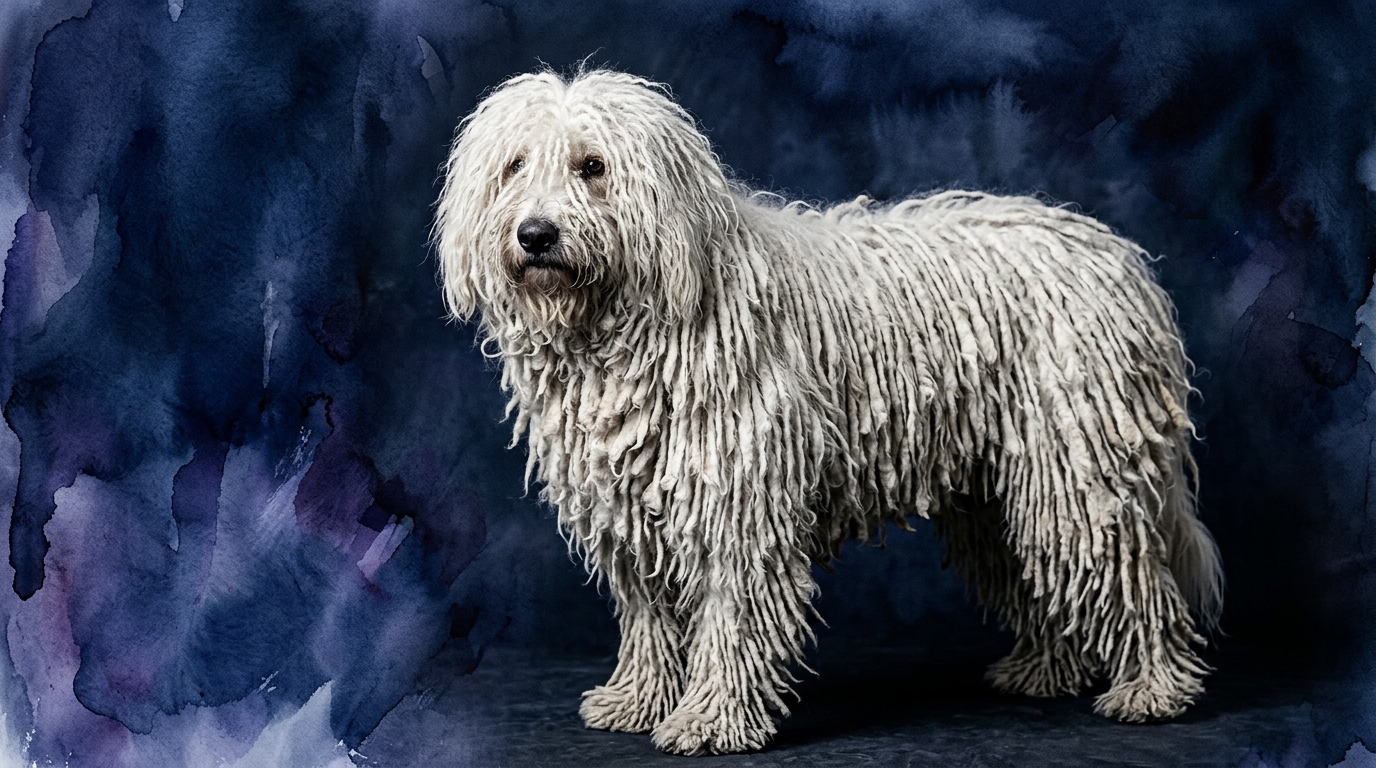
Side-by-Side IQ Profile: Canaan Dog vs. Komondor
The Canaan Dog, originating from the arid landscapes of the Middle East, holds a Coren rank of #43, placing them in the above-average category for working and obedience aptitude. Their problem-solving ability is rated 3/5, demonstrating a moderate capacity for independent thought and finding solutions, often relying on keen observation. Training speed is also 3/5; they grasp new commands at a steady pace, requiring consistent, engaging methods. Social intelligence stands at 3/5, allowing them to integrate well while maintaining independence. Their instinctive drive is 3/5, exhibiting a balanced inclination towards herding and guarding, which can be channeled. A standout trait is their memory, rated 4/5, indicating a robust ability to retain learned behaviors, routines, and experiences, making them reliable in consistent settings.
The Komondor, a majestic Hungarian livestock guardian, holds a Coren rank of #67, positioning them in the fair category for working and obedience. Their problem-solving ability is 3/5, showing moderate capacity to assess and resolve issues, often leveraging protective instincts. Training speed is 3/5, as they acquire skills at a similar pace, but their independence often means a deliberate, sometimes stubborn, approach. Social intelligence is 3/5, allowing for strong family bonds, though more reserved with strangers. Their instinctive drive is 3/5, particularly concerning guarding, informing much behavior. Komondors exhibit a solid memory, rated 3/5, for important routines and family members, though less expansive for specific, less critical details compared to the Canaan Dog.
Where the Canaan Dog Wins Cognitively
The Canaan Dog's most pronounced cognitive advantage lies in its superior memory, rated 4/5 compared to the Komondor's 3/5. This enhanced recall means a Canaan Dog is more likely to remember complex sequences of commands, the location of specific items, or past training sessions with greater precision. For an owner, this translates to faster re-establishment of routines or more consistent execution of behaviors. Their memory also contributes to adaptability, as they readily recall and apply past experiences to new situations, learning from previous successes and failures.
While both breeds share similar ratings across problem-solving, training speed, social intelligence, and instinctive drive, the Canaan Dog's slightly higher Coren ranking (43 vs 67) suggests a nuanced edge in overall cognitive processing. This isn't about raw "smartness," but a tendency towards quicker assimilation and a more agile mental approach to novel tasks, leveraging memory to connect past learnings. Their desert pariah heritage fostered independent thinking and quick adaptation, benefiting cognitive flexibility.
Where the Komondor Wins Cognitively
The Komondor's cognitive strength is deeply interwoven with its historical role as a livestock guardian, manifesting in a particular kind of problem-solving and social intelligence optimized for protection. While rated 3/5 for problem-solving, their solutions often involve strategic threat assessment and independent decision-making to safeguard charges, rather than seeking human intervention. This manifests as deliberate, watchful intelligence, processing environmental cues to identify dangers, often making complex judgments without explicit instruction.
Furthermore, their instinctive drive, while rated similarly at 3/5, is channeled into a singular, unwavering focus on guarding, which shapes their cognitive landscape. This isn't a "win" in raw intellectual capacity, but a specialized cognitive framework prioritizing vigilance, territorial awareness, and decisive protective action. Their social intelligence, though reserved, allows for deep, unwavering loyalty to their family unit, interpreting subtle shifts in their 'flock's' emotional state and responding with appropriate, often protective, actions. This specialized cognitive filtering allows them to excel.
Which is Easier to Train and Why
When evaluating ease of training, both the Canaan Dog and the Komondor are rated 3/5 for training speed, suggesting they learn at a moderate pace. However, their underlying behavioral differences significantly impact the training experience. The Canaan Dog, with its superior memory, retains commands and routines more consistently; once learned, a behavior is likely to stick. Their herding background imbues them with a desire to work alongside humans, making them generally more receptive to direction and eager to participate in structured activities, given engaging, positive training. They are independent, but focus can be captured with stimulating tasks.
The Komondor, while capable of learning, approaches training with characteristic independence and self-assurance. Their guarding instincts mean they are bred to make their own decisions in the field, which can translate into a "what's in it for me?" attitude during sessions. They require patience, consistency, and a deep understanding of their guardian mindset. Repetitive drills might bore them, leading to disengagement. Training a Komondor often feels less like teaching and more like negotiation, requiring an owner to build trust and demonstrate leadership, guiding them to understand the *purpose* behind a command. Their training speed might be similar, but their *willingness* to comply differs based on context and their own assessment.
Which Suits Active Owners vs. Relaxed Owners
The Canaan Dog generally aligns better with active owners who appreciate a canine companion for various pursuits. Their balanced instinctive drive and moderate problem-solving abilities mean they thrive on mental and physical engagement. Owners who enjoy activities like advanced obedience, agility, hiking, or competitive scent work will find the Canaan Dog a willing, capable partner. They possess stamina for long walks or jogs and mental agility for new tricks or puzzle toys. Their need for consistent stimulation means a relaxed owner offering minimal interaction might find their Canaan Dog restless or inventing undesirable entertainment.
The Komondor, while requiring regular exercise to maintain physical health, is often more suited to owners who appreciate a watchful, independent presence rather than a constant activity partner. Their guarding instincts mean their "work" is often observing and patrolling territory, mentally taxing but physically less demanding than agility. Relaxed owners who can provide a secure, spacious environment and are content with a dog that primarily acts as a steadfast guardian will find the Komondor a good match. While they enjoy walks, they aren't usually seeking intense, prolonged physical exertion beyond patrolling, making them less suited for high-energy running or sporting companions.
The Verdict
Choose the Canaan Dog if you appreciate a responsive companion with excellent memory, eager to participate in varied activities and consistent training, suitable for an engaged, active lifestyle.
Opt for the Komondor if you seek a dedicated, independent guardian whose calm vigilance and protective instincts are paramount, thriving in a secure environment with an owner who understands their deliberate, self-assured nature.
🧠 Find Your Pet's IQ Score
Our Pet IQ Lab assessment covers 25+ tests across 5 cognitive dimensions — personalized to your breed.
Take the Full IQ Test →Frequently Asked Questions
Is a Canaan Dog or Komondor better for a first-time dog owner?
Neither breed is typically recommended for first-time owners due to their independent natures and specific training requirements. Both require consistent, experienced handling and early socialization to thrive and prevent behavioral challenges.
Do Canaan Dogs or Komondors shed a lot?
Canaan Dogs are moderate seasonal shedder, with a double coat that requires regular brushing. Komondors, with their corded coats, do not "shed" in the traditional sense, but their cords require specialized maintenance to prevent matting and keep them clean.
Which breed is more protective of its family?
The Komondor is inherently more protective, bred specifically as a livestock guardian to independently defend its charges against threats. While Canaan Dogs are alert and will bark at strangers, their protective instincts are typically less pronounced and more situational compared to the Komondor's unwavering guardian drive.