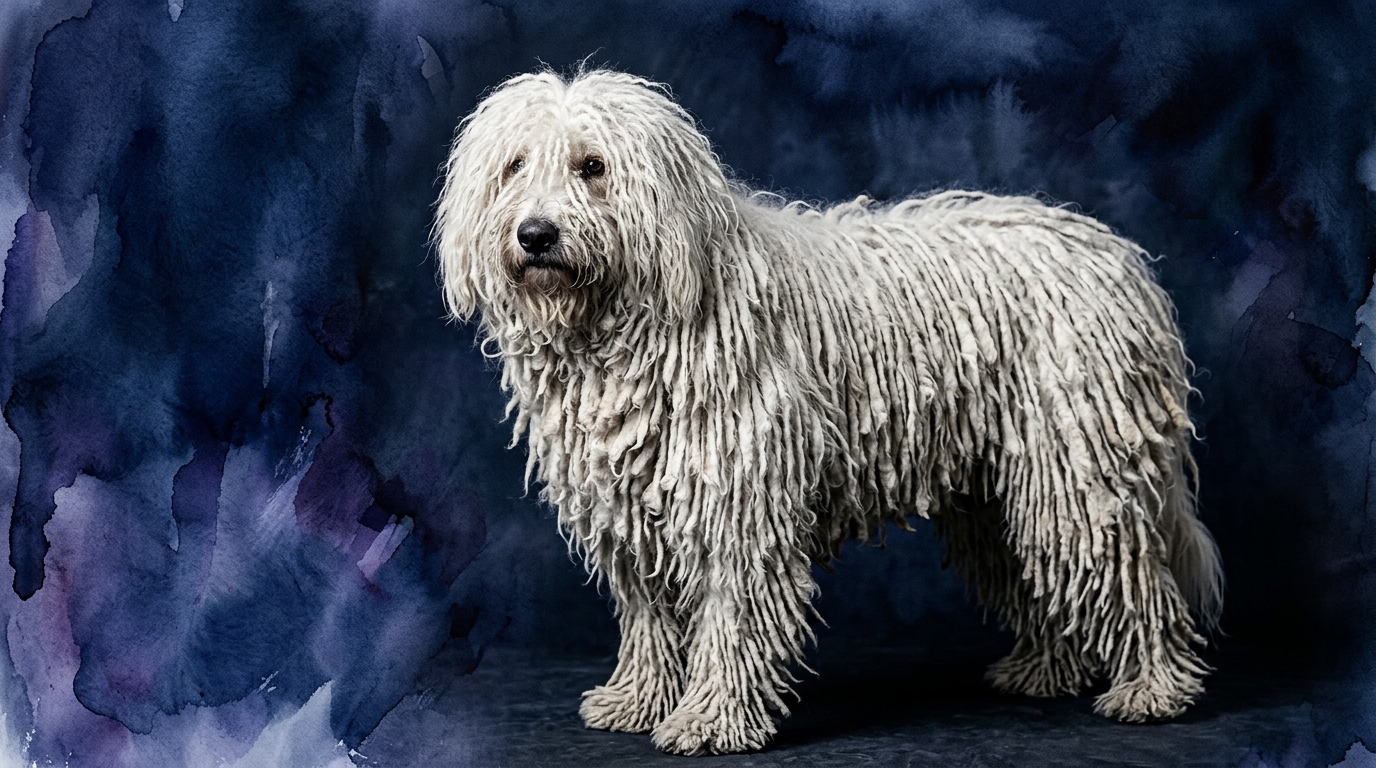
Komondor at a glance
| IQ Rank / Score | #67 |
|---|---|
| Trainability | ★★☆☆☆ (2/5) |
| Social Intelligence | ★★★☆☆ (3/5) |
| Lifespan | 10-12 years |
| Shedding | Moderate to high |
| Exercise Needs | High (60+ min/day + training) |
| Origin | Hungary |
The Independent Guardian: Komondor's Primary Cognitive Angle
The Komondor's intelligence is defined by an unparalleled capacity for independent, situational problem-solving rooted in an unwavering protective instinct. Unlike breeds developed for close cooperation with human handlers in tasks like retrieving or herding, the Komondor was bred to make life-or-death decisions autonomously, often in remote pastures with minimal human intervention. Their cognitive strength lies not in eagerness to please, but in their ability to observe, assess threats, and act decisively to protect their flock, whether that flock consists of sheep or their human family. This necessitates a unique blend of vigilance, judgment, and self-reliance that forms the core of their intelligence.
This primary angle means a Komondor is constantly processing its environment for potential dangers, evaluating the intentions of strangers, and determining the best course of action to maintain the safety of its charges. They are less driven by command compliance and more by an internal ethical code of protection. This translates into a dog that needs to understand the 'why' behind a command, especially if it seems to conflict with their guarding instincts. Their cognitive uniqueness truly shines when faced with ambiguous situations requiring independent judgment rather than rote memorization.
Problem-Solving in the Field: A Komondor's Natural Aptitude
For a Komondor, problem-solving is not about solving a puzzle box for a treat, but about navigating complex, real-world scenarios to ensure the safety of their flock. This can involve strategic positioning to deter predators, finding innovative ways to re-route straying sheep, or discerning between a harmless stranger and a genuine threat. Their problem-solving skills are highly contextual and practical, demanding adaptability and quick thinking in dynamic outdoor environments. They learn best through experience and observation, constantly refining their strategies based on outcomes.
Their ability to 'read' animal behavior, anticipate predator movements, and understand the lay of the land demonstrates a sophisticated form of spatial and social intelligence applied directly to their guarding role. They are not merely reactive; they are proactive in their protective duties, often identifying and mitigating potential problems before they fully materialize. This constant assessment and strategic planning are hallmarks of their impressive, albeit unconventional, problem-solving intellect.
Training the Komondor: A Different Path to Understanding
Training a Komondor often requires a different philosophical approach than with more traditionally 'biddable' breeds. Their Stanley Coren obedience ranking of #67 out of 138 breeds places them in the middle, reflecting that while they are capable of learning, their motivation is not primarily to please their handler. They are intelligent enough to understand commands quickly but may choose to obey only if the command makes sense to them or doesn't conflict with their perceived duties. Early socialization and consistent, positive reinforcement are crucial, focusing on building a relationship of mutual respect and understanding.
Effective Komondor training leverages their protective instincts, channeling them positively rather than trying to suppress them. Teaching 'place' commands for boundaries, 'leave it' for inappropriate targets, and 'come' for safety recall are vital. Their learning is driven by perceived purpose and security, rather than just repetition or reward. Patience, consistency, and a deep understanding of their LGD nature will yield a well-behaved, albeit independent, companion.
Social Dynamics and Instinctive Wisdom
Komondors possess a highly developed social intelligence, but one that is acutely focused on their 'flock.' They are experts at discerning who belongs and who doesn't, quickly categorizing individuals as family, accepted friends, or potential threats. This acute social filtering is paramount for their role as guardians. Within their established social unit, they can be remarkably gentle, tolerant, and attentive, particularly with children and other animals they consider part of their flock.
Their instinctive drive for vigilance and protection means they are constantly processing social cues and environmental changes. They are masters of subtle communication, using body language, stance, and vocalizations to warn or deter. While they may not be adept at interpreting complex human emotional nuances like a highly people-focused breed, their ability to read the intentions of strangers and differentiate between playful antics and actual aggression is a testament to their specialized social cognition. This deep-seated instinctual wisdom guides their every interaction and decision.
Memory: The Guardian's Almanac
A Komondor's memory is robust and highly functional, particularly when it pertains to their territory, routines, and the individuals within their 'flock.' They meticulously map their environment, remembering safe zones, patrol routes, and potential entry points for threats. They commit to memory the faces and scents of family members, regular visitors, and animals they are tasked to protect, often for their entire lives. This comprehensive memory allows them to quickly identify anything new or out of place, which is a critical aspect of their vigilance.
Beyond remembering individuals, Komondors retain lessons from past encounters, whether positive or negative. A successful deterrence of a perceived threat will reinforce their protective behaviors, while a negative experience might make them more wary or adjust their strategy. This long-term memory for patterns and outcomes contributes significantly to their effectiveness as guardians, allowing them to build a complex understanding of their world.
Komondor IQ Profile Breakdown
Our Pet IQ Lab scores provide a snapshot of the Komondor's unique cognitive strengths, reflecting their specialized intelligence as a livestock guardian dog. Their **Problem-Solving** (4/5) is high, demonstrating their capability for independent, practical solutions in dynamic environments. **Training Speed** (2/5) is moderate to low for traditional obedience, as their learning is driven more by purpose than eager compliance. Their **Social Intelligence** (3/5) is excellent within their defined flock, showcasing strong discernment of who belongs, but less generalized to broader human social cues. The Komondor's **Instinctive Drive** (5/5) is exceptionally high, underpinning virtually all of their cognitive processes and actions. Finally, their **Memory** (4/5) is strong, particularly for territory, routines, and individuals, crucial for their guarding responsibilities.
Unraveling the Komondor's Cognitive Strengths: Recommended Tests
To truly assess the Komondor's specialized intelligence, tests that highlight their independent problem-solving and environmental awareness are most appropriate. We recommend the Spatial Navigation Maze, Barrier Navigation Test, and Novel Environment Test to gauge their cognitive profile accurately.
The **Spatial Navigation Maze** would measure their ability to effectively map and navigate complex physical spaces, mirroring their need to patrol and understand territory. The **Barrier Navigation Test** is excellent for observing their persistence and ingenuity in overcoming physical obstacles to reach a goal, directly correlating to their protective duties. Lastly, the **Novel Environment Test** would assess their initial cautious assessment, exploratory behaviors, and adaptation to new surroundings, critical for a dog that needs to independently evaluate unfamiliar situations.
Myth Busting: The 'Stubborn' Komondor
**Claim:** Komondors are stubborn and difficult to train, indicating a low intelligence. This widespread belief often leads to frustration for new owners and misunderstanding of the breed's true capabilities.
**Why It Exists:** This myth largely stems from their independent nature and their breeding purpose. Komondors were designed to make their own decisions in the absence of human command, particularly when guarding livestock. They aren't inherently disobedient; rather, they question commands that seem illogical or conflict with their ingrained protective instincts. Their lack of eagerness to perform 'tricks' purely for human entertainment is often misconstrued as intellectual deficiency.
**Truth:** Komondors are highly intelligent, but their intelligence is geared towards independent thought and protection, not blind obedience. They excel at understanding complex situations and making autonomous judgments. While they may not respond to commands with the snappy enthusiasm of a Border Collie, they are capable of learning a wide range of commands and expectations, especially when training methods respect their independence and focus on channeling their natural protective drives. Their perceived 'stubbornness' is actually a testament to their deep-seated self-reliance and cognitive ability to prioritize perceived duty.
A Surprising Glimpse into Komondor Cognition
The Komondor's iconic corded coat, while offering formidable physical protection against predators and harsh weather, also served as a remarkable form of cognitive camouflage. Historically, this dense, felted coat allowed them to blend seamlessly with the sheep they guarded, making them virtually indistinguishable from the flock to unsuspecting predators until the moment they sprang into action. This visual deception is a fascinating aspect of their evolutionary strategy, turning their physical attributes into a cognitive advantage. It highlights an unspoken intelligence in their design – a breed whose very appearance was part of its defensive strategy, enabling surprise attacks rather than overt challenges. This unique form of 'stealth' in plain sight demonstrates a sophisticated adaptation that goes beyond mere physical robustness.
Komondor vs. Other Working Breeds
When comparing the Komondor to other working breeds, their distinct cognitive profile becomes even clearer. Versus the **Great Pyrenees**, another revered livestock guardian, the Komondor often displays a more intensely focused and actively defensive approach to guarding. While both breeds are independent and protective, the Komondor is frequently described as having a more pronounced, often vocal, and assertive response to perceived threats, making independent assessment of threat levels a crucial differentiator in their cognitive styles. Where a Pyrenees might deter with its presence, a Komondor is more likely to engage directly if it deems necessary, showcasing a higher threshold for intervention rooted in its unique brand of decision-making.
Frequently Asked Questions About Komondor Intelligence
**Q: Are Komondors good family pets?** A: Yes, with proper socialization, consistent training that respects their independence, and an understanding of their guarding instincts, Komondors can be incredibly devoted and gentle family members, viewing their human family as their cherished flock.
**Q: Do Komondors need a lot of mental stimulation?** A: Komondors require significant mental stimulation, but it's often intrinsic to their role as guardians. They thrive on having a job, whether it's patrolling a large yard or simply observing their surroundings, which satisfies their innate vigilance and protective drives. While puzzle toys can be enriching, their primary mental exercise comes from assessing their environment and making independent decisions, not from complex obedience routines.
3 At-Home Tests to Measure Your Komondor's IQ
These tests are adapted from peer-reviewed ethology research. No equipment is needed beyond items you have at home. Run each test 5–10 times for reliable results.
The Myth: "Komondors are stubborn and difficult to train, indicating a low intelligence."
✅ Komondors are highly intelligent, but their cognition is geared towards independent problem-solving and protection, not blind obedience; their perceived 'stubbornness' is actually a display of their self-reliance and deep-seated ability to prioritize perceived duty.
Komondor vs. Similar Breeds
🧠 What's Your Dog's IQ Score?
Our full Pet IQ Lab assessment includes 12+ tests across 5 cognitive dimensions, calibrated for Komondors specifically.
Take the Full IQ Test →Frequently Asked Questions
How smart is a Komondor?
Our Pet IQ Lab framework scores cognition across five dimensions (max 25). The Komondor totals 14/25 — above-average for a domestic dog. The full article breaks down each dimension with at-home tests.
Are Komondors easy to train?
Komondors are independent learners; short, highly-motivating sessions work best. They score 2/5 on Training Speed in our breed profile.
Are Komondors good with children and other pets?
Komondors can live well with families when socialized early. Their Social Intelligence scores 3/5, so supervise interactions with small children and introduce new pets gradually.
Do Komondors need a lot of mental stimulation?
Absolutely. With Problem Solving 3/5 and Instinctive Drive 4/5, Komondors need daily mental work — puzzle feeders, scent games, training sessions, or nose-work — to avoid boredom.
How much exercise does a Komondor need?
Komondors need active engagement. Plan for 45-60 minutes of exercise and training per day, plus mental stimulation.
How good is a Komondor's memory?
Komondors score 2/5 on memory. They remember high-value associations well; less-used cues fade without refresher sessions.
What is the typical lifespan of a Komondor?
Typical lifespan is 10-12 years for a large dog like the Komondor.
The Komondor stands as a testament to specialized intelligence, where independence, protective instinct, and practical problem-solving converge to create an unparalleled guardian. Understanding their unique cognitive profile is key to appreciating this majestic and deeply intelligent breed.