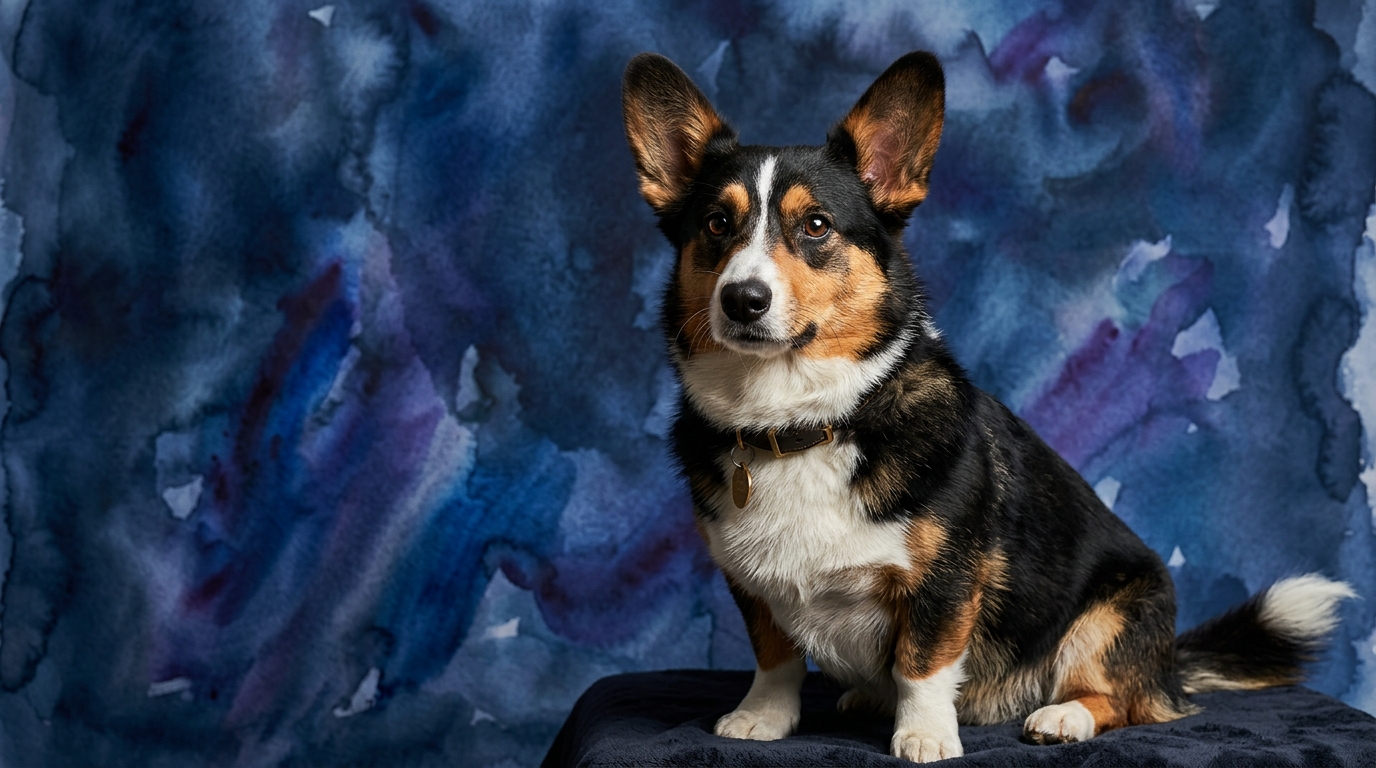

Side-by-Side Cognitive Profile
**Cardigan Welsh Corgi (Herding, Coren rank #26)**
**Problem Solving (4/5):** These Corgis display strong independent thought, often devising their own solutions to obstacles, a remnant of their herding days where they had to outsmart livestock and navigate complex terrains.
**Training Speed (4/5):** Their eagerness to work and capacity to quickly grasp new commands makes them responsive learners, particularly when tasks involve sequential actions, strategic thinking, or physical coordination.
**Social Intelligence (3/5):** While capable of forming deep bonds, their social cognition is more geared towards understanding hierarchy and roles within a family unit rather than nuanced emotional mirroring, reflecting their working background.
**Instinctive Drive (3/5):** A moderate drive to herd and manage their environment is present, often manifesting as a desire to keep family members 'together,' direct household activities, or investigate new surroundings.
**Memory (4/5):** Cardigans possess a robust memory for routines, commands, and spatial layouts, which aids both their rapid trainability and their ability to navigate complex environments or recall learned sequences.
**English Toy Spaniel (Toy, Not Coren-ranked)**
**Problem Solving (3/5):** English Toy Spaniels approach challenges with a gentle curiosity, often relying on their human companions for guidance and comfort rather than attempting complex independent solutions.
**Training Speed (3/5):** They are willing learners, though their pace is more measured than a working breed, responding best to positive reinforcement, patient repetition, and a strong desire to please their human.
**Social Intelligence (3/5):** These spaniels excel in companion-focused social interaction, keenly attuned to human moods and desires, and often seeking close physical proximity and emotional connection as their primary goal.
**Instinctive Drive (3/5):** Their primary drive is companionship, exhibiting a strong desire for human interaction and comfort, with minimal inherent drive for tasks like hunting, herding, or independent exploration.
**Memory (3/5):** They remember familiar faces, pleasant routines, and basic commands well, though perhaps not with the same intricate detail or long-term recall for complex, multi-step sequences as a herding breed.
Where the Cardigan Welsh Corgi Excels Cognitively
The Cardigan Welsh Corgi clearly outshines the English Toy Spaniel in areas demanding independent strategic thinking and task execution. Their problem-solving score of 4/5 indicates a breed that actively seeks solutions, often without direct human prompting, which is invaluable in dynamic situations. This translates into a dog that can figure out how to open a gate, retrieve a specific toy from a pile, or navigate a new environment with confidence. Furthermore, their superior training speed (4/5) means they absorb new commands and multi-step tasks at an impressive pace, quickly forming associations between actions and desired outcomes. This cognitive agility, coupled with their strong memory, allows them to retain a vast repertoire of learned behaviors, making them exceptional candidates for advanced obedience, agility, or even complex trick training.
Where the English Toy Spaniel Shines Cognitively
While the English Toy Spaniel may not possess the Corgi's independent problem-solving prowess, their cognitive strengths lie in areas that foster deep human-animal bonds. Their social intelligence, rated at 3/5, while matching the Corgi's numerical score, manifests differently; it's profoundly geared towards emotional attunement and companionship. They are masters of subtle cues, often anticipating their owner's needs for comfort or interaction, making them exceptional emotional support animals. Their instinctive drive, also 3/5, is almost entirely directed towards seeking and providing companionship, resulting in a dog whose cognitive resources are dedicated to fostering connection rather than managing a flock. This breed's gentle approach to learning and their focus on positive interaction means they thrive in environments where emotional connection is prioritized over strict task performance, making their cognitive style perfectly suited for a devoted family companion.
Trainability: Corgi vs. Spaniel
Based on their respective IQ profiles, the Cardigan Welsh Corgi generally presents as an easier breed to train for a wide range of commands and complex behaviors. Their 4/5 rating in both problem-solving and training speed signifies a dog that not only grasps concepts quickly but also applies independent thought to execute them. They are eager to work and respond well to consistent, engaging training methods that challenge their intellect, often showing a natural inclination to follow directions. Conversely, the English Toy Spaniel, with its 3/5 scores in these areas, is certainly trainable but requires a more patient, gentle, and praise-driven approach. They learn effectively but at a more deliberate pace, thriving on positive reinforcement and emotional encouragement rather than the more task-oriented challenges a Corgi might embrace. A Corgi might quickly master a multi-step agility course, while an English Toy Spaniel might take longer but will diligently perform a comforting 'lap sit' command with perfect emotional resonance.
Matching Canine Cognition to Lifestyle
For active owners seeking a canine partner for sports, advanced training, or outdoor adventures, the Cardigan Welsh Corgi is the more suitable choice. Their cognitive profile, marked by strong problem-solving and rapid training acquisition, aligns perfectly with activities like herding trials, agility, rally obedience, or even scent work. They possess the mental stamina and desire to engage in intellectually stimulating tasks for extended periods, making them ideal for owners who enjoy structured activities and continuous learning with their dog. In contrast, the English Toy Spaniel is an excellent fit for relaxed owners who prioritize companionship, gentle walks, and quiet indoor activities. Their cognitive strengths are centered around social connection and comfort, making them perfect for those who desire a devoted lap companion rather than a working partner. They are content with fewer strenuous mental challenges, preferring to spend their cognitive energy on understanding and bonding with their human family.
The Verdict
Choose the Cardigan Welsh Corgi if you are an active owner seeking a mentally agile partner for training, sports, and independent problem-solving challenges.
Opt for the English Toy Spaniel if you desire a gentle, devoted companion whose cognitive strengths lie in emotional connection and quiet companionship.
🧠 Find Your Pet's IQ Score
Our Pet IQ Lab assessment covers 25+ tests across 5 cognitive dimensions — personalized to your breed.
Take the Full IQ Test →Frequently Asked Questions
Do Cardigan Welsh Corgis need a lot of mental stimulation?
Yes, their high problem-solving and memory scores mean Cardigan Welsh Corgis thrive on regular mental challenges. Daily puzzle toys, training sessions, and varied experiences are crucial to keep their minds engaged and prevent boredom-related behaviors.
Are English Toy Spaniels difficult to housetrain due to their size?
English Toy Spaniels are generally not difficult to housetrain, but their smaller bladders mean more frequent potty breaks are necessary, especially when young. Consistency, positive reinforcement, and a regular schedule are key to success, leveraging their desire to please.
How do their social intelligence scores impact interaction with children?
Both breeds score 3/5 in social intelligence, but interpret it differently. A Cardigan Corgi might try to 'herd' children, requiring supervision, while an English Toy Spaniel's social focus on companionship makes them gentle, attentive playmates, though their delicate nature requires careful handling by children.