
Side-by-Side IQ Profile
The Cosmic Pet Pet IQ Lab employs a five-dimensional framework to assess canine intelligence, moving beyond simplistic labels to offer a nuanced understanding of a breed's cognitive strengths. This framework evaluates problem-solving, training speed, social intelligence, instinctive drive, and memory, providing a comprehensive view of how each breed processes information and interacts with its world.
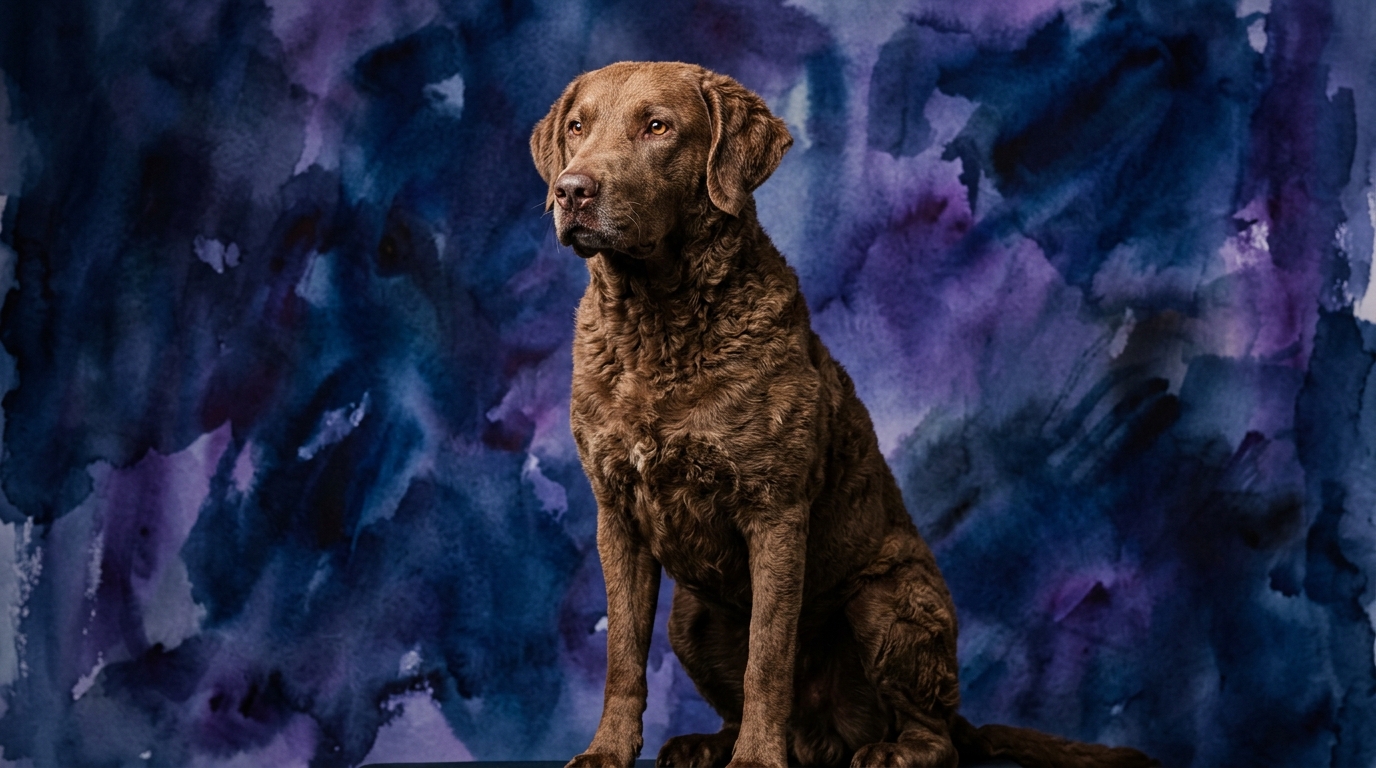
The Chesapeake Bay Retriever, with a Coren rank of #27, presents a robust cognitive profile tailored for its demanding retrieving role. Its Problem Solving at 4/5 indicates a capacity for independent thought in complex situations, such as navigating icy waters or dense cover to retrieve fowl. A Training Speed of 4/5 suggests a quick grasp of commands, though its independent nature means consistency is paramount. Social Intelligence at 3/5 points to a loyal but reserved temperament, forming deep bonds with its inner circle while often being wary of strangers. An Instinctive Drive of 3/5 highlights its strong, yet manageable, urge for hunting and water work. Finally, its Memory at 4/5 allows it to recall specific training cues and past experiences effectively, crucial for repetitive retrieving tasks.
The Brittany, holding a higher Coren rank of #19, showcases an equally impressive, yet subtly different, cognitive makeup. Its Problem Solving also scores 4/5, reflecting an agile mind capable of adapting to varied field conditions, often demonstrating cleverness in locating game. Matching the Chessie with a Training Speed of 4/5, Brittanys are eager learners who respond well to positive reinforcement, often displaying a keen desire to please their handlers. Their Social Intelligence, also 3/5, indicates a generally friendly and adaptable disposition, though they can be sensitive and require gentle handling. An Instinctive Drive of 3/5 underscores their strong birding instincts for pointing and retrieving, balanced by a strong desire for human interaction. The standout attribute is their Memory, rated at an exceptional 5/5, signifying an extraordinary ability to recall intricate patterns, specific locations, and complex sequences of learned behaviors, making them incredibly reliable in demanding field scenarios.
Where Chesapeake Bay Retriever Wins Cognitively
While many scores align, the Chesapeake Bay Retriever's cognitive edge often emerges in scenarios demanding resilience and independent decision-making under pressure. Its 4/5 Problem Solving, paired with a robust physical constitution, translates into a dog that can methodically work through challenging environmental obstacles, such as breaking through ice or traversing difficult terrain, relying on its own judgment to complete a retrieve. This isn't just about speed, but about enduring mental fortitude.
The Chessie's particular blend of 4/5 Memory and 3/5 Social Intelligence also creates a unique advantage for owners seeking a steadfast, self-reliant partner. While not universally gregarious, its deep, focused loyalty means it commits learned tasks and handler expectations to memory with an unwavering resolve. This often manifests as a dog that remembers complex, multi-stage tasks over long periods, performing them with an understated confidence that requires less constant reassurance than some more handler-dependent breeds. Its cognitive strength lies in its ability to internalize and execute demanding roles with a quiet determination.
Where Brittany Wins Cognitively
The Brittany's cognitive profile truly shines with its exceptional 5/5 Memory score, an attribute that sets it apart in learning and retention. This superior recall capability means Brittanys can master and execute intricate sequences of commands and field patterns with remarkable precision and consistency. For tasks requiring a vast repertoire of learned behaviors, such as advanced agility courses or complex hunting scenarios involving multiple cues and locations, the Brittany's mental capacity for retention provides a distinct advantage, allowing for rapid progression through training levels.
Furthermore, the Brittany's 4/5 Problem Solving, combined with its high memory and eager disposition, suggests a cognitive style characterized by flexible adaptability and quick learning in new situations. They are adept at processing environmental cues and handler directions simultaneously, formulating solutions efficiently. This makes them particularly responsive to nuanced training, where subtle body language or vocal inflections are key. Their ability to quickly associate consequences with actions and remember those associations makes them highly amenable to shaping complex behaviors, often appearing to anticipate their handler's next move in a dynamic environment.
Which Is Easier to Train and Why
Assessing which breed is 'easier' to train requires a deeper look beyond their identical 4/5 Training Speed scores. The Brittany, with its exceptional 5/5 Memory and generally more sensitive, handler-oriented temperament, often presents as more straightforward for a broader range of trainers. They exhibit a keen desire to engage and please, making them highly responsive to positive reinforcement methods and eager to absorb new information. Their superior memory means once a concept is grasped, it is likely retained with minimal refresher, allowing for faster progression through complex training curricula and reliable performance in high-pressure situations.
In contrast, while the Chesapeake Bay Retriever also learns quickly (4/5 Training Speed), its independent streak and discerning social intelligence (3/5) mean training often requires a more confident, consistent, and patient approach. A Chessie might grasp a command swiftly, but its decision to execute it can sometimes be influenced by its own assessment of the situation or perceived value, rather than immediate handler compliance. This isn't stubbornness in a negative sense, but rather a manifestation of its problem-solving and self-reliance, requiring a trainer who can establish clear expectations and a strong partnership built on mutual respect. For some, this independent thinking can make them feel less 'easy' to train, even if their cognitive capacity for learning is high.
Which Suits Active Owners vs. Relaxed Owners
Given their Sporting group heritage, neither the Chesapeake Bay Retriever nor the Brittany is suited for truly relaxed or sedentary lifestyles; both demand substantial physical and mental engagement. However, the type of activity they thrive on differs, guiding owners towards the best fit. The Chessie, with its robust build and independent nature, is an ideal companion for owners who embrace rigorous outdoor adventures, especially those involving water. Long, strenuous hikes, swimming, and challenging retrieving tasks in varied weather conditions resonate with its inherent drive and problem-solving abilities. They excel with owners who appreciate a dog that can work alongside them, making its own decisions when appropriate, rather than constantly seeking direction.
The Brittany, while equally active, leans towards owners who enjoy highly interactive and mentally stimulating pursuits. Their exceptional memory and eagerness to please make them superb candidates for field trials, agility, obedience, and extensive interactive play sessions that involve complex commands and rapid transitions. They thrive on being 'busy' with their people, valuing close collaboration and consistent engagement. Owners who enjoy teaching intricate behaviors and appreciate a dog that is highly responsive and attentive to their cues will find the Brittany an exceptionally rewarding partner, eager to participate in every shared activity.
The Verdict
If you seek a resilient, independent partner for demanding outdoor adventures, particularly those involving water and requiring a dog to think for itself while remaining steadfastly loyal, the Chesapeake Bay Retriever is an excellent choice.
If you value exceptional memory, highly responsive behavior, and a keen desire to work closely with you on intricate tasks, field pursuits, and mentally stimulating activities, the Brittany will prove to be an exceptionally rewarding companion.
🧠 Find Your Pet's IQ Score
Our Pet IQ Lab assessment covers 25+ tests across 5 cognitive dimensions — personalized to your breed.
Take the Full IQ Test →Frequently Asked Questions
Do Chesapeake Bay Retrievers or Brittanys make better family pets?
Both breeds can be excellent family companions with proper socialization and training from a young age. The Chessie forms deep bonds with its family but can be reserved with strangers, requiring careful introductions. The Brittany is generally more outgoing and adaptable, thriving on interactive family engagement, though its sensitivity means a gentle approach is always best. Providing ample exercise and mental stimulation is crucial for either breed to integrate smoothly into a household.
How much exercise do these breeds require daily?
As high-energy sporting breeds, both the Chesapeake Bay Retriever and the Brittany demand significant daily exercise, typically 60-90 minutes of vigorous activity. This includes long walks, runs, swimming for the Chessie, or field work and interactive play for the Brittany, essential for their physical and mental well-being. Without adequate outlets for their energy and cognitive engagement, they may develop undesirable behaviors such as excessive chewing or barking.
Are there significant differences in their grooming needs?
Yes, their coats differ notably. The Chesapeake Bay Retriever has a dense, oily double coat that requires minimal but regular brushing to manage shedding and maintain its water-resistant properties, plus occasional bathing. The Brittany, in contrast, has a medium-length, feathered coat that needs more frequent brushing, often daily, to prevent mats and tangles, especially around the ears, legs, and tail, along with routine ear cleaning.