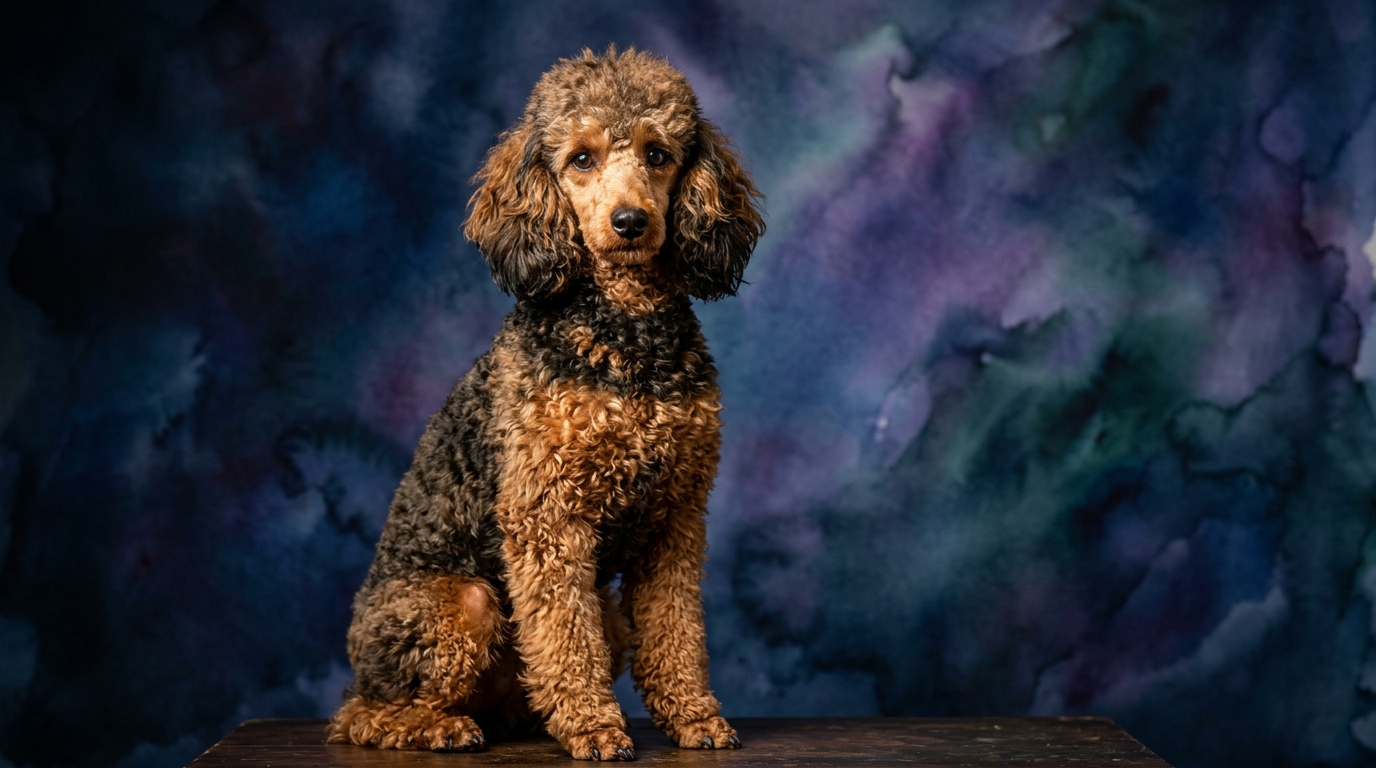
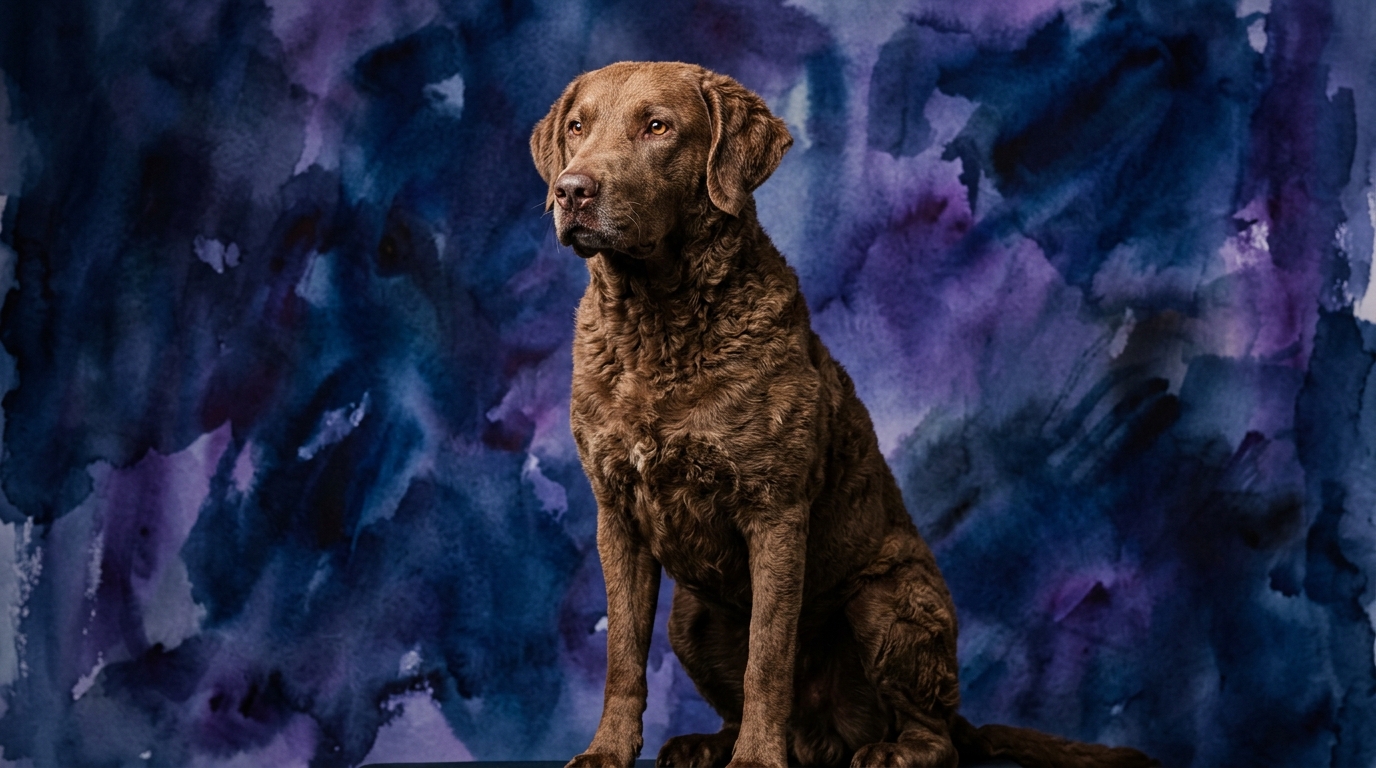
Side-by-Side IQ Profile: Poodle (Standard) vs. Chesapeake Bay Retriever
The Cosmic Pet Pet IQ Lab employs a five-dimensional framework to assess canine cognition, providing a nuanced understanding beyond simple ranking. For the Poodle (Standard), a breed ranked #2 by Coren, its profile shows exceptional across-the-board capabilities. Its Problem Solving is rated 5/5, indicating a profound capacity for abstract thought, strategic planning, and tackling novel challenges with adaptability. Training Speed is also 5/5, reflecting an almost immediate grasp of new commands and complex sequences, often requiring minimal repetition. Social Intelligence, at 5/5, points to a deep attunement to human emotional states and intentions, making them extraordinarily perceptive companions. Their Instinctive Drive, rated 4/5, represents a strong, yet flexible, inclination towards tasks like retrieving or agility, which can be readily channeled. Finally, Memory, at 5/5, underscores their ability to retain vast amounts of information, from complex routines to specific cues, over extended periods.
In contrast, the Chesapeake Bay Retriever, Coren ranked #27, presents a profile honed for specific, demanding work. Its Problem Solving is rated 4/5, demonstrating robust practical intelligence, particularly in navigating environmental obstacles to achieve a goal, though perhaps less inclined towards abstract puzzles. Training Speed, at 4/5, signifies a solid learning capacity, acquiring commands reliably, but often benefiting from more consistent reinforcement than a Poodle. Social Intelligence, at 3/5, suggests a more reserved and independent demeanor; they form deep bonds but may not display the same universal eagerness to please or immediate social reciprocity as some other breeds. Their Instinctive Drive, rated 3/5, is highly focused on their retrieving heritage, exhibiting immense persistence in their specific working role, but might be less broadly adaptable to diverse activities. Memory, at 4/5, indicates good retention of learned behaviors and field patterns, crucial for their working tasks, but possibly not matching the sheer volume of a Poodle’s recall.
Where Poodle (Standard) Wins Cognitively
The Poodle (Standard) consistently demonstrates superior cognitive flexibility and an expansive capacity for learning across diverse domains. Their 5/5 Problem Solving isn't just about figuring things out; it’s about applying novel solutions to unforeseen situations, often displaying a strategic approach. For instance, a Standard Poodle might quickly deduce how to unlatch a complex gate or manipulate a series of objects to retrieve a hidden treat, showing a blend of insight and sequential reasoning. This contrasts with a more trial-and-error approach seen in many breeds.
Furthermore, the Poodle's 5/5 Social Intelligence allows for an unparalleled depth of communication and understanding with their human counterparts. They are acutely aware of subtle shifts in tone, body language, and mood, often anticipating their owner's next move or emotional state. This makes them exceptionally responsive and intuitive partners in activities ranging from service work to competitive obedience, where nuanced cues are paramount. Their 5/5 Training Speed and Memory also mean they can master and retain an extensive repertoire of commands and tricks, adapting rapidly to new rules or environments with minimal effort.
Where Chesapeake Bay Retriever Wins Cognitively
The Chesapeake Bay Retriever, while possessing a different cognitive makeup, excels in areas crucial to its heritage, particularly in focused persistence and environmental resilience. Its 4/5 Problem Solving, though not as abstract as the Poodle's, is supremely effective in practical, task-oriented scenarios. A Chessie will tenaciously work through obstacles in harsh terrain to retrieve game, demonstrating impressive resolve and a single-minded dedication to completing its objective. This isn't about solving a puzzle box, but about navigating a frozen lake or dense undergrowth with unwavering determination.
The Chessie's 3/5 Instinctive Drive, while lower than the Poodle's, is intensely channeled into specific, demanding tasks. This drive manifests as an unyielding commitment to its working role, often performing in extreme weather conditions that might deter other breeds. Their independence, stemming from their 3/5 Social Intelligence, allows them to make effective decisions in the field without constant human direction, a valuable trait for a working retriever. Their 4/5 Memory is particularly strong for recalling specific field locations, scent trails, and retrieving patterns, which is critical for successful hunting expeditions over varied landscapes.
Which is Easier to Train and Why
Based on their respective IQ profiles, the Poodle (Standard) is generally easier to train for a wider array of tasks and in various environments. Their 5/5 Training Speed means they pick up new commands with remarkable swiftness, often after just a few repetitions. This efficiency stems from their high cognitive flexibility and eagerness to engage in mentally stimulating activities. Coupled with their 5/5 Social Intelligence, Poodles are highly motivated by human interaction and approval, making them receptive to positive reinforcement and quick to offer desired behaviors.
The Chesapeake Bay Retriever, with a 4/5 Training Speed, certainly learns effectively, but often requires more consistency and a clear, purpose-driven approach. Their 3/5 Social Intelligence suggests they are less universally people-pleasing; while deeply loyal, their motivation might be more tied to the task itself rather than general social approval. Training a Chessie often benefits from understanding their strong, focused drive and channeling it into productive outlets. They may exhibit more independence or a 'what's in it for me?' attitude compared to the Poodle, necessitating patience and a firm, fair hand, but once they grasp a concept and see its utility, their dedication is profound.
Which Suits Active Owners vs. Relaxed Owners
The Poodle (Standard) is an excellent match for active owners who seek a highly engaged and versatile companion. Their 5/5 Problem Solving and Memory, combined with a 4/5 Instinctive Drive, means they thrive on varied physical and mental challenges. Owners who enjoy activities like competitive obedience, agility, rally, or even complex trick training will find a Poodle a willing and exceptionally capable partner. They require consistent mental stimulation to prevent boredom, making them suitable for owners who are prepared to integrate regular cognitive exercises into their daily routine. Their social perceptiveness also makes them ideal for owners who desire a dog deeply attuned to family dynamics and human interaction.
The Chesapeake Bay Retriever, conversely, is best suited for active owners whose lifestyle revolves around specific, robust outdoor pursuits, especially those involving water and retrieving. Their focused 3/5 Instinctive Drive and resilient nature make them unparalleled partners for hunting, field trials, or vigorous outdoor adventures in challenging environments. While they also need physical activity, their temperament leans towards purpose-driven exertion rather than generalized playfulness. Relaxed owners might struggle with a Chessie's inherent drive for work, which, if not appropriately channeled, can lead to frustration for both dog and owner. They thrive with individuals who appreciate a steadfast, independent companion for demanding, focused activities.
The Verdict
Choose the Poodle (Standard) if you seek a highly adaptable, socially perceptive, and quick-learning companion eager to engage in diverse mental and physical activities, thriving on nuanced interaction and consistent cognitive enrichment.
Opt for the Chesapeake Bay Retriever if you desire a robust, independent, and dedicated partner for demanding outdoor activities, particularly those involving retrieving and resilience in challenging environments, valuing focused drive over broad versatility.
🧠 Find Your Pet's IQ Score
Our Pet IQ Lab assessment covers 25+ tests across 5 cognitive dimensions — personalized to your breed.
Take the Full IQ Test →Frequently Asked Questions
Do Poodles need a lot of mental stimulation?
Yes, Poodles (Standard) with their 5/5 Problem Solving and Memory require substantial mental stimulation to remain content and well-adjusted. They excel at learning complex commands, solving puzzles, and participating in dog sports, thriving when their cognitive abilities are regularly challenged.
Are Chesapeake Bay Retrievers good family dogs?
Chesapeake Bay Retrievers can be devoted family dogs, forming strong, loyal bonds, especially with their primary caregivers. However, their 3/5 Social Intelligence means they tend to be more reserved with strangers and possess a strong, independent working drive that requires consistent training and clear boundaries within a family setting.
Which breed is better for first-time dog owners?
The Poodle (Standard) is often a more forgiving choice for first-time dog owners due to their 5/5 Training Speed and Social Intelligence, making them highly responsive and eager to please. The Chesapeake Bay Retriever's strong, focused drive and more independent nature might present a greater challenge for those new to dog ownership.