
Side-by-Side IQ Profile
Ranked #27 by Coren, the Chesapeake Bay Retriever's Problem Solving at 4/5 signifies a strong ability to navigate intricate scenarios and environmental puzzles. A Training Speed of 4/5 indicates a quick grasp of new commands, making them responsive learners. Social Intelligence, at 3/5, suggests adequate reading of human cues, often with a focused, sometimes reserved demeanor. Their Instinctive Drive, 3/5, is geared towards retrieving, showing task persistence. A Memory score of 4/5 means they retain learned information and spatial awareness effectively, recalling commands and experiences with accuracy.
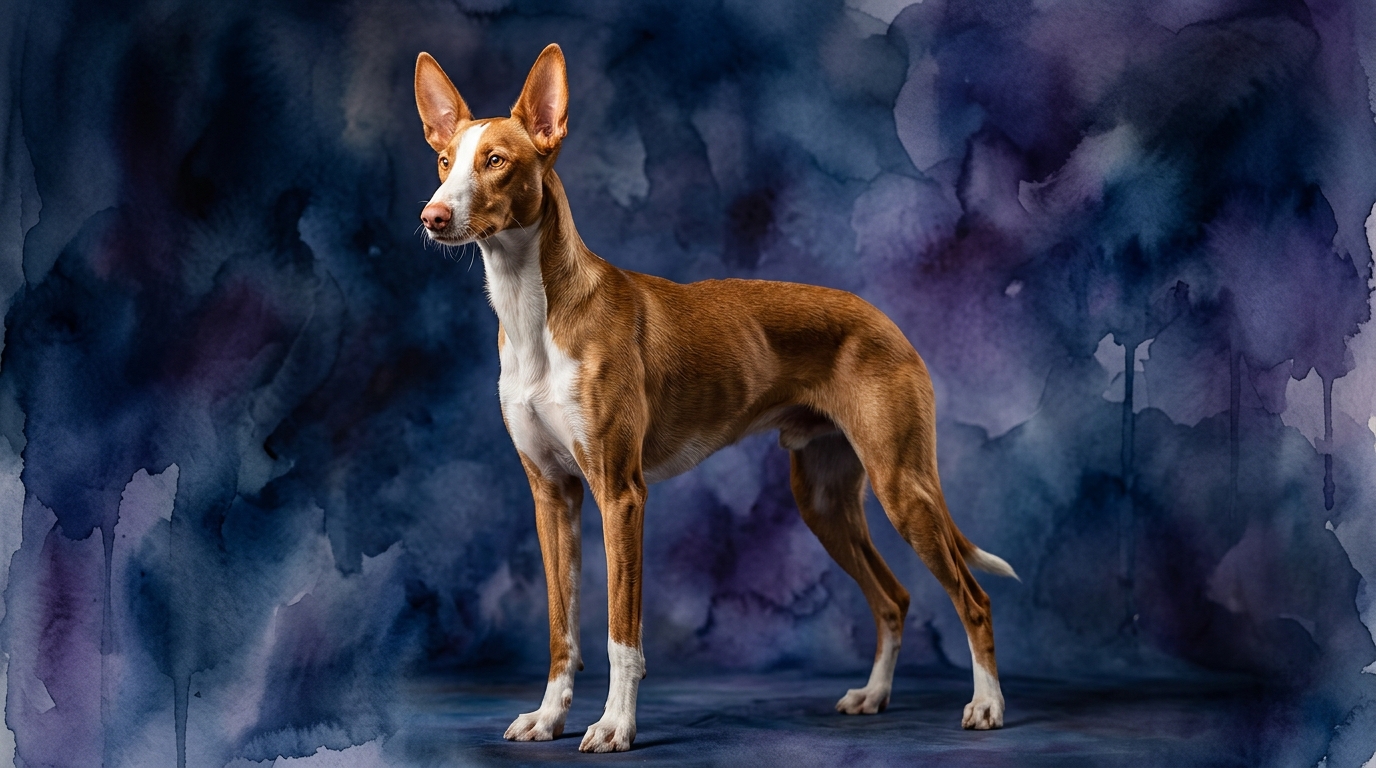
The Ibizan Hound, Coren rank #53, presents a distinct cognitive profile. Their Problem Solving at 3/5 indicates competence in practical, independent problem-solving rooted in hunting instincts. A Training Speed of 3/5 suggests moderate learning, often requiring engaging, varied approaches due to their independent nature. Social Intelligence, 3/5, shows capability in forming bonds and understanding cues, though they often maintain a dignified, sometimes aloof presence. Their Instinctive Drive, 3/5, is profoundly rooted in sighthound heritage, compelling them to chase and track. A Memory score of 3/5 means they recall information and experiences reasonably well, though less persistently than a Chessie.
Where Chesapeake Bay Retriever Wins Cognitively
The Chesapeake Bay Retriever significantly excels in areas demanding sustained, directed engagement and rapid learning. Its Problem Solving score of 4/5, compared to the Ibizan's 3/5, means the Chessie proficiently deciphers multi-step tasks like navigating obstacles for retrieves or solving puzzle toys, actively processing and strategizing. Their superior Training Speed (4/5 versus 3/5) allows them to absorb new commands and behaviors with remarkable efficiency, adapting readily to complex regimens like advanced obedience or field trials. Crucially, the Chessie's 4/5 Memory score, a full point above the Ibizan's, ensures learned skills are retained over long periods, allowing consistent performance and less need for refreshers. This robust memory makes them exceptionally reliable partners in structured activities.
Where Ibizan Hound Wins Cognitively
While the Ibizan Hound's numerical scores appear modest, its cognitive architecture excels in independent thought and sensory acuity. Its Instinctive Drive, 3/5, is uniquely honed for sighthound purpose, manifesting as unparalleled focus on movement and sophisticated rapid processing of visual information across vast distances. This cognitive strength involves swift pattern recognition and predictive tracking, allowing precise anticipation of prey movement. Their Problem Solving score of 3/5, geared towards field self-sufficiency, enables split-second decisions and adaptation of hunting strategies without direct human intervention. This independent problem-solving, rooted in centuries of chasing game, means they excel at tasks where autonomy and quick, unassisted action are paramount, showcasing a specialized form of cognitive prowess.
Which is Easier to Train and Why
The Chesapeake Bay Retriever unequivocally holds the advantage for ease of training, thanks to its higher Training Speed (4/5) and Problem Solving (4/5). Chessies were bred for close human collaboration in retrieving, fostering a strong desire to please and a high capacity for understanding commands. Their superior memory ensures learned lessons stick, minimizing repetitive reinforcement. They thrive on structure and clear direction, making them ideal for traditional obedience, dog sports, and working roles demanding precision. In contrast, the Ibizan Hound, with its 3/5 Training Speed, presents a different challenge. As sighthounds, they were bred for independent hunting, relying on instinct over constant human direction. This independence means a less inherent desire to please and a tendency to prioritize their own motivations, especially with compelling visual stimuli. While capable learners, their training demands more patience, creativity, and motivation-based techniques, as they can quickly bore with repetition and seem "stubborn" when instincts prevail.
Which Suits Active Owners vs Relaxed Owners
Both breeds demand active ownership, but their ideal activities diverge, suiting different "active" owners. The Chesapeake Bay Retriever thrives with structured, consistent physical and mental challenges. Its high Problem Solving and Training Speed mean it excels in competitive obedience, agility, dock diving, and field work. They require vigorous exercise coupled with engaging mental tasks to prevent boredom. A Chessie owner enjoys training, maintains a clear routine, and is prepared for a dedicated, intense canine partner. The Ibizan Hound also needs substantial activity, but often in a less structured, more free-ranging manner. Its powerful Instinctive Drive and keen senses make it exceptional for lure coursing, long off-leash runs in secure areas, or hiking. They focus less on complex obedience and more on the thrill of chase and exploration. An Ibizan owner appreciates independent spirit, provides safe outlets for running, and prefers less formal, more spontaneous activities over rigorous, human-directed training.
The Verdict
Opt for a Chesapeake Bay Retriever if you seek a highly trainable, dedicated working partner who excels in structured environments, enjoys complex problem-solving, and retains lessons with remarkable consistency.
Select an Ibizan Hound if you appreciate an independent, visually driven companion who thrives on expansive, free-ranging exercise and makes swift, autonomous decisions in pursuit-oriented activities.
🧠 Find Your Pet's IQ Score
Our Pet IQ Lab assessment covers 25+ tests across 5 cognitive dimensions — personalized to your breed.
Take the Full IQ Test →Frequently Asked Questions
Can Ibizan Hounds be trained for complex tasks like a Chesapeake Bay Retriever?
While Ibizan Hounds possess problem-solving abilities, their independent nature and lower training speed mean they typically require more patience and creative motivation than a Chesapeake Bay Retriever for complex, human-directed tasks. They excel more in activities that leverage their natural sighthound instincts.
Do Chesapeake Bay Retrievers make good family pets despite their working drive?
Chesapeake Bay Retrievers can be excellent family pets, provided their significant physical and mental exercise needs are met. Their strong memory and trainability make them reliable companions, but their social intelligence suggests they might be more reserved with strangers than some other breeds.
How do their instinctive drives manifest differently in a home environment?
A Chesapeake Bay Retriever's instinctive drive often manifests as a desire to "retrieve" household items or engage in structured play, and a need for a job. An Ibizan Hound's drive appears as a keen interest in movement, potential for chasing small animals, and a need for secure spaces for off-leash running.