
Side-by-Side Cognitive Profiles: Dachshund vs. Irish Setter
The Cosmic Pet Pet IQ Lab provides a granular view into canine intelligence, dissecting it into five key dimensions. For the Dachshund, a small but mighty Hound, their Coren rank of #49 places them in the average working/obedience group, suggesting a respectable but not top-tier capacity for command learning. Their Problem Solving score of 4/5 indicates a cleverness often applied to self-serving tasks, like figuring out how to reach a forbidden treat or navigate tight spaces. Training Speed, however, sits at a modest 2/5, reflecting their independent nature and a tendency to prioritize their own agenda over human instruction. Social Intelligence is rated 3/5, meaning they form strong bonds with their immediate family but can be reserved or even suspicious of strangers. Instinctive Drive is a powerful 5/5, a hallmark of their badger-hunting heritage, manifesting as a relentless pursuit of scent and a love for digging. Memory is a solid 3/5, allowing them to recall routines and some commands, but perhaps not with the precision of more biddable breeds.
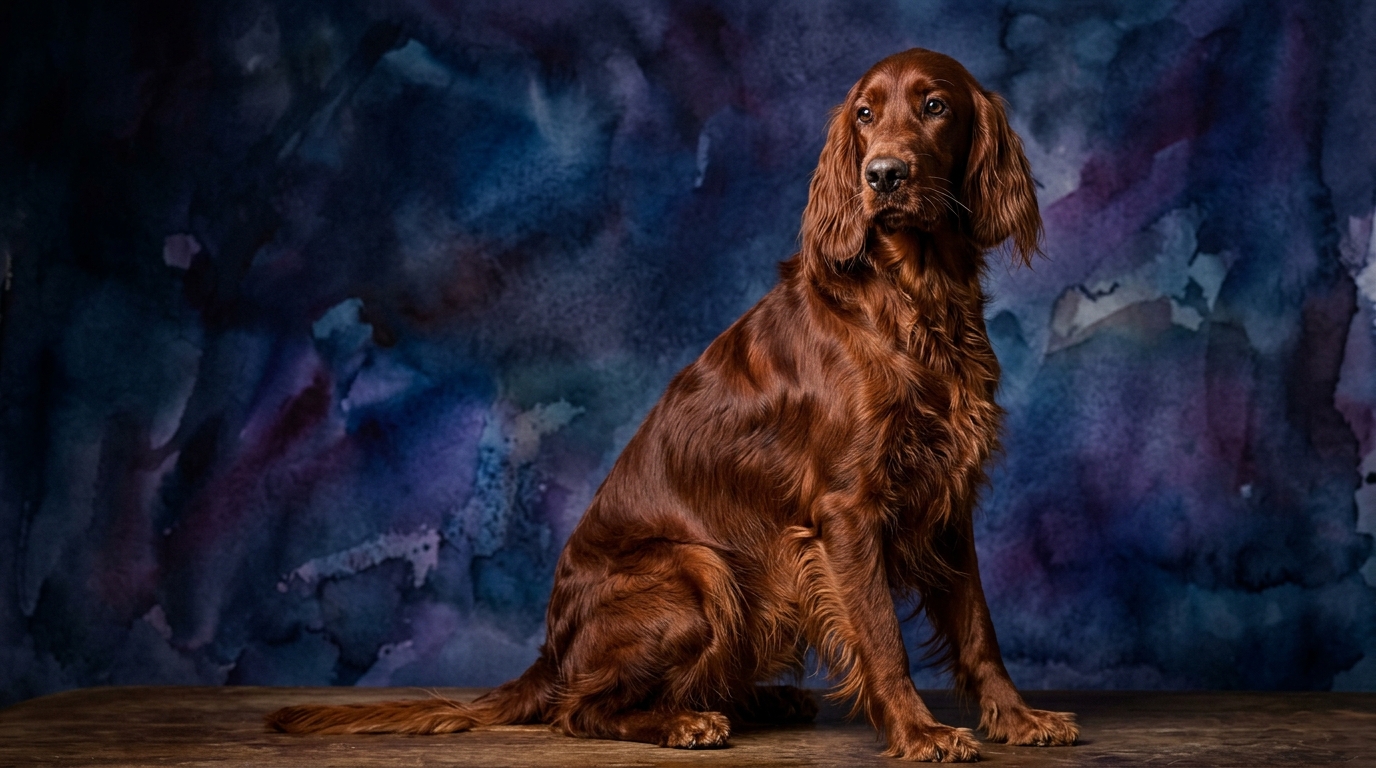
In contrast, the Irish Setter, a striking Sporting dog, boasts a Coren rank of #35, positioning them in the above-average category for working and obedience intelligence. Their Problem Solving score, like the Dachshund, is 4/5, but this often translates to resourceful navigation in the field or understanding complex sequences during cooperative tasks. Where the Setter truly distinguishes itself is in Training Speed, earning a 4/5; they are eager to please and pick up new commands with enthusiasm and relative ease. Social Intelligence matches the Dachshund at 3/5, indicating a generally friendly and outgoing disposition, though sometimes bordering on boisterousness. Their Instinctive Drive is a moderate 3/5, reflecting a strong desire for retrieving and scent work, but typically less intense or singularly focused than a hound's. Finally, their Memory is a strong 4/5, enabling them to retain vast amounts of training information and recall experiences with notable clarity.
Where the Dachshund Cognitively Excels
The Dachshund's standout cognitive strength lies in their Instinctive Drive, rated a perfect 5/5. This isn't just about chasing squirrels; it's a deep-seated tenacity and focus that fuels their problem-solving. When faced with a challenge, a Dachshund's mind is often singularly driven by their intrinsic motivation, whether it's burrowing under a blanket, tracking an interesting scent, or devising a strategy to access a coveted item. Their independent problem-solving (4/5) is frequently a byproduct of this drive, making them remarkably persistent and creative in achieving their goals, even if those goals aren't aligned with human expectations. This cognitive tenacity allows them to operate effectively without constant human direction, making them incredibly self-sufficient in certain contexts.
Their compact size combined with this powerful instinctive drive means they are adept at navigating and manipulating their immediate environment in ways larger dogs cannot. A Dachshund might not be solving complex puzzles for human amusement, but they are masters at assessing spatial relationships to squeeze into tight spots, tunneling under obstacles, or using their elongated body to reach things. This specific type of problem-solving, rooted in their original purpose, showcases a unique cognitive flexibility geared towards independent exploration and resource acquisition within their perceived territory.
Where the Irish Setter Cognitively Excels
The Irish Setter's cognitive strengths shine brightest in areas requiring cooperation and retention, particularly highlighted by their Training Speed (4/5) and Memory (4/5). These scores indicate a brain wired for learning and collaboration with a human partner. Their ability to quickly grasp new commands and sequences makes them highly adaptable to various training disciplines, from advanced obedience to intricate field work. They process and internalize instructions efficiently, demonstrating a keen understanding of cause and effect in human-dog interactions, which is crucial for complex tasks.
Furthermore, their superior memory allows them to build a rich tapestry of learned behaviors and experiences. An Irish Setter remembers not just a command, but the context in which it was learned, the rewards associated with it, and the nuances of their handler's cues. This excellent retention means that once a skill is acquired, it tends to stick, enabling them to perform reliably over time and in different environments. Their problem-solving (4/5) often manifests as cooperative intelligence, where they use their wits to work alongside their human companions to achieve a shared objective, a stark contrast to the Dachshund's more self-directed ingenuity.
Training Dynamics: Dachshund vs. Irish Setter
When it comes to ease of training, the Irish Setter (Training Speed 4/5) undeniably holds the advantage over the Dachshund (Training Speed 2/5). The Setter's higher score reflects their inherent eagerness to please and their focus on their handler, traits characteristic of the Sporting group. They thrive on positive reinforcement and the mental engagement that training provides, often viewing learning new commands as an enjoyable partnership. Their excellent memory further enhances this, allowing them to recall previously learned behaviors and build upon them rapidly, making them highly receptive to consistent instruction and capable of mastering a wide array of skills, from basic manners to advanced sporting tasks.
The Dachshund, on the other hand, presents a more challenging training experience due to their independent and often stubborn nature. Their profound instinctive drive (5/5) means they are frequently more interested in following a scent or burrowing than in executing a 'sit' command. While they are certainly capable of learning, their low training speed score indicates that consistency, patience, and finding high-value motivators are paramount. They require a handler who understands their hound mentality and can make training feel like their idea, or at least highly rewarding for them, rather than a forced compliance. Real behavioral differences include the Dachshund's propensity for selective hearing when their nose takes over, versus the Setter's generally attentive disposition in a training setting.
Ideal Companions: Active vs. Relaxed Lifestyles
For active owners seeking a dynamic partner, the Irish Setter is an excellent match. Their boundless energy and moderate instinctive drive (3/5) mean they require significant daily exercise, not just physical exertion but also mental stimulation through activities like fetch, long hikes, or even canine sports. Their cooperative intelligence and eagerness to learn make them ideal for owners who enjoy engaging in training, agility, or field work. An Irish Setter thrives when given a job to do and ample opportunities to burn off their considerable physical and mental energy alongside their human companions, making them unsuitable for a purely sedentary lifestyle.
Conversely, the Dachshund can be a better fit for owners with a more relaxed lifestyle, provided their unique cognitive needs are still met. While they enjoy walks and playtime, their exercise requirements are generally lower than a Setter's. Their independence and strong instinctive drive (5/5) mean they can often entertain themselves with scent games, puzzle toys, or by simply exploring their environment. However, 'relaxed' does not equate to 'low-maintenance' mentally; Dachshunds still need consistent mental engagement to prevent boredom, which can lead to undesirable behaviors. They suit owners who appreciate a dog with a strong personality and are prepared to engage their clever minds with varied, often self-directed, activities rather than constant high-intensity cooperative play.
The Verdict: Choosing Your Canine Companion
The Verdict
Choose a Dachshund if you appreciate a clever, independent spirit with a tenacious drive, and are prepared for a dog that often thinks for itself, requiring patient and creative engagement.
Opt for an Irish Setter if you desire an energetic, cooperative companion eager to learn and participate in active pursuits, thriving on a strong partnership and consistent training.
🧠 Find Your Pet's IQ Score
Our Pet IQ Lab assessment covers 25+ tests across 5 cognitive dimensions — personalized to your breed.
Take the Full IQ Test →Frequently Asked Questions
Are Dachshunds stubborn?
Yes, Dachshunds can exhibit stubbornness, largely due to their powerful instinctive drive (5/5) and independent problem-solving nature. They often prioritize their own interests, like following a scent, over human commands, requiring consistent and rewarding training to gain their cooperation.
Do Irish Setters need a lot of exercise?
Absolutely. Irish Setters are a high-energy Sporting breed requiring substantial daily physical activity and mental stimulation. Long walks, runs, active play, and engaging training sessions are crucial to keep them happy, healthy, and prevent boredom-related behaviors.
Which breed is better with children?
Both breeds can be good with children, but require proper socialization and supervision. Irish Setters are generally more tolerant and playful due to their outgoing nature, while Dachshunds, though loyal to their family, can be less patient with rough handling and may prefer older, more respectful children.