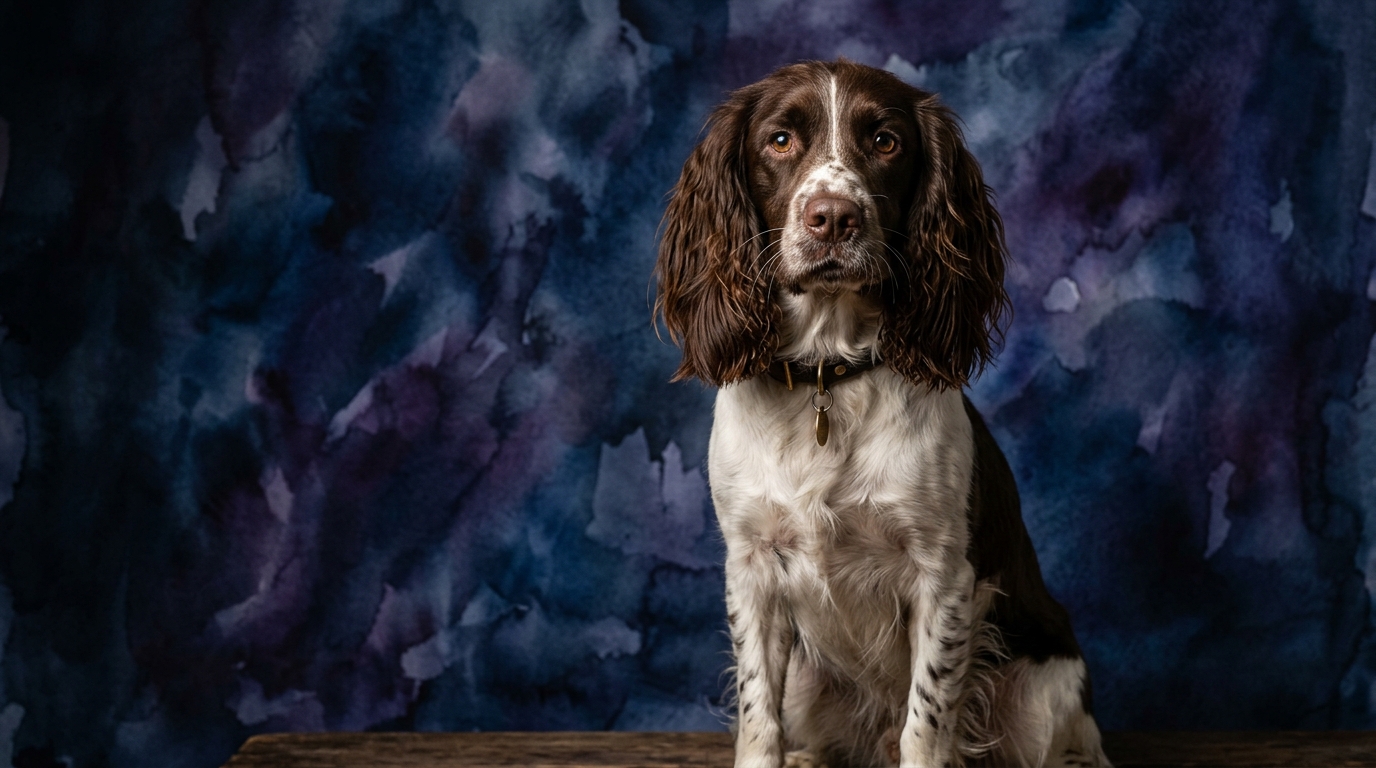

Side-by-Side IQ Profile: English Springer Spaniel vs. Irish Terrier
The Cosmic Pet Pet IQ Lab employs a five-dimensional framework to assess canine intelligence, providing a nuanced perspective beyond simple obedience. Let's examine how the English Springer Spaniel, a Sporting Group stalwart, and the Irish Terrier, a spirited member of the Terrier Group, measure up across these crucial cognitive metrics.
The **English Springer Spaniel (ESS)** presents a profile indicative of a highly capable working dog, scoring exceptionally well across the board. Their Problem Solving is rated at 4 out of 5, demonstrating an ability to navigate novel situations and figure out solutions with commendable efficiency. Training Speed is a standout at a perfect 5 out of 5, reflecting their eagerness to learn and retain commands rapidly. Social Intelligence, crucial for human-canine partnership, sits at 4 out of 5, indicating strong responsiveness to human cues and emotional understanding. An Instinctive Drive of 5 out of 5 underscores their profound natural aptitudes for their original purpose, often related to scent work and retrieving. Finally, their Memory is strong at 4 out of 5, allowing them to recall learned behaviors and experiences over time.
The **Irish Terrier (IT)**, while no less spirited, exhibits a more moderate and independent cognitive profile across all dimensions. Their Problem Solving is rated at 3 out of 5, meaning they are capable of solving challenges but may approach them with less urgency or directness than an ESS. Training Speed is also 3 out of 5, suggesting they will learn, but perhaps require more repetition and varied motivational strategies. Social Intelligence stands at 3 out of 5, indicating they are aware of human interactions but might prioritize their own interests more frequently. Their Instinctive Drive is 3 out of 5, signifying a solid drive that is present but perhaps less intensely focused on a singular task than a spaniel's. Memory is likewise 3 out of 5, meaning they retain information adequately but might not recall complex sequences with the same precision as a higher-scoring breed.
Where the English Springer Spaniel Wins Cognitively
The English Springer Spaniel's cognitive strengths make them exceptional partners for tasks requiring precision, speed, and cooperative effort. Their perfect 5/5 score in Training Speed means they absorb new commands and routines with remarkable alacrity, often anticipating their handler's next instruction. This rapid learning curve makes them a joy to train for obedience, agility, and complex field work.
Coupled with a 4/5 in Problem Solving, ESS are not just rote learners; they can apply learned principles to new situations, making them adept at navigating challenging environments or solving practical puzzles. Their powerful 5/5 Instinctive Drive fuels a relentless work ethic, particularly in scent detection and retrieving, where their focus and stamina are unparalleled. This drive, combined with 4/5 Social Intelligence, means they are highly attuned to human direction and eager to collaborate, making them responsive and deeply connected working companions. Their 4/5 Memory ensures that these learned skills and solutions are retained, building a robust repertoire of abilities over time.
Where the Irish Terrier Wins Cognitively
While the Irish Terrier's scores are consistently at 3/5, this doesn't signify a lack of capability, but rather a distinct cognitive style that appeals to different types of owners. Their moderate Instinctive Drive (3/5) can be a 'win' for owners who appreciate a dog with natural terrier tenacity but without the overwhelming, singular focus of a high-drive sporting dog. This allows them to engage with various activities without becoming solely fixated on one pursuit, offering a more versatile companion for general family life.
The Irish Terrier's 3/5 Social Intelligence often translates into a charming independence. They are not constantly seeking human approval, which can be a strength for owners who value a dog with its own distinct personality and less prone to separation anxiety. This moderate social drive means they are capable of forming deep bonds, but they also possess a self-assuredness that allows them to entertain themselves and be less 'needy' than some breeds. Their 3/5 in Problem Solving, Training Speed, and Memory suggests a dog that is perfectly capable of learning and adapting, but one that rewards patience, consistency, and creative motivation from their human, fostering a unique and resilient bond built on mutual respect rather than sheer compliance. Their cognitive strength lies in their unwavering spirit and hardiness, qualities that enable them to persist where others might falter.
Which is Easier to Train and Why
When it comes to ease of training, the English Springer Spaniel generally presents a more straightforward experience. Their exceptional 5/5 Training Speed means they grasp new commands quickly and are inherently motivated to perform for their handler. This is further supported by their 4/5 Social Intelligence, making them highly responsive to verbal cues and body language, and their strong desire to please. Their 5/5 Instinctive Drive, while powerful, can be readily channeled into productive training exercises, leading to rapid progress in obedience, scent work, and retrieving tasks.
The Irish Terrier, with consistent 3/5 scores across Problem Solving, Training Speed, and Social Intelligence, requires a different training approach. They are not 'difficult' in the sense of being unable to learn, but they are often described as more independent and spirited. Their moderate Training Speed means commands might require more repetition and patience to solidify, and their moderate Social Intelligence suggests they may not always prioritize human directives over their own curious impulses. Training an Irish Terrier often involves more creative motivation, a consistent and firm but fair hand, and an understanding that their terrier tenacity can sometimes manifest as stubbornness if not channeled appropriately. Owners who enjoy a challenge and a dog that makes them earn its cooperation will find the Irish Terrier rewarding, though it demands more sustained effort than an ESS.
Which Suits Active Owners vs. Relaxed Owners
The English Springer Spaniel is unequivocally suited for active owners. Their 5/5 Instinctive Drive and the inherent energy of a sporting breed demand significant daily physical and mental engagement. They thrive on long walks, runs, hikes, retrieving games, and participation in dog sports like agility, obedience, and field trials. An ESS needs a 'job' to do, whether it's competitive sport or simply a consistent routine of engaging activities. Owners who are prepared for several hours of active interaction daily will find an ESS to be an incredibly fulfilling and devoted companion, but they are not a breed for a relaxed, sedentary lifestyle, as boredom can quickly lead to destructive behaviors.
The Irish Terrier, while not a couch potato, can suit owners with an active but perhaps less intense lifestyle than what an ESS demands. Their 3/5 Instinctive Drive means they possess energy and require regular exercise—daily walks, playtime, and opportunities to explore—to keep them happy and well-behaved. However, they may not require the same volume or intensity of structured 'work' as a high-drive sporting dog. Their moderate social intelligence also means they can be content with periods of independent activity, making them suitable for owners who enjoy a spirited companion but also appreciate a dog that can amuse itself. They are robust and enjoy outdoor adventures but can also settle down indoors, provided their exercise needs are consistently met. They are an excellent fit for active individuals or families who enjoy regular outdoor activities but aren't necessarily seeking a competitive canine athlete.
The Verdict
Choose an English Springer Spaniel if you seek a highly cooperative, task-oriented, and eager-to-please companion who excels in rapid learning and thrives on shared activities and a strong work ethic.
Opt for an Irish Terrier if you appreciate an independent, spirited, and tenacious dog that offers a rewarding challenge in training and forms a deep bond with an owner who respects its unique, self-assured personality.
🧠 Find Your Pet's IQ Score
Our Pet IQ Lab assessment covers 25+ tests across 5 cognitive dimensions — personalized to your breed.
Take the Full IQ Test →Frequently Asked Questions
Are Irish Terriers hard to train?
Irish Terriers are not inherently hard to train, but they do require more patience, consistency, and creative motivation than some other breeds. Their moderate Training Speed and Social Intelligence mean they may learn at a slower pace and prioritize their own interests, but with the right approach, they are capable learners.
Do English Springer Spaniels need a lot of exercise?
Yes, English Springer Spaniels have a very high Instinctive Drive and energy level, requiring substantial daily exercise and mental stimulation. They thrive on long walks, runs, retrieving games, and structured activities to prevent boredom and ensure their well-being.
Which breed is better with children?
Both breeds can be good with children when properly socialized and trained, though their approaches differ. English Springer Spaniels, with higher Social Intelligence, are often more overtly cooperative and eager to engage in family activities, while Irish Terriers, with their independent spirit, may tolerate children but prefer interactions on their own terms, requiring supervision to ensure respectful boundaries.