
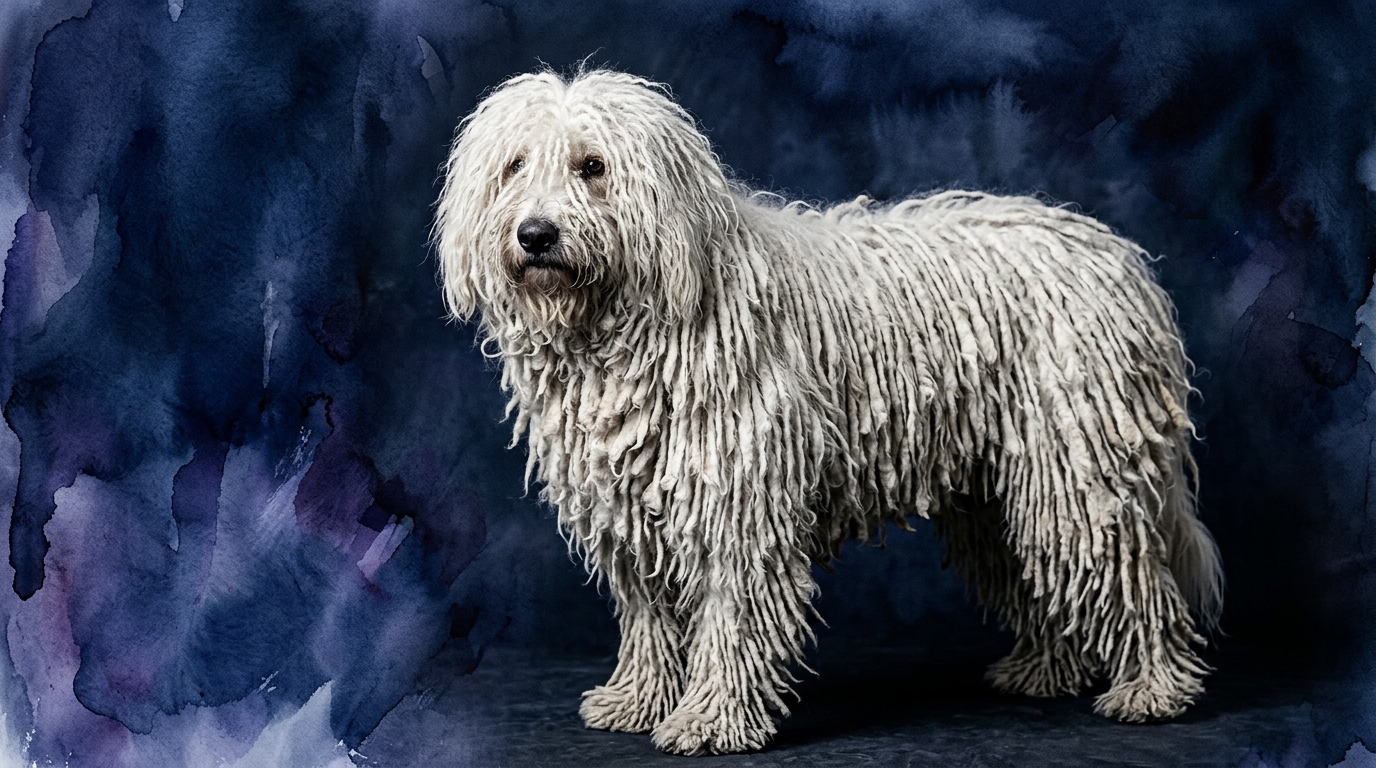
Side-by-Side IQ Profile: English Springer Spaniel vs. Komondor
The Cosmic Pet Pet IQ Lab provides a structured framework to assess canine intelligence across five key dimensions. For the English Springer Spaniel, ranked #13 by Coren, its profile reflects a highly cooperative and task-oriented mind: a Problem Solving score of 4/5 indicates an aptitude for navigating complex scenarios and adapting strategies, such as following intricate scent trails or figuring out how to retrieve objects from challenging locations. Its Training Speed is an exceptional 5/5, showcasing a rapid ability to acquire new commands and routines. Social Intelligence scores 4/5, demonstrating a keen awareness of human cues and a strong desire for interaction, while an Instinctive Drive of 5/5 underscores its powerful innate motivation for retrieving and working. Finally, its Memory is rated 4/5, enabling robust retention of training and past experiences.
In contrast, the Komondor, a working breed with a Coren rank of #67, presents a profile geared towards independent judgment and vigilance: its Problem Solving is 3/5, primarily focused on assessing and responding to threats within its territory rather than human-directed puzzles. Training Speed stands at 3/5, indicating it can learn, but often requires more patience and understanding of its independent motivations. Social Intelligence is 3/5, reflecting deep bonds with its immediate family or 'flock' but a reserved demeanor towards strangers. Its Instinctive Drive is also 3/5, driven by an unwavering protective instinct rather than cooperative tasks. Memory is likewise 3/5, strong for recognizing its charges and territory, but less so for intricate command sequences.
Where the English Springer Spaniel Wins Cognitively
The English Springer Spaniel's cognitive strengths lie in its exceptional cooperative intelligence and adaptability. With a 5/5 Training Speed and 4/5 Social Intelligence, this breed excels at understanding and executing complex human directives. Their problem-solving (4/5) is often applied to collaborative tasks, such as figuring out the most efficient way to retrieve a fallen bird or navigating an agility course with precision. This makes them highly successful in dog sports, obedience trials, and as working gundogs, where a deep partnership with their handler is paramount. Their memory (4/5) allows them to retain vast repertoires of commands and recall specific instructions, making them incredibly consistent performers. This breed's mind is wired to engage, learn, and perform alongside its human partners, making them incredibly rewarding for owners who enjoy active training and joint activities.
Where the Komondor Wins Cognitively
The Komondor's cognitive prowess is rooted in its profound independence and self-reliance, honed over centuries as a livestock guardian. While its scores might appear lower in traditional measures of 'trainability,' its 3/5 Problem Solving and 3/5 Instinctive Drive are perfectly aligned with its historical purpose: to assess threats and make autonomous decisions without human intervention. This breed's intelligence is not about following commands quickly, but about vigilant observation, discerning friend from foe, and acting decisively to protect its charges. Its memory (3/5) is highly effective for remembering territorial boundaries, identifying regulars versus intruders, and recalling past situations that required its protective intervention. The Komondor's social intelligence (3/5), while reserved with outsiders, translates into an unwavering, deep-seated loyalty and protective bond with its inner circle, a cognitive strength essential for its guardian role.
Which is Easier to Train and Why
Based on their IQ profiles, the English Springer Spaniel is unequivocally easier to train than the Komondor. The Springer's 5/5 Training Speed and 4/5 Social Intelligence mean they are inherently eager to please, quick to grasp new concepts, and highly responsive to positive reinforcement. They thrive on engagement and view training as a cooperative game, applying their 4/5 problem-solving skills to deciphering what their handler wants. Their strong instinctive drive (5/5) means they are highly motivated to work and retrieve, making them enthusiastic participants in structured learning.
The Komondor, with a 3/5 Training Speed and a more independent 3/5 Social Intelligence, presents a greater challenge for the average owner. This breed's mind is designed for autonomous decision-making rather than eager compliance. While capable of learning, they often require more repetition, patience, and a trainer who understands their motivations. Commands must make sense to them in the context of their guarding instincts. Their problem-solving (3/5) is geared towards vigilance and protection, not necessarily towards solving human-initiated puzzles or performing tricks. Training a Komondor requires consistency, firmness, and a deep respect for its strong will and independent nature, often necessitating specialized handling techniques.
Which Suits Active Owners vs. Relaxed Owners
For the truly active owner, the English Springer Spaniel is an ideal match. Its 5/5 Instinctive Drive translates into a boundless need for physical activity and mental engagement. These dogs thrive on long hikes, scent work, agility, retrieving games, and competitive dog sports. An owner who enjoys spending hours outdoors and actively involving their dog in activities will find the Springer a joyful, tireless companion. Failure to meet their significant exercise and mental stimulation requirements can lead to boredom and potentially destructive behaviors, as their intelligent minds and energetic bodies crave purpose.
Neither breed is truly suited for a 'relaxed' owner seeking a sedentary companion. However, the Komondor's activity profile is different. While not requiring constant, high-intensity bursts of exercise like the Springer, the Komondor demands a secure environment and an owner who understands its need for vigilant 'work.' Their activity is often expressed through patrolling their territory, observing their surroundings, and being mentally alert. A Komondor owner must be prepared to manage a large, powerful dog with strong protective instincts, which requires consistent socialization and training, even if the daily physical exercise is more about consistent walks and yard time rather than intense sporting activities. A truly relaxed owner might struggle with the Komondor's independent nature and protective responsibilities.
The Verdict
Choose the English Springer Spaniel if you seek a highly engaged, cooperative, and trainable companion for active pursuits, competitive dog sports, or a family dog eager to learn and participate in every adventure.
Choose the Komondor if you appreciate an independent, watchful guardian, understand the commitment to specialized training and socialization, and can provide a secure environment for its protective instincts, perhaps with livestock or large property.
🧠 Find Your Pet's IQ Score
Our Pet IQ Lab assessment covers 25+ tests across 5 cognitive dimensions — personalized to your breed.
Take the Full IQ Test →Frequently Asked Questions
Are Komondors truly untrainable due to their independent nature?
No, Komondors are not untrainable, but their 3/5 training speed means they require a more patient, consistent, and understanding approach. They learn best when commands are presented as logical or necessary, aligning with their guarding instincts, rather than arbitrary tasks.
Do English Springer Spaniels really need a lot of exercise?
Yes, with an instinctive drive of 5/5, English Springer Spaniels have a profound need for significant physical exercise and mental engagement daily. They thrive on activities like retrieving, scent work, and long hikes to channel their energy positively.
Which breed is generally better with children?
The English Springer Spaniel, with its 4/5 social intelligence and eager-to-please nature, is generally more adaptable and playful with children when properly socialized. The Komondor's 3/5 social intelligence means it forms deep bonds with its family but can be reserved or overly protective with new people, including children outside its immediate 'flock,' requiring careful management and socialization.