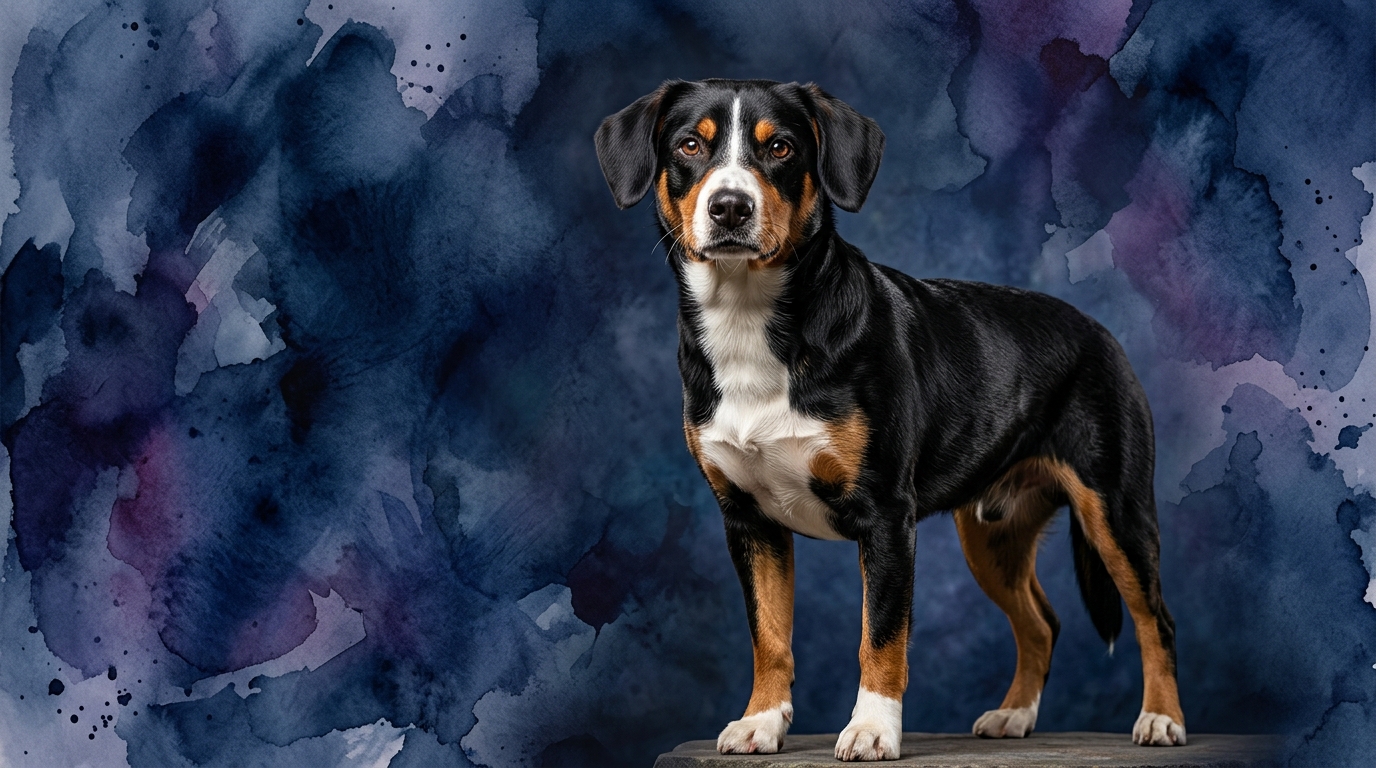
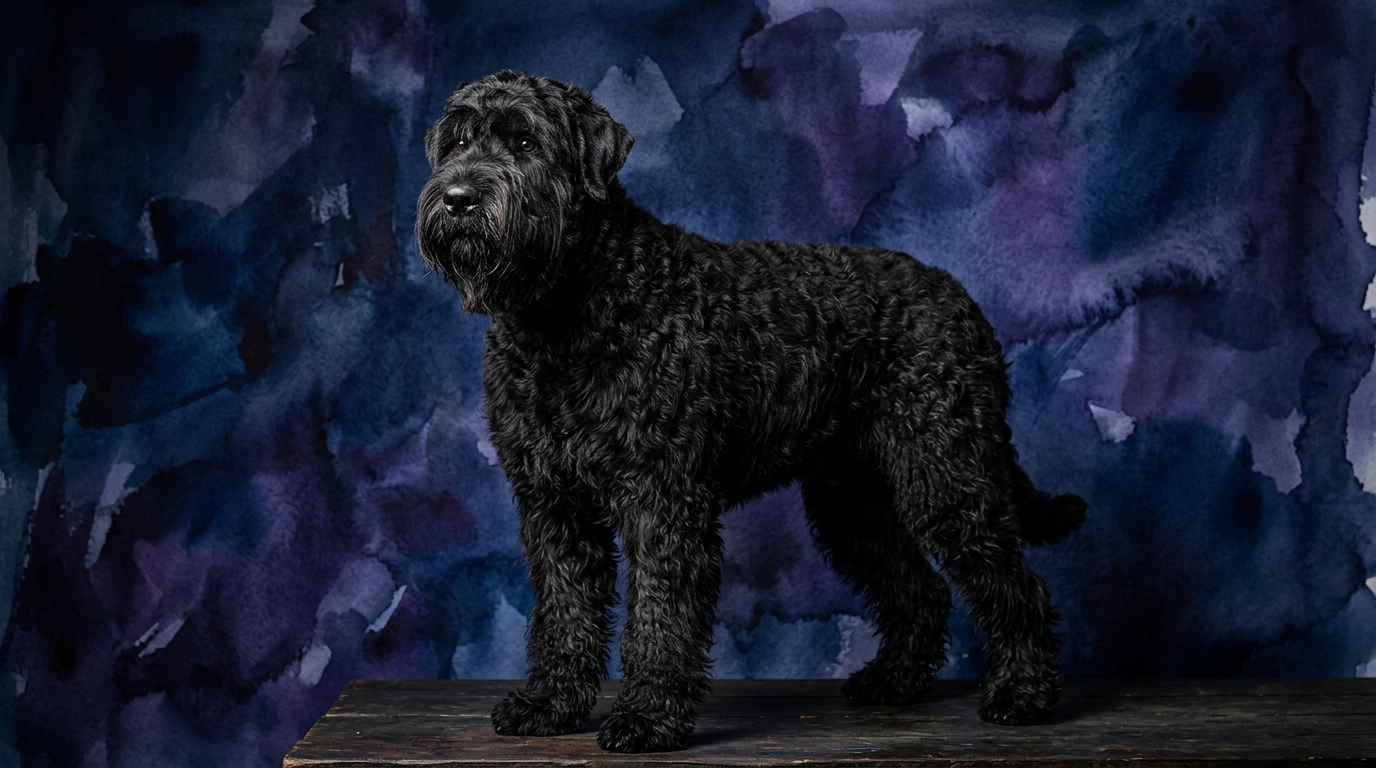
Side-by-Side IQ Profile: Entlebucher Mountain Dog vs. Black Russian Terrier
At first glance, the Entlebucher Mountain Dog and the Black Russian Terrier appear to possess identical cognitive profiles according to our Pet IQ Lab, each scoring 3/5 across Problem Solving, Training Speed, Social Intelligence, Instinctive Drive, and Memory. However, these numerical similarities belie profound differences in how these abilities manifest, deeply influenced by their breed groups and historical purposes.
For the **Entlebucher Mountain Dog (Herding)**, a 3/5 in **Problem Solving** means they excel at dynamically assessing and responding to a flock's movements, anticipating escape routes or gathering strays in varied terrains. This isn't abstract puzzle-solving, but practical, on-the-hoof strategic thinking essential for managing livestock. Their **Training Speed (3/5)** reflects a good capacity for learning complex command sequences quickly, especially when tasks align with their natural herding instincts, showing eagerness to engage with their handler. Their **Social Intelligence (3/5)** is geared towards understanding subtle cues from their handler and the behavior of animals, allowing them to navigate social hierarchies within a working team. The **Instinctive Drive (3/5)** in an Entlebucher is a moderate yet persistent herding impulse, expressed through their desire to gather, control, and move, typically channeled into focused, structured activity. Finally, their **Memory (3/5)** reliably recalls intricate herding patterns, specific commands for different scenarios, and the layout of their working environment, serving practical working purposes by retaining learned behaviors and routines.
The **Black Russian Terrier (Working)**, while sharing the same numerical scores, applies these cognitive abilities in a distinct manner. Their **Problem Solving (3/5)** is rooted in protective instincts, enabling them to assess potential threats, discern intentions, and determine appropriate responses within their territory to ensure security. Their **Training Speed (3/5)** allows them to learn foundational obedience and protection work effectively, often requiring clear, consistent instruction and a confident leader, as their learning is driven by purpose and the establishment of clear boundaries. The BRT's **Social Intelligence (3/5)** is characterized by intense loyalty to their family unit and a discerning wariness towards strangers; they are adept at reading human emotions within their trusted circle and identifying those outside who might pose a perceived risk. Their **Instinctive Drive (3/5)** is a significant protective and territorial impulse, manifesting as vigilance and natural assertiveness, compelling them to guard their home and family. Consequently, their **Memory (3/5)** is robust for individuals, consistently distinguishing between family, accepted visitors, and potential threats, and recalling established routines and territorial boundaries to inform their protective behaviors.
Where the Entlebucher Mountain Dog Wins Cognitively
Despite the identical numerical scores, the Entlebucher Mountain Dog's cognitive strengths shine in dynamic, spatially oriented tasks. Their problem-solving (3/5) is uniquely adapted to an ever-changing environment, allowing them to make quick decisions about livestock movement, anticipating where a sheep might bolt or how to redirect a stubborn cow. This involves a fluid grasp of cause-and-effect in a moving landscape that differs from the more static assessment of a territorial guardian.
Their social intelligence (3/5) also presents a distinct advantage in cooperative multi-species communication. An Entlebucher excels at reading not just human intent, but also the subtle body language of animals, using this understanding to gently persuade or firmly guide without causing panic. This nuanced social navigation, critical for effective herding, demonstrates a specific application of their intelligence focused on influence and management rather than pure deterrence.
Furthermore, their memory (3/5) is particularly strong in retaining complex sequences of actions and understanding routes, which is vital for repeated herding tasks across different fields or for executing elaborate agility courses. They recall the specific "dance" of a herding trial, demonstrating a sequential memory distinct from the Black Russian Terrier's emphasis on remembering individuals or fixed boundaries.
Where the Black Russian Terrier Wins Cognitively
The Black Russian Terrier, while sharing the same 3/5 cognitive ratings, excels in areas demanding discernment, vigilance, and strategic defense. Their problem-solving (3/5) is particularly strong in threat assessment and environmental monitoring. A BRT can quickly evaluate a novel sound or approaching figure, deciding if it warrants a warning or a more assertive response, a critical skill for their guardian role that requires rapid, accurate judgment in potentially high-stakes situations.
Their social intelligence (3/5) is highly specialized for loyalty and protection within their family unit. They form incredibly deep bonds and are acutely attuned to the emotional states of their trusted humans, offering comfort or protection as needed. This profound family focus, coupled with a deliberate wariness of outsiders, means their social understanding is less about broad cooperative engagement and more about intense, selective allegiance and boundary enforcement.
The Black Russian Terrier's instinctive drive (3/5) is a powerful asset in their cognitive profile, providing an unwavering commitment to protection. This drive underpins their memory (3/5) for "who belongs" and "who doesn't," making them exceptionally reliable in remembering past interactions and maintaining a consistent protective stance towards strangers. This unwavering, purpose-driven cognitive framework defines their unique strength in security and territorial management.
Which is Easier to Train and Why
While both breeds score 3/5 in training speed, the *nature* of their trainability differs significantly due to their intrinsic motivations and historical roles. The Entlebucher Mountain Dog, with its strong herding drive, often finds training highly engaging when it mimics problem-solving or management tasks. They are typically eager to please and respond well to positive reinforcement that taps into their desire for purposeful work. Their 3/5 training speed means they can grasp complex commands relatively quickly, especially when the training is consistent, clear, and provides an outlet for their natural instincts to control movement. They excel in activities like obedience, agility, and, of course, herding trials, where precision and responsiveness are paramount.
The Black Russian Terrier, also rated 3/5 for training speed, approaches training with a different mindset. Their working background, focused on protection and guarding, means they require a firm, confident, and consistent handler from an early age. They learn quickly when motivated by purpose and clarity, but their inherent independence and strong protective instincts mean they might challenge boundaries more readily than an Entlebucher. Training a BRT isn't just about teaching commands; it's about establishing leadership and trust, ensuring that their formidable drives are channeled appropriately. They might learn a "stay" command just as fast, but their interpretation might be "stay here and guard" rather than "stay here until released." Behavioral differences like the BRT's inclination to make independent judgments in protective scenarios, versus the EMD's tendency to work in close partnership to control a flock, mean that while both absorb information at a similar rate, the *process* and *focus* of training can feel quite different.
Which Suits Active Owners vs. Relaxed Owners
Neither the Entlebucher Mountain Dog nor the Black Russian Terrier is suited for truly relaxed owners, but their demands for activity differ. The Entlebucher Mountain Dog thrives with active owners who can provide consistent mental and physical stimulation. Their herding background means they possess a sustained energy level and a cognitive need for "a job." They require daily structured exercise, such as long walks, hikes, or engaging play sessions, coupled with mental challenges like obedience training, dog sports, or even urban herding activities. Owners who are prepared for an active lifestyle, enjoy training, and can provide a consistent outlet for their breed-specific drives will find an Entlebucher a rewarding companion.
The Black Russian Terrier also requires an active and experienced owner, but their "activity" often leans more towards structured leadership, extensive socialization, and secure environmental management. While they do need regular exercise to maintain physical condition, their primary cognitive and behavioral needs revolve around understanding their role, having clear boundaries, and being properly integrated into a family. A BRT can be calm and composed indoors once their needs are met, but they are not a "set it and forget it" breed. Owners must be committed to ongoing training, ensuring their protective instincts are well-managed, and providing a safe, secure environment where they can feel responsible without becoming overbearing. They are not for owners seeking a low-maintenance companion or those unfamiliar with managing a powerful, discerning working breed.
The Verdict
Choose an Entlebucher Mountain Dog if you are an active individual or family seeking a highly engaged, cooperative companion for dynamic activities like hiking, dog sports, or structured training that provides an outlet for their herding intellect.
Opt for a Black Russian Terrier if you are an experienced, confident owner prepared to provide firm, consistent leadership, extensive socialization, and a secure environment for a discerning, loyal protector.
🧠 Find Your Pet's IQ Score
Our Pet IQ Lab assessment covers 25+ tests across 5 cognitive dimensions — personalized to your breed.
Take the Full IQ Test →Frequently Asked Questions
Do identical IQ scores mean these breeds are equally easy to own?
Not at all; identical scores like 3/5 indicate similar cognitive potential but the manifestation of that potential is profoundly shaped by breed purpose. The Entlebucher's herding nature requires active engagement and structured tasks, while the Black Russian Terrier's guardian role demands significant leadership and socialization.
How does a '3/5' in Problem Solving differ between these two?
For the Entlebucher, 3/5 problem-solving involves dynamic, spatial reasoning to manage moving livestock or navigate complex agility courses. For the Black Russian Terrier, it means assessing threats, discerning intentions, and making strategic decisions related to protection and territorial security.
Can a Black Russian Terrier participate in herding sports, or an Entlebucher in protection work?
While individual dogs may show aptitude, their core instincts differ significantly. A BRT's protective drive is not designed for the nuanced control of herding, and an EMD's herding instinct isn't geared towards the assertive defense required for protection work, making cross-role training much more challenging.