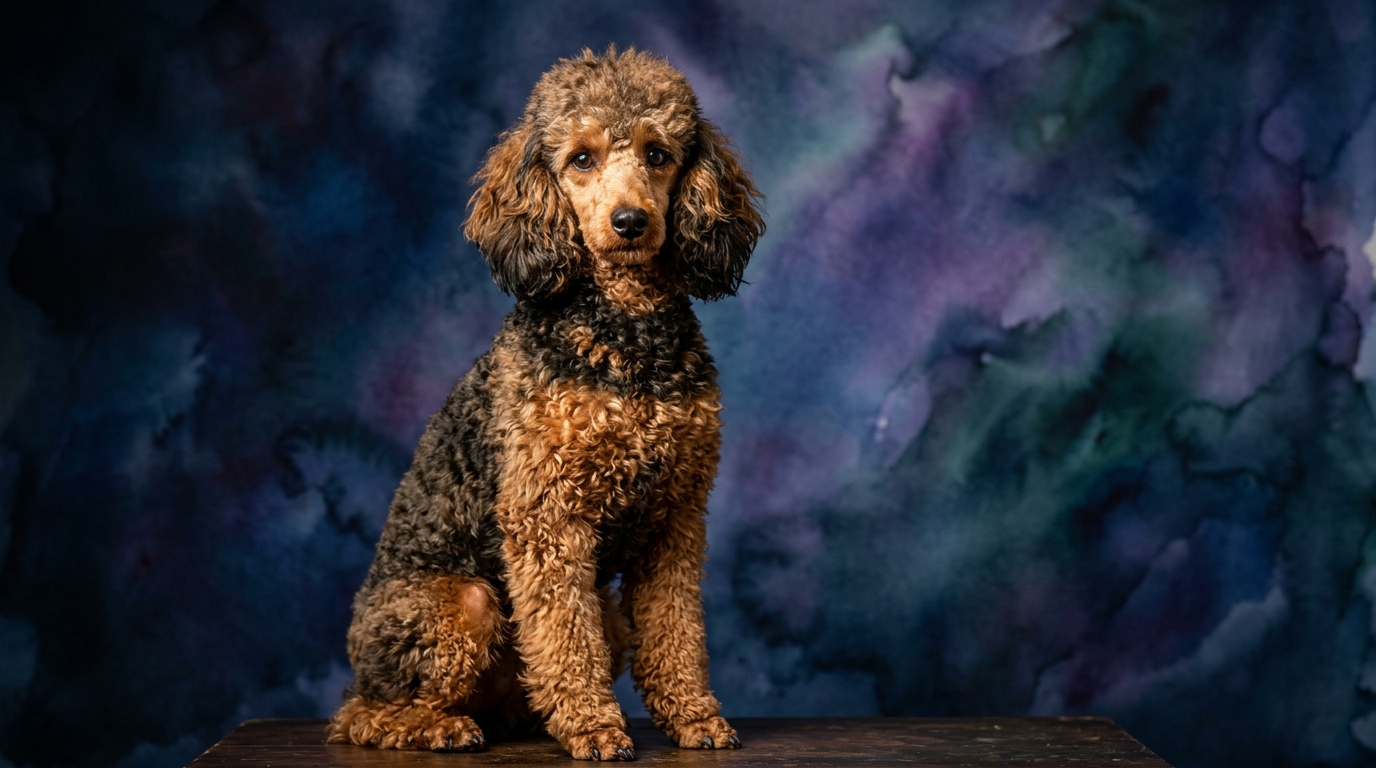
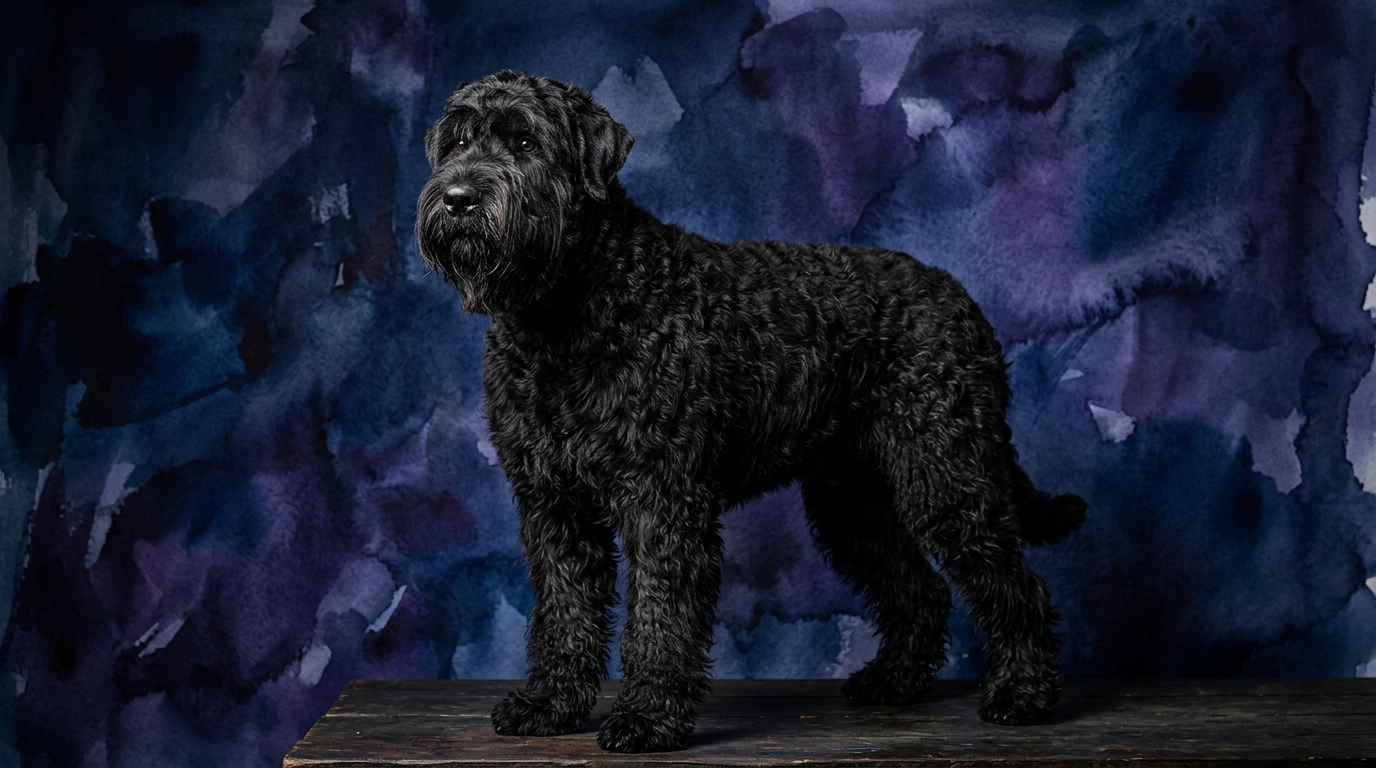
Side-by-Side IQ Profile: Poodle (Standard) vs. Black Russian Terrier
The Cosmic Pet Pet IQ Lab employs five key dimensions to evaluate cognitive function. Understanding these scores for the Standard Poodle and Black Russian Terrier offers insight into their distinct mental architectures.
For the **Poodle (Standard)**:
**Problem Solving (5/5):** A Standard Poodle approaches novel situations with an exceptional degree of analytical thought, frequently devising creative and efficient solutions to intricate challenges. This breed doesn't merely react to obstacles; it actively strategizes, demonstrating an innate ability to understand cause-and-effect relationships, making them adept at navigating complex environments or mastering multi-step puzzle toys with remarkable speed.
**Training Speed (5/5):** This breed demonstrates an exceptional capacity for quickly grasping new commands and routines, often requiring very few repetitions to internalize a behavior. This rapid acquisition makes them highly responsive to varied training methodologies and advanced tasks, showcasing a remarkable mental agility.
**Social Intelligence (5/5):** The Standard Poodle possesses a nuanced understanding of human cues and emotional states, adapting its behavior to social contexts with remarkable sensitivity. They interpret body language and vocal tone with precision, fostering deep, responsive bonds and often anticipating their owner's intentions.
**Instinctive Drive (4/5):** While often associated with elegance, the Standard Poodle retains a significant drive for retrieval and water work, reflecting its hunting heritage. This drive manifests as focused engagement in specific tasks, providing motivation for activities that channel their energetic nature.
**Memory (5/5):** This breed exhibits an outstanding ability to recall learned behaviors, commands, and even specific situations over extended periods. Once a lesson is learned, it tends to be retained with remarkable persistence, aiding in consistent performance and building a vast repertoire of understood cues.
For the **Black Russian Terrier**:
**Problem Solving (3/5):** The Black Russian Terrier typically approaches challenges with a more straightforward, practical mindset, often preferring to rely on established methods or direct action rather than seeking novel solutions. While capable of resolving problems, particularly those related to their protective duties, they may require more consistent guidance or repeated exposure to develop new, flexible strategies for unfamiliar situations.
**Training Speed (3/5):** This breed learns new commands and routines at a moderate pace, requiring consistent repetition and clear instruction to solidify behaviors. While capable of learning, the process is typically more gradual than with breeds demonstrating higher training speed, demanding patience and persistence from the trainer.
**Social Intelligence (3/5):** The Black Russian Terrier possesses a functional understanding of social cues, primarily focusing on its immediate family unit and perceived threats. Its social interactions are often direct and purpose-driven, valuing loyalty and protection over nuanced emotional interpretation, especially with strangers.
**Instinctive Drive (3/5):** Originating as a military dog, its drive is predominantly focused on protection and guarding, manifesting as a strong territorial instinct. This drive is purposeful and serious, less about playful engagement and more about vigilant oversight of its environment and family.
**Memory (3/5):** This breed retains learned behaviors and routines adequately, particularly those reinforced through consistent practice and associated with their protective duties. While not as persistent as some breeds in recalling arbitrary information, their memory serves their working functions well by remembering established boundaries and familiar individuals.
Where the Poodle (Standard) Wins Cognitively
The Standard Poodle's cognitive superiority is most evident in its **Problem Solving (5/5)** and **Memory (5/5)** capabilities. They exhibit an unparalleled capacity for abstract reasoning, quickly grasping complex concepts and applying them to new scenarios. For instance, a Poodle might effortlessly learn a sequence of ten distinct commands and then, when faced with a slightly altered version, adapt its performance without significant retraining. This analytical prowess allows them to excel in activities demanding intricate thought, such as competitive obedience routines requiring multiple steps and precise execution, or scent work where they must discriminate subtle differences. Their memory ensures that once a solution or command is mastered, it is retained with impressive longevity, building a vast repertoire of learned behaviors.
Furthermore, their **Training Speed (5/5)**, coupled with their strong memory, means they absorb and retain information at an accelerated rate. This isn't just about learning tricks; it extends to understanding household rules, routines, and even the subtle social dynamics within a family unit. A Standard Poodle can often predict an owner's next action based on subtle cues, showcasing a cognitive agility that allows for a highly responsive and fluid partnership in various settings, from casual walks to advanced performance events. This makes them exceptionally adaptable to diverse living situations and learning environments.
Where the Black Russian Terrier Wins Cognitively
While the Black Russian Terrier's numerical IQ scores are generally lower than the Standard Poodle's across the board, their cognitive strengths are uniquely tailored to their original purpose: protection and guarding. Their **Instinctive Drive (3/5)**, though rated moderately, is intensely focused and purposeful. This drive isn't about playful engagement but rather a serious, unwavering commitment to their perceived role as a family guardian. Their problem-solving, rated 3/5, is highly effective within this specialized domain; they excel at assessing and responding to potential threats, demonstrating a keen situational awareness that prioritizes the safety of their home and people. This manifests as a thoughtful, deliberate approach to strangers or novel stimuli in their territory, rather than an impulsive reaction.
Their **Social Intelligence (3/5)**, while not as broadly adaptable as the Poodle's, is acutely honed for discerning trusted family members from outsiders. This specific cognitive tuning allows them to interpret subtle shifts in human behavior concerning their immediate circle, making them exceptional at identifying situations that require their protective intervention. A Black Russian Terrier's memory (3/5), though not photographic, is robust enough to recall individuals and past interactions, contributing to their discerning nature. They remember who belongs and who doesn't, reinforcing their role as a steadfast sentinel who, once bonded, offers unwavering loyalty and a distinct brand of focused cognitive reliability.
Which is Easier to Train and Why
When evaluating ease of training, the Standard Poodle clearly stands out due to its exceptional **Training Speed (5/5)** and profound **Social Intelligence (5/5)**. This breed demonstrates an uncanny ability to grasp new commands and complex routines with remarkable alacrity, often requiring only a handful of repetitions to internalize a behavior. This rapid acquisition means training sessions are not only highly productive but also engaging and less prone to frustration for both the dog and its handler. For example, teaching a Standard Poodle a multi-step retrieve involving different objects and locations might take a fraction of the time it would take for many other breeds, as they quickly connect verbal cues with actions and desired outcomes.
Furthermore, the Poodle's acute social intelligence plays a pivotal role in its trainability. They possess a nuanced understanding of human body language, vocal inflections, and emotional states, allowing them to anticipate expectations and respond with precision. This deep attunement fosters a highly communicative and responsive training partnership, where the dog actively seeks to understand and comply. This contrasts with the Black Russian Terrier, which, with its moderate training speed (3/5) and more independent social intelligence (3/5), typically requires more direct, consistent, and patient reinforcement to achieve the same level of proficiency, making the Poodle demonstrably easier to train for a wide array of tasks.
Matching Breeds to Owner Lifestyles
The Standard Poodle is ideally suited for owners who thrive on active engagement and are prepared to provide abundant mental stimulation for their companion. Their high scores in **Problem Solving (5/5)**, **Training Speed (5/5)**, and **Memory (5/5)** mean they flourish when challenged with intricate tasks, dog sports like agility, obedience, or even advanced trick training. These dogs require owners who are committed to spending significant time on interactive, challenging activities, as their substantial cognitive capacity can lead to boredom and undesirable behaviors if not adequately exercised. An owner who enjoys teaching new skills and participating in diverse dog sports will find a Standard Poodle an unparalleled partner, thriving on constant intellectual partnership.
In contrast, the Black Russian Terrier is a better match for owners who appreciate a steadfast, independent guardian and are prepared to provide consistent, firm leadership and structured exercise. While not demanding the same *type* of varied mental puzzles as a Poodle, their **Instinctive Drive (3/5)** for protection and their more deliberate **Problem Solving (3/5)** mean they benefit from clear boundaries, a predictable routine, and purposeful tasks related to their guarding instincts. These dogs require an owner who understands the nuances of working breeds, values a serious demeanor, and can consistently reinforce their role within the family structure. They are not dogs for casual or infrequent engagement but rather partners in a structured, disciplined environment where their natural protective tendencies are managed and directed appropriately.
The Verdict
Choose a Standard Poodle when seeking a highly adaptable, rapidly learning companion for advanced training, dog sports, or a partner that thrives on intricate mental challenges and close social interaction.
Choose a Black Russian Terrier when prioritizing a devoted, protective guardian with a serious temperament, and an owner is prepared for consistent, disciplined training focused on boundary setting and purposeful work.
🧠 Find Your Pet's IQ Score
Our Pet IQ Lab assessment covers 25+ tests across 5 cognitive dimensions — personalized to your breed.
Take the Full IQ Test →Frequently Asked Questions
Does a Standard Poodle's high social intelligence make it prone to separation anxiety?
A Standard Poodle's exceptional social intelligence (5/5) means it forms deep bonds and can be sensitive to its owner's presence. While not inherently prone to separation anxiety, their strong desire for interaction necessitates careful training to ensure they are comfortable and secure when left alone, preventing over-reliance on constant companionship.
How does the Black Russian Terrier's instinctive drive (3/5) influence its daily behavior?
The Black Russian Terrier's instinctive drive (3/5) is primarily geared towards protection and guarding, leading to a vigilant and serious demeanor. This manifests as a strong territorial instinct and a tendency to be reserved with strangers, requiring consistent socialization and clear leadership from an early age to manage these powerful inclinations responsibly.
Can a Black Russian Terrier learn complex commands despite its moderate training speed (3/5)?
Absolutely. While its training speed is moderate (3/5), the Black Russian Terrier is capable of learning complex commands and routines. Success hinges on patience, consistency, and employing clear, positive reinforcement methods, often requiring more repetitions and a longer learning curve than a breed with higher training speed.