
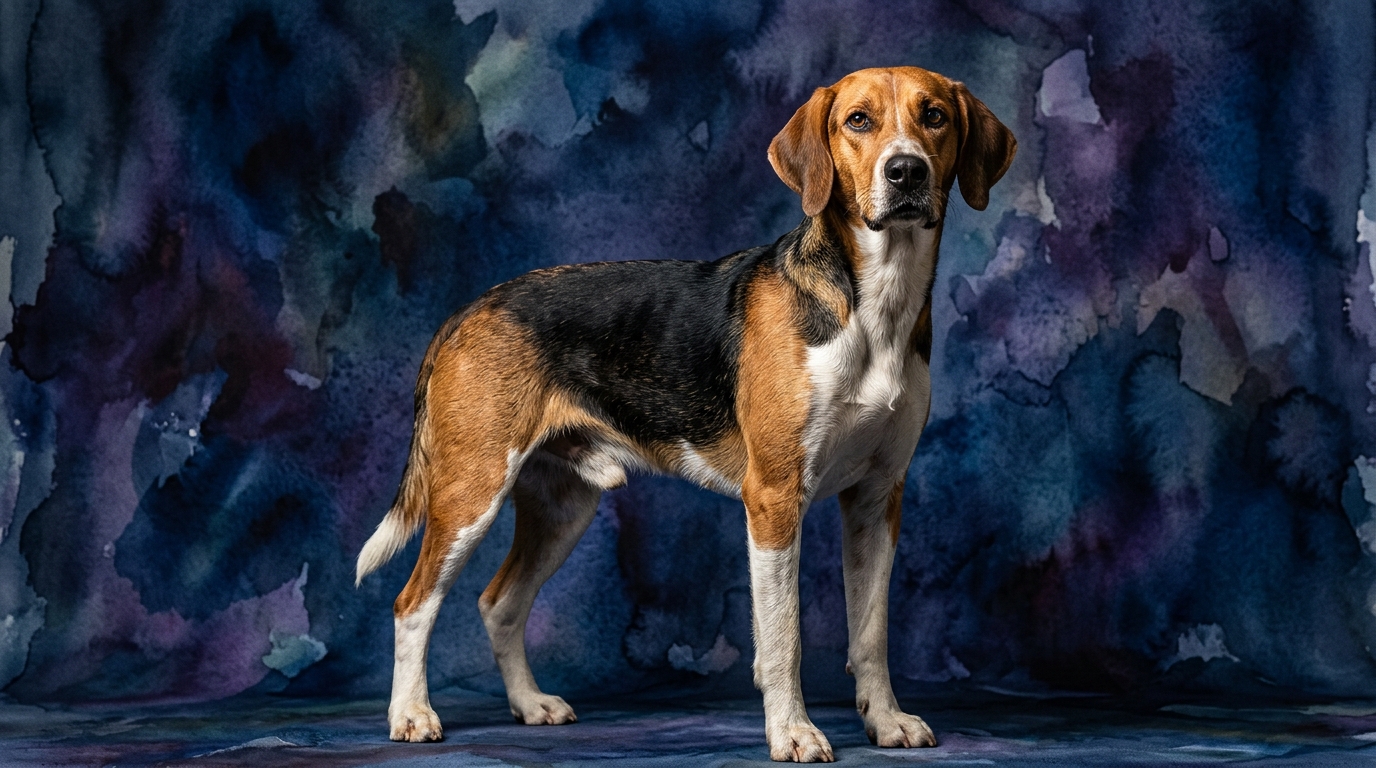
Side-by-Side Cognitive Profiles
The Cosmic Pet Pet IQ Lab offers a nuanced framework for understanding canine cognition, breaking down intelligence into five key dimensions. Examining the German Shorthaired Pointer (GSP) and the English Foxhound through this lens reveals their foundational differences.
The German Shorthaired Pointer, a Sporting Group member with a Coren rank of #17, exhibits a robust cognitive profile. Their Problem Solving is rated 5/5, indicating an exceptional capacity to navigate novel situations, understand cause-and-effect, and devise solutions. Training Speed stands at 4/5, suggesting a rapid grasp of new commands and routines. Social Intelligence, also 4/5, highlights their attunement to human cues and a strong desire for interaction and cooperation. An Instructive Drive of 5/5 underscores their intense, versatile working instincts, while Memory at 4/5 ensures they retain learned behaviors and environmental information effectively.
In contrast, the English Foxhound, a member of the Hound Group and not Coren-ranked, presents a more focused, though less varied, cognitive makeup. Their Problem Solving is rated 3/5, meaning they can address straightforward challenges but may rely more on instinct than complex reasoning in ambiguous scenarios. Training Speed is also 3/5, indicating they learn at a moderate pace, requiring consistent reinforcement. Social Intelligence, at 3/5, points to a capability for bonding, often more within a pack dynamic, and perhaps less nuanced in interpreting individual human expressions. Their Instinctive Drive is 3/5, primarily centered on scent work and pursuit, while Memory, also 3/5, supports routine and familiar patterns but may not extend to intricate, multi-step tasks with the same proficiency as the GSP.
Where the German Shorthaired Pointer Excels Cognitively
The German Shorthaired Pointer's cognitive strengths are evident across multiple domains, making them exceptionally versatile and adaptable. Their top-tier Problem Solving (5/5) means they are not just reactive but proactive, capable of assessing complex situations and formulating effective responses. This manifests in their ability to quickly learn intricate hunting strategies, solve puzzle toys with enthusiasm, or even figure out how to open gates.
Coupled with their high Training Speed (4/5) and Social Intelligence (4/5), GSPs are remarkably receptive to instruction and eager to collaborate. They are highly attuned to their handler's desires, processing commands and even subtle body language to perform tasks. This responsiveness, combined with their strong memory, allows them to master a broad repertoire of commands and routines, making them prime candidates for advanced obedience, agility, and a wide array of dog sports.
Furthermore, their Instinctive Drive (5/5) is not merely strong but also highly malleable and directed. While primarily bred for hunting, this drive can be channeled into diverse activities, from search and rescue to competitive tracking or even assistance work, demonstrating their capacity to apply innate abilities to varied human-directed objectives. This cognitive flexibility and drive for engagement set them apart as highly capable working partners.
Where the English Foxhound Finds Its Cognitive Niche
While the English Foxhound’s cognitive scores are generally lower than the GSP's, their specific profile is perfectly tailored for their historical purpose and can be a significant advantage in certain contexts. Their Instinctive Drive (3/5), though numerically lower, is intensely focused on scent work and persistent pursuit, which is a specialized form of intelligence for sustained, singular-minded tasks. They excel at following a scent trail for extended periods, displaying remarkable stamina and unwavering focus on their olfactory mission, often to the exclusion of other stimuli.
The English Foxhound's moderate Problem Solving (3/5) and Social Intelligence (3/5) can translate into a desirable independence. They are less prone to "overthinking" or constantly seeking human direction when engaged in a scenting task, allowing them to work autonomously. This self-reliance means they can be content to follow their nose for hours without needing constant human validation or intricate commands, making them ideal for owners who appreciate a dog with a strong, self-directed purpose in the outdoors.
Their pack-oriented Social Intelligence (3/5) also means they often integrate very well into multi-dog households. While they may not be as finely attuned to individual human nuances as a GSP, they are generally amiable and cooperative within a canine social structure, fostering a harmonious environment if other dogs are present. This specific cognitive makeup, therefore, isn't a deficit but rather an optimization for endurance, singular focus, and group living.
Training Dynamics: GSP vs. English Foxhound
The training experience differs considerably between these two breeds, largely due to their disparate cognitive profiles. The German Shorthaired Pointer, with its 4/5 Training Speed and 5/5 Problem Solving, generally proves to be a highly responsive and eager student. They quickly grasp new commands, enjoy the mental challenge of learning, and are motivated by the opportunity to work alongside their human companions. Their 4/5 Social Intelligence means they are often keen to please and form strong cooperative bonds, which greatly facilitates the training process, allowing for the introduction of complex sequences and advanced tasks relatively early.
In contrast, the English Foxhound’s 3/5 Training Speed and 3/5 Social Intelligence suggest a more patient and persistent approach is necessary. They are not inherently difficult to train, but their strong independent scent drive means they can be easily distracted by environmental odors, making focused attention a challenge. Training requires consistent, positive reinforcement, engaging methods, and a deep understanding of their hound nature. While they learn, it often takes more repetition and a stronger incentive to solidify commands, especially recall when their nose is to the ground. Their independence means they may not always be as driven by a desire to please as the GSP, prioritizing their own sensory explorations instead.
Matching Breeds to Lifestyles: Active vs. Self-Directed Owners
Choosing between a German Shorthaired Pointer and an English Foxhound often comes down to an owner's lifestyle and what they seek in a canine companion. The GSP is an ideal match for highly active owners who thrive on collaboration and seek a dog to participate in a wide array of activities. Their intense Instinctive Drive (5/5) and high Problem Solving (5/5) mean they require significant physical exercise and consistent mental stimulation. Owners who enjoy dog sports, hunting, competitive obedience, long runs, hiking, or even aspiring to canine assistance work will find a GSP to be an enthusiastic and capable partner. They are not content with mere backyard access; they need a job or a consistent outlet for their energy and sharp mind, thriving on shared experiences and challenges.
The English Foxhound, while also an athletic breed, appeals to a slightly different type of active owner. They are well-suited for owners who appreciate a dog with a powerful, self-directed drive for exploration, particularly through scent. While they need substantial physical exercise, such as long walks, runs, or opportunities for off-leash exploration in secure areas, their mental engagement is often satisfied by following a compelling scent trail rather than needing constant human-directed tasks. They might suit owners who enjoy long, rambling outdoor adventures where the dog can independently indulge its olfactory instincts, rather than being a constant, collaborative partner in intricate tasks. They are not for truly relaxed or sedentary owners, but for those who value an independent, enduring companion for focused outdoor pursuits.
The Verdict
Choose the German Shorthaired Pointer if you desire a highly trainable, versatile, and collaborative canine partner for a variety of tasks, dog sports, or hunting, as they thrive on engagement and relish learning new challenges alongside their human.
Opt for the English Foxhound if you appreciate a more independent companion with a powerful nose for tracking, content to follow a scent trail for miles, and value a dog that integrates well into a multi-dog household, provided you can accommodate their strong, singular drive for scent work.
🧠 Find Your Pet's IQ Score
Our Pet IQ Lab assessment covers 25+ tests across 5 cognitive dimensions — personalized to your breed.
Take the Full IQ Test →Frequently Asked Questions
Are English Foxhounds difficult to train due to their lower IQ scores?
While their training speed is rated moderately, English Foxhounds are not inherently "difficult" but require consistent, patient, and engaging training methods. Their strong independent scent drive means owners must be prepared to work with, rather than against, their natural instincts, making recall particularly vital.
Can a German Shorthaired Pointer be a good family pet despite its high drive?
Absolutely, German Shorthaired Pointers can be excellent family pets, provided their significant physical and mental exercise requirements are consistently met. Their social intelligence and eagerness to please make them affectionate companions who thrive on being an active part of family life.
Do English Foxhounds need a lot of exercise, given their hunting background?
Yes, English Foxhounds are athletic hounds bred for endurance and require substantial daily exercise to remain content and healthy. Long walks, runs, or opportunities to explore scent trails in a secure area are essential to satisfy their innate drive.