
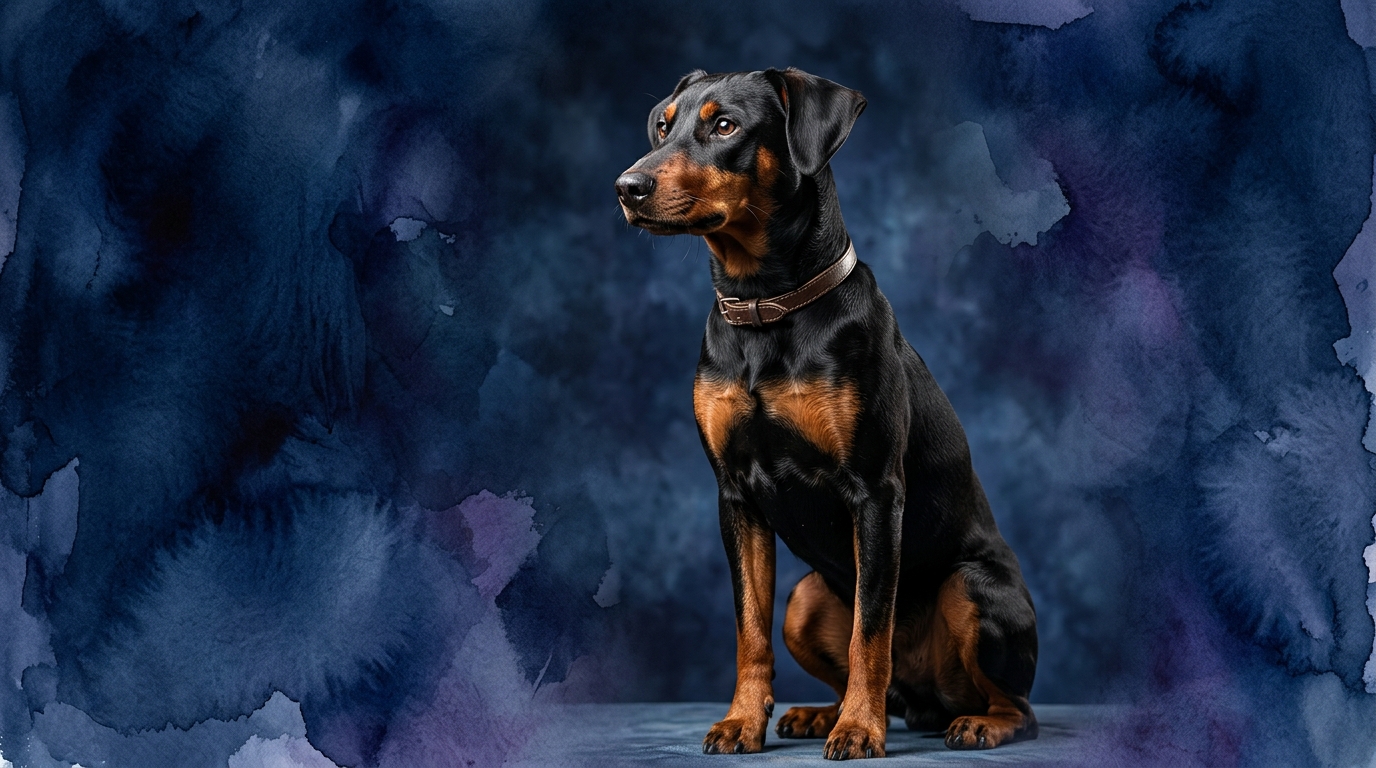
Side-by-Side IQ Profile: GSP vs. German Pinscher
When comparing the cognitive blueprints of the German Shorthaired Pointer (GSP) and the German Pinscher (GP), a clear divergence emerges, reflecting their distinct historical roles. The GSP, a Sporting breed ranked #17 by Coren, presents a profile marked by exceptional specialization. Its problem-solving capacity scores a peak 5/5, indicating a profound ability to analyze and overcome complex challenges. Training speed is rated 4/5, signifying a quick grasp of new concepts, while social intelligence also stands at 4/5, reflecting strong human-canine communication. A commanding 5/5 for instinctive drive underscores its powerful, innate behaviors, particularly for hunting, complemented by a solid 4/5 memory for retaining learned information and experiences.
In contrast, the German Pinscher, a Working breed unranked by Coren, exhibits a more generalized, yet robust, intellectual makeup. Across all five dimensions—problem-solving, training speed, social intelligence, instinctive drive, and memory—the GP consistently scores 3/5. This suggests a practical, balanced intelligence, capable of learning and adapting, but without the extreme specializations seen in the GSP. Their cognitive profile points to a dog that is competent and observant, rather than one driven by singular, intense predispositions.
Where the German Shorthaired Pointer Excels Cognitively
The German Shorthaired Pointer's cognitive advantages are evident in its superior problem-solving acumen and intense instinctive drive. With a 5/5 rating in problem-solving, GSPs demonstrate a remarkable capacity for intricate thought, whether it’s navigating complex scent trails to locate game or devising strategies to retrieve a hidden object. This isn't merely about following commands; it’s about independent reasoning and adapting to unforeseen circumstances with intellectual agility.
Their commanding 5/5 instinctive drive, particularly their prey drive and pointing instinct, means they possess an unparalleled focus and relentless energy in field work. This isn't just physical stamina, but a deep cognitive engagement with their primary purpose, allowing them to process vast amounts of sensory information related to game birds with incredible efficiency and precision. Their 4/5 memory further enhances this, enabling them to recall specific locations, patterns, or even the subtle nuances of a scent, building a sophisticated cognitive map of their environment and reinforcing learned strategies for success.
Where the German Pinscher Shows Unique Cognitive Strengths
While the German Pinscher’s cognitive scores are uniformly moderate at 3/5, this profile translates into distinct strengths, offering a pragmatic and resilient intelligence that excels in different contexts. Their moderate instinctive drive, for instance, means they possess a strong protective instinct and a keen awareness of their surroundings without the overwhelming, singular focus on prey that defines a pointer. This allows for a more general vigilance, making them excellent watchdogs who effectively assess and respond to novel stimuli in their territory.
Their 3/5 problem-solving ability is often applied to practical, immediate concerns within their daily environment, such as figuring out how to access a favored spot or reacting appropriately to household changes, rather than complex, multi-stage challenges. This balanced approach allows them to switch between tasks and roles with greater ease, adapting their attention from family companion to alert guardian without the intense, specialized tunnel vision of the GSP. Their cognitive makeup favors versatile competence over extreme specialization.
Training Dynamics: Which Breed is Easier to Shape?
The German Shorthaired Pointer generally presents as the more straightforward breed to train, a direct result of its higher ratings in training speed (4/5) and social intelligence (4/5), coupled with its exceptional problem-solving (5/5). GSPs tend to grasp new commands and concepts quickly, eager to please and highly motivated by interaction and praise, reflecting their deep desire to work collaboratively with their human companions. Their problem-solving abilities also mean they can generalize learned behaviors to new situations more readily, making them adaptable learners for complex tasks.
In contrast, the German Pinscher, with its consistent 3/5 scores across the board, requires a more consistent and patient approach. While capable learners, their moderate training speed means more repetition may be necessary, and their slightly more independent streak can sometimes demand stronger incentives or clearer demonstrations of a command’s purpose. Their social intelligence, while competent, may not be as finely attuned to subtle human cues as the GSP's, necessitating more explicit instruction and less reliance on unspoken communication.
Matching Breeds to Owner Lifestyles: Active vs. Balanced
The distinction between these two breeds regarding owner suitability is quite pronounced, primarily dictated by their instinctive drives and energy levels. The German Shorthaired Pointer, with its exceptional instinctive drive (5/5) and high problem-solving capacity, unequivocally suits active owners who can provide substantial daily exercise and consistent mental challenges. These dogs thrive when engaged in activities that tap into their ancestral purpose, such as hunting, tracking, or competitive dog sports. Their cognitive architecture demands outlets for their boundless energy and sharp minds; a sedentary lifestyle would lead to frustration and potentially destructive behaviors.
Conversely, the German Pinscher, while certainly not a sedentary breed, possesses a more moderate instinctive drive (3/5) and overall activity level. They require regular walks, playtime, and engaging mental stimulation, but their needs are typically less intense than the GSP's. They can adapt to owners with an active but perhaps less specialized lifestyle, enjoying varied activities from long hikes to puzzle toys. However, it's crucial to note that neither breed is suited for a truly 'relaxed' or sedentary owner, as both possess working dog instincts that necessitate engagement and purpose.
The Verdict
Choose the German Shorthaired Pointer if you are an exceptionally active individual or family seeking a highly trainable, driven companion for outdoor adventures, hunting, or competitive dog sports, ready to channel their intense cognitive and physical energy.
Opt for the German Pinscher if you desire a vigilant, moderately active, and pragmatic companion for a dynamic household, valuing their adaptable intelligence and protective instincts without the specialized demands of a dedicated field dog.
🧠 Find Your Pet's IQ Score
Our Pet IQ Lab assessment covers 25+ tests across 5 cognitive dimensions — personalized to your breed.
Take the Full IQ Test →Frequently Asked Questions
Is the German Shorthaired Pointer suitable for first-time dog owners?
While highly trainable, the GSP's intense energy, high drive, and need for consistent mental and physical stimulation can be challenging for inexperienced owners. They require a significant commitment to training and exercise to thrive, making them better suited for those prepared for a demanding companion.
Do German Pinschers bark a lot due to their protective nature?
German Pinschers are indeed vigilant and possess a moderate instinctive drive for protection, which often translates into alert barking to signal perceived threats. Consistent training and early socialization are crucial to manage this behavior, teaching them appropriate times to alert and when to be quiet.
How do their memory scores impact their daily lives?
The GSP's 4/5 memory contributes to their excellent recall in the field and ability to learn complex routines quickly, allowing them to retain vast amounts of information. The GP's 3/5 memory is solid for daily commands and routines but might require more consistent reinforcement for less frequently practiced skills, making clear communication vital.