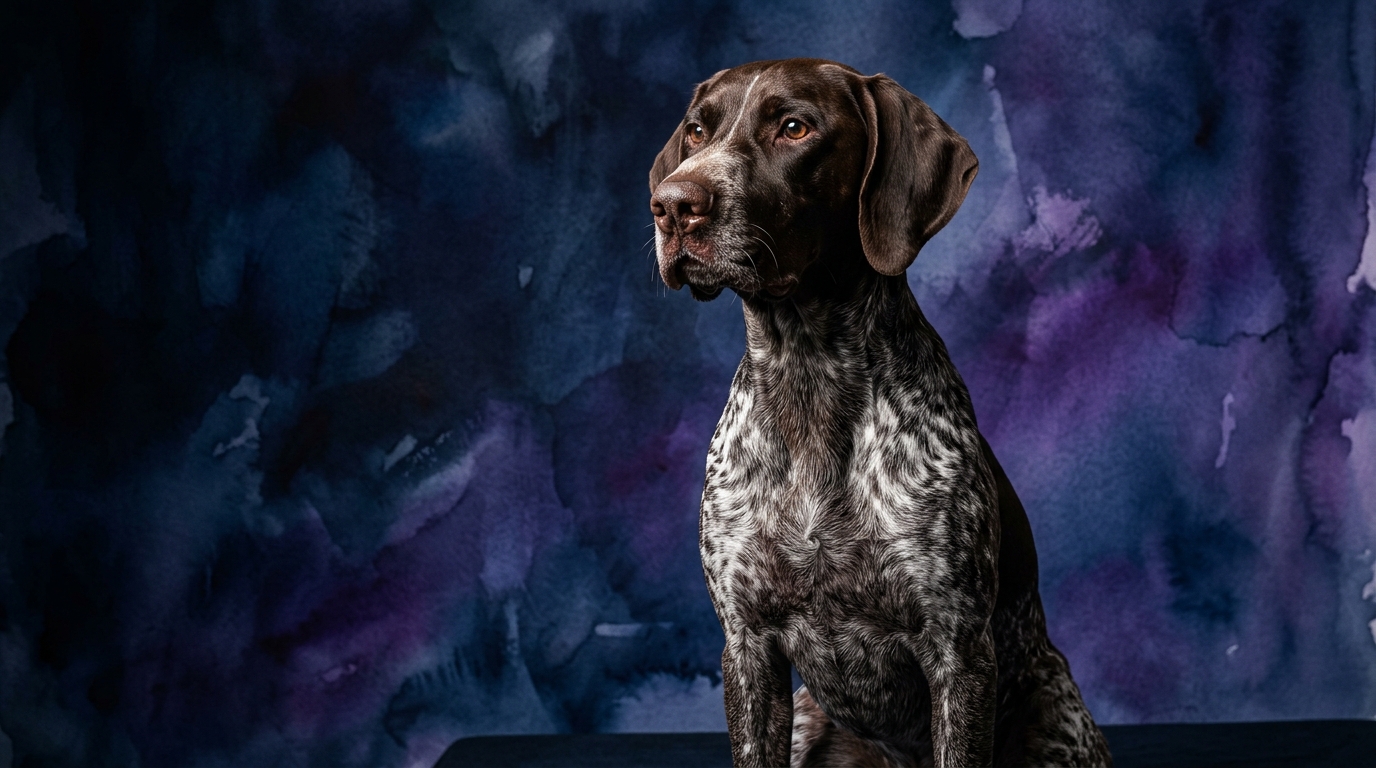

Side-by-Side IQ Profile: German Shorthaired Pointer vs. Rat Terrier
At The Cosmic Pet Pet IQ Lab, we evaluate canine intelligence across five key dimensions, revealing the nuanced cognitive blueprints of each breed. The German Shorthaired Pointer (GSP), a Sporting group member with a Coren ranking of #17, presents a robust and well-rounded cognitive architecture. Its Problem Solving score of 5/5 indicates an exceptional capacity for understanding complex scenarios and devising multi-step solutions, often in dynamic environments. Training Speed at 4/5 reflects a quick grasp of new commands and routines, making them receptive learners. Social Intelligence, also 4/5, highlights their aptitude for reading human cues and forming strong collaborative bonds, crucial for their role as hunting partners. An Instinctive Drive of 5/5 underscores an intense, persistent motivation towards their natural working behaviors, while a Memory score of 4/5 allows for the retention of intricate patterns and learned behaviors over time.
In contrast, the Rat Terrier, a tenacious member of the Terrier group not listed on Coren's ranking, exhibits a cognitive profile tailored for independent, focused tasks. Across all five dimensions—Problem Solving, Training Speed, Social Intelligence, Instinctive Drive, and Memory—the Rat Terrier consistently scores 3/5. This does not imply a lack of capability, but rather a distinct operational intelligence. A Problem Solving score of 3/5 indicates efficient, practical thinking for immediate, tangible challenges, often requiring quick decisions rather than elaborate planning. Training Speed at 3/5 suggests they learn at a moderate pace, requiring consistency and clear motivation. Social Intelligence at 3/5 points to a companionable nature, but perhaps with a stronger independent streak, less reliant on constant human direction than some breeds. Their Instinctive Drive of 3/5 is potent and directed, particularly towards small prey, while Memory at 3/5 supports the recall of essential routines and effective hunting strategies.
Where the German Shorthaired Pointer Excels Cognitively
The German Shorthaired Pointer's cognitive strengths are particularly evident in its superior Problem Solving (5/5) and profound Instinctive Drive (5/5). This breed demonstrates a remarkable ability to analyze complex field situations, such as tracking elusive game through varied terrain, adapting strategies on the fly, and executing multi-stage retrieves. Their mental processes involve not just reacting, but actively planning and adjusting. This translates to an animal that can learn intricate sequences for obedience, agility, or field trials with impressive efficiency, often anticipating the next step in a task.
Furthermore, the GSP's high Social Intelligence (4/5) and Training Speed (4/5) mean they are highly attuned to their human handlers, eager to collaborate and quick to understand expectations. This makes them exceptional partners for activities requiring synchronized effort and nuanced communication. Their Memory (4/5) supports this by allowing them to retain vast repertoires of commands, signals, and environmental knowledge, building upon past experiences to refine future actions. A GSP's cognitive advantage lies in its capacity for comprehensive, cooperative problem-solving, driven by an unyielding enthusiasm for work.
Where the Rat Terrier Finds Its Cognitive Niche
While the Rat Terrier's scores are consistently 3/5, this profile is not a deficit but an optimized design for its specific historical purpose: independent vermin control. Its Problem Solving at 3/5 shines in rapid-fire, localized challenges—figuring out how to get into a tight space, outsmarting a small, quick target, or navigating obstacles in a confined environment. This isn't about grand strategic planning, but about effective, immediate tactical execution. Their cognitive strength lies in focused tenacity and quick, decisive action rather than extensive, cooperative strategizing.
The Rat Terrier's Instinctive Drive (3/5) is highly concentrated and persistent when focused on its quarry, allowing it to work independently for extended periods without constant human input. This self-reliance, coupled with its moderate Social Intelligence (3/5), means it can be an effective problem-solver on its own terms. Owners seeking a dog with a clear, directed purpose that doesn't demand constant, complex mental engagement from them might find the Rat Terrier's cognitive balance to be a distinct advantage. Its Memory (3/5) is perfectly adequate for recalling successful hunting patterns and navigating familiar territories, proving efficient for its niche.
Which is Easier to Train, and Why
Based on their cognitive profiles, the German Shorthaired Pointer will generally be easier to train for a broad range of tasks compared to the Rat Terrier. The GSP's Training Speed of 4/5, combined with its 4/5 Social Intelligence, means it absorbs commands quickly and is highly motivated by human interaction and approval. Their strong Problem Solving (5/5) allows them to understand the 'why' behind tasks, not just the 'what,' leading to faster generalization of learned behaviors. For instance, a GSP can quickly learn a complex retrieve sequence, understanding the objective even if the environment changes, because of its inherent drive to work collaboratively and its capacity for mental mapping.
The Rat Terrier, with a Training Speed of 3/5 and Social Intelligence of 3/5, requires more patience and consistency. While trainable, they may take longer to master new commands and might prioritize their independent instincts over immediate compliance. Their background as independent vermin hunters means they were bred to make their own decisions, not always to look to a human for direction. This can manifest as selective hearing or a strong preference for pursuing their own interests, such as a scent trail, over following a command. Training a Rat Terrier often benefits from shorter, engaging sessions and positive reinforcement that makes them feel like they are 'winning' the game, rather than simply obeying.
Cognitive Fit: Active Owners vs. Relaxed Owners
For owners with an active lifestyle seeking a highly engaged and cooperative partner, the German Shorthaired Pointer is an exceptional cognitive match. Their 5/5 Instinctive Drive demands significant physical and mental exertion; these are dogs that thrive on purpose-driven activities like hunting, agility, dock diving, or extensive hiking. Their 5/5 Problem Solving and 4/5 Social Intelligence mean they excel in structured training and enjoy learning complex skills, making them ideal for individuals who want to dedicate time to advanced dog sports or working roles. A GSP requires an owner who can consistently provide outlets for its expansive energy and formidable mental capacity, lest it channel its problem-solving prowess into less desirable household activities.
Conversely, the Rat Terrier's cognitive profile suits owners who appreciate a spirited yet moderately demanding companion. While still active, their 3/5 Instinctive Drive and 3/5 Problem Solving suggest a less intense requirement for constant, complex mental engagement than a GSP. They are content with regular walks, interactive play, and opportunities for independent exploration in a secure yard. Owners who enjoy observing a dog's independent problem-solving skills in smaller, everyday contexts, and who are comfortable with a companion that might have a more self-directed personality, will find the Rat Terrier a rewarding fit. They are not suited for entirely sedentary lifestyles, but their cognitive needs are generally more manageable for owners who might not be training for competitive field trials every weekend.
The Verdict: When to Choose Each Breed
Choosing between a German Shorthaired Pointer and a Rat Terrier hinges on aligning your lifestyle with their unique cognitive blueprints. The GSP is the ideal choice for dedicated, active individuals or families who desire a highly intelligent, cooperative, and physically demanding partner eager for complex training, extensive outdoor adventures, and a shared sense of purpose. This breed thrives when its formidable mind and body are consistently challenged and engaged in collaborative activities.
The Rat Terrier is best suited for owners who appreciate a tenacious, independent, and moderately energetic companion with a focused drive, capable of efficient, practical problem-solving. This breed will flourish with consistent, engaging training, regular exercise, and an owner who respects its self-sufficient nature, providing outlets for its innate curiosity without requiring constant, high-level mental direction.
The Verdict
Choose the German Shorthaired Pointer if you seek a highly engaged, cooperative partner for complex tasks, demanding activities, and shared adventures, capable of intricate problem-solving.
Opt for the Rat Terrier if you desire a tenacious, independent companion with a focused drive, suited for moderate activity levels and perhaps less structured, more self-directed engagement.
🧠 Find Your Pet's IQ Score
Our Pet IQ Lab assessment covers 25+ tests across 5 cognitive dimensions — personalized to your breed.
Take the Full IQ Test →Frequently Asked Questions
Are Rat Terriers hard to train?
Rat Terriers are generally trainable, but their 3/5 Training Speed and 3/5 Social Intelligence mean they may require more patience and consistency than some breeds. Their independent nature, stemming from their vermin-hunting background, means they can be more self-directed and might need stronger motivation, making training effective with positive reinforcement and engaging, short sessions.
Do German Shorthaired Pointers need a lot of mental stimulation?
Absolutely. With a 5/5 Problem Solving score and 5/5 Instinctive Drive, German Shorthaired Pointers have a profound need for mental stimulation. They thrive on learning complex tasks, engaging in problem-solving games, and participating in activities that challenge their sharp minds and channel their high energy, making consistent training and enrichment crucial for their well-being.
Which breed is better for first-time dog owners based on intelligence?
Neither breed is inherently 'better' for first-time owners without considering the owner's lifestyle and commitment. The German Shorthaired Pointer's high cognitive demands can be overwhelming for novices, while the Rat Terrier's independent streak might also pose challenges. A first-time owner comfortable with consistent, engaging training and moderate activity might find the Rat Terrier manageable, while a GSP requires a highly dedicated, active, and knowledgeable owner prepared for significant mental and physical engagement.