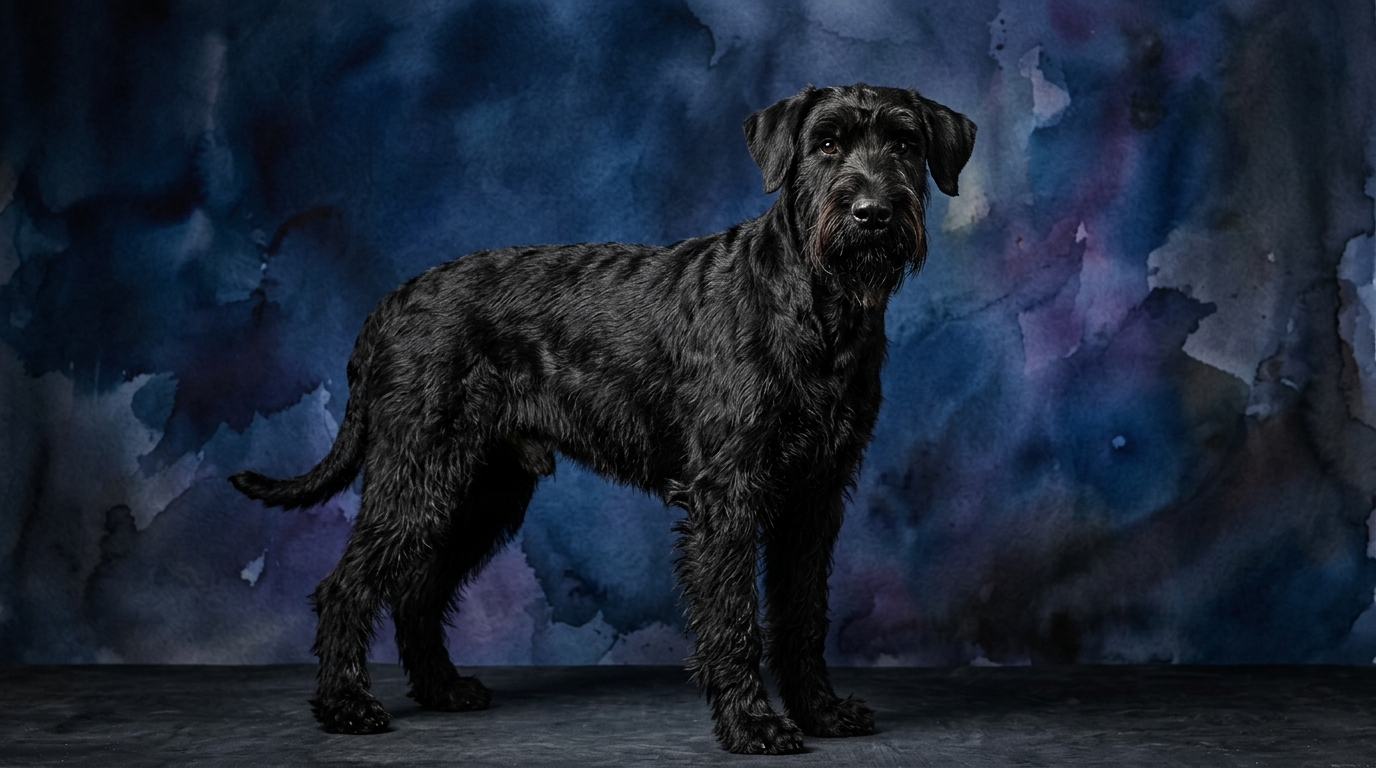

Side-by-Side IQ Profile: Giant Schnauzer vs. English Toy Spaniel
The Cosmic Pet Pet IQ Lab employs a five-dimensional framework to assess canine cognitive abilities, offering a nuanced view beyond simple rankings. Let's examine how the Giant Schnauzer and the English Toy Spaniel measure up across these specific dimensions.
The **Giant Schnauzer**, a breed from the Working group and ranked #28 by Coren, demonstrates a formidable cognitive profile. Its Problem Solving ability scores 4/5, indicating a strong capacity to independently navigate complex situations and strategize solutions to challenges. Training Speed is also high at 4/5, reflecting their quick grasp of new commands and procedures. Social Intelligence stands at 3/5, suggesting a balanced understanding of human cues and interactions, often tempered by an independent streak. Their Instinctive Drive, rated 3/5, points to a moderate but present inclination for tasks, protection, and prey pursuit. Finally, Memory is robust at 4/5, enabling them to retain intricate routines and past experiences with considerable accuracy.
In contrast, the **English Toy Spaniel**, a charming companion from the Toy group, presents a different cognitive emphasis. This breed is not Coren-ranked, aligning with its role as a dedicated house pet rather than a working dog. Its Problem Solving ability is rated 3/5, suggesting they can tackle moderate challenges but might prefer human guidance for more intricate puzzles. Training Speed also sits at 3/5, indicating they learn at a steady pace, requiring consistent and positive reinforcement. Social Intelligence matches the Schnauzer at 3/5, but manifests as a deep attunement to human emotion and a desire for close companionship. Instinctive Drive is 3/5, typically expressed as a gentle curiosity rather than a strong urge to work or hunt. Memory is rated 3/5, meaning they retain routines and familiar commands reliably, though perhaps not with the same depth as their working counterparts.
Where the Giant Schnauzer Wins Cognitively
The Giant Schnauzer's cognitive strengths clearly lie in areas demanding independent thought, rapid learning, and robust recall. Their 4/5 rating in Problem Solving means they excel at figuring out how to open gates, locate hidden objects, or navigate complex agility courses without constant direction. This breed processes information quickly and applies past learning to new scenarios effectively, making them adept at tasks requiring sequential actions or strategic thinking.
Furthermore, their 4/5 Training Speed allows them to absorb a vast repertoire of commands and behaviors in fewer repetitions compared to many breeds. This isn't just about basic obedience; it extends to advanced protection work, competitive obedience, or even scent detection. Coupled with their 4/5 Memory, a Giant Schnauzer can recall intricate sequences of commands or remember specific routes and individuals over long periods, making them reliable partners for demanding roles. Their cognitive architecture is geared towards purpose-driven application, where mental acuity directly translates into task execution.
Where the English Toy Spaniel Wins Cognitively
While the English Toy Spaniel's cognitive scores are generally lower in areas of independent task execution, their strengths are profound within their sphere of companionship. Their 3/5 Social Intelligence, while numerically equal to the Giant Schnauzer, manifests quite differently. They possess a subtle yet powerful ability to perceive and respond to human emotional states, offering comfort and presence without needing explicit commands. This makes them exceptional at providing emotional support and forming deep, intuitive bonds.
Their moderate 3/5 Problem Solving and Instinctive Drive scores can be seen as advantages for their role as house pets. They are less likely to independently 'problem-solve' ways to escape the yard or engage in disruptive behaviors driven by a strong working instinct. Instead, their cognitive focus is on maintaining harmony within the home and fulfilling their role as an affectionate presence. Their gentler drive means fewer impulses to manage, making them naturally more tranquil companions whose 'wins' are measured in quiet devotion and emotional resonance rather than overt skill demonstration.
Which is Easier to Train and Why
Determining which breed is 'easier' to train depends heavily on the owner's goals and approach. The Giant Schnauzer, with its 4/5 Training Speed and 4/5 Problem Solving, absorbs new information rapidly and can generalize concepts quickly. This means they can learn complex commands and multi-step tasks efficiently. However, their 3/5 Instinctive Drive and independent nature necessitate a firm, consistent, and engaging training regimen. If not adequately challenged or given a 'job,' their problem-solving skills might be directed towards outsmarting their owners or pursuing their own agenda, requiring an experienced hand to channel their mental energy constructively.
The English Toy Spaniel, with 3/5 in both Training Speed and Problem Solving, will require more patience and repetition during training sessions. They might not pick up new commands as quickly as a Schnauzer, but their strong desire for human connection, stemming from their 3/5 Social Intelligence, makes them eager to please their beloved person. Training for this breed often focuses on basic manners, house-training, and recall within a home environment. They respond best to positive reinforcement and gentle methods, as harsh corrections can be counterproductive due to their sensitive nature. While they may not master advanced obedience as swiftly, their inherent desire for companionship makes them willing and pleasant pupils for the right owner.
Which Suits Active Owners vs. Relaxed Owners
The Giant Schnauzer is undeniably suited for active owners who can meet their considerable mental and physical demands. Their high Problem Solving and Memory scores mean they thrive on continuous learning, advanced obedience, dog sports like agility, or protection work. An owner who enjoys daily vigorous exercise, structured training sessions, and providing a 'job' for their dog will find a deeply fulfilling partnership with a Giant Schnauzer. They require an owner who understands the nuances of a working breed's cognitive needs and can provide consistent engagement to prevent boredom and potential behavioral issues.
Conversely, the English Toy Spaniel is an ideal match for relaxed owners seeking a devoted, low-key companion. Their moderate Instinctive Drive and preference for close proximity to their humans make them content with moderate daily walks and indoor playtime. They flourish in environments where companionship is prioritized over intense activity or complex tasks. Older individuals, families with a calmer lifestyle, or those living in apartments will find the English Toy Spaniel's affectionate nature and lower exercise requirements to be a perfect fit, offering quiet devotion and warmth without demanding a high-octane lifestyle.
The Verdict
Choose the Giant Schnauzer if you are an active, experienced owner seeking a capable working partner who thrives on complex training, independent problem-solving, and robust physical and mental engagement.
Opt for the English Toy Spaniel if you desire a gentle, devoted companion whose primary focus is affectionate interaction, providing emotional comfort, and a tranquil presence in a relaxed home environment.
🧠 Find Your Pet's IQ Score
Our Pet IQ Lab assessment covers 25+ tests across 5 cognitive dimensions — personalized to your breed.
Take the Full IQ Test →Frequently Asked Questions
Are Giant Schnauzers good with children?
Giant Schnauzers, with their 3/5 social intelligence and protective instincts, can be good family dogs, but require early and consistent socialization to ensure gentleness. Their size and working drive mean interactions with children should always be supervised, and they benefit from clear boundaries and training.
Do English Toy Spaniels bark a lot?
English Toy Spaniels, being companion dogs with 3/5 social intelligence, are attuned to their environment and human presence. They may bark to alert their owners to strangers or unusual sounds, but generally, they are not considered excessive barkers if their social needs are met and they feel secure within their home.
How much exercise does a Giant Schnauzer need compared to an English Toy Spaniel?
A Giant Schnauzer, hailing from a working background, requires substantial daily exercise including vigorous physical activity and significant mental stimulation. An English Toy Spaniel, in contrast, is content with moderate daily walks and indoor play, prioritizing companionship and gentle interaction over high-intensity physical demands.