
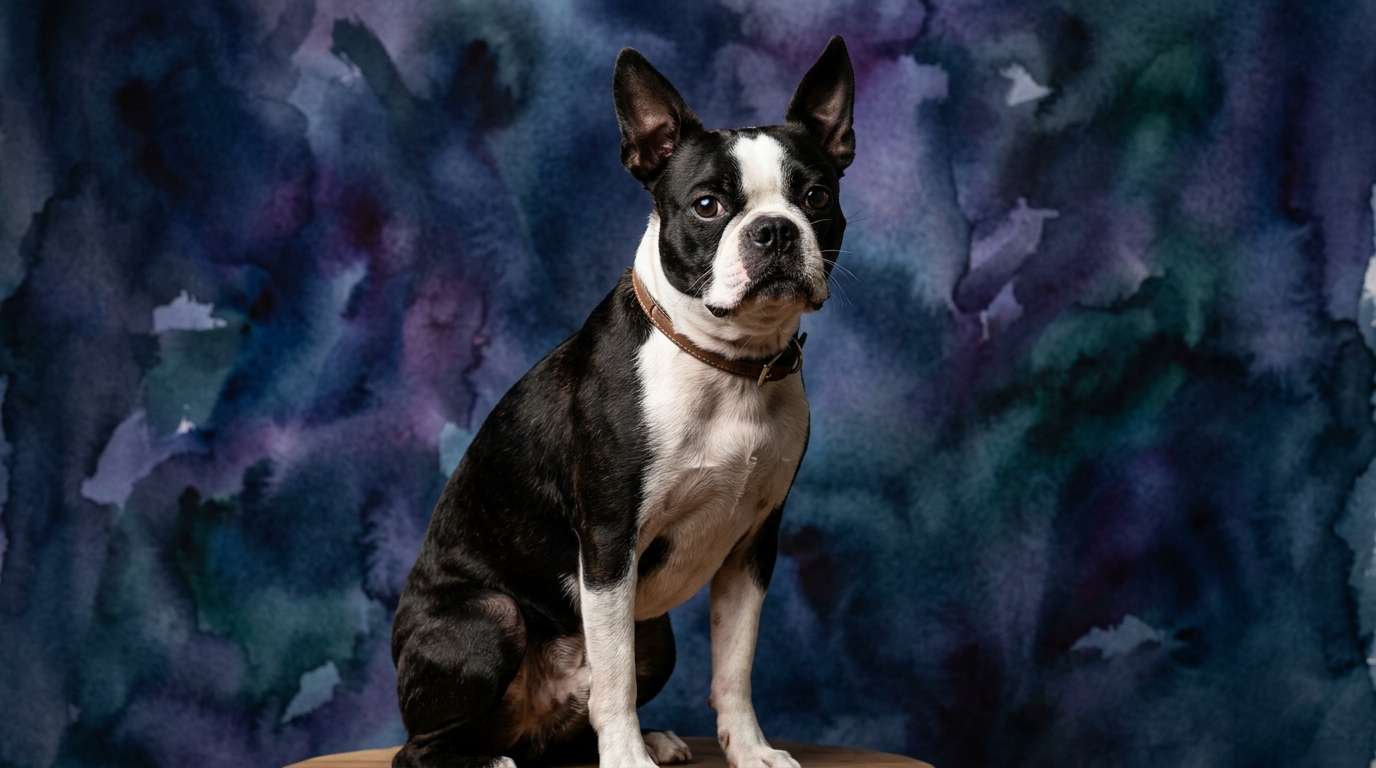
Side-by-Side Cognitive Profile: Golden Retriever vs. Boston Terrier
At The Cosmic Pet Pet IQ Lab, we delve into five key cognitive dimensions to provide a nuanced understanding of a breed's mental makeup. For the Golden Retriever, a Sporting group dog with a Coren rank of #4, their profile showcases a robust and versatile intellect. Their Problem Solving is rated 4/5, indicating a strong capacity for navigating complex situations and adapting to new challenges. Training Speed is an exceptional 5/5, reflecting their rapid acquisition of new commands and routines. Social Intelligence also stands at 5/5, highlighting their profound ability to understand human cues and emotions. Their Instinctive Drive, rooted in their working heritage, is 4/5, while their Memory is a solid 4/5 for retaining information and experiences.
In contrast, the Boston Terrier, a Non-Sporting breed with a Coren rank of #54, presents a cognitive profile geared more towards companionship and adaptability within a domestic setting. Their Problem Solving is 3/5, suggesting they handle everyday puzzles well but may require more guidance for abstract tasks. Training Speed is 3/5, indicating a moderate learning pace that benefits from consistency and engaging methods. Their Social Intelligence is a commendable 4/5, showing a strong connection to their human families. Instinctive Drive is lower at 2/5, reflecting less emphasis on traditional working tasks, and their Memory is 3/5, suitable for retaining routines and commands with regular reinforcement.
Where the Golden Retriever Excels Cognitively
The Golden Retriever's cognitive profile shows a distinct edge in several key areas, making them remarkably adaptable and responsive companions across a wide range of activities. Their Training Speed (5/5) is particularly noteworthy; they absorb new instructions and complex sequences with remarkable efficiency, often requiring minimal repetitions before a behavior is solidified and reliably performed. This rapid acquisition is supported by their robust Memory (4/5), allowing them to retain a vast repertoire of commands, complex sequences, and past experiences over extended periods, ensuring consistent performance. Furthermore, their elevated Problem Solving (4/5) capacity means they often approach novel situations with a thoughtful, adaptive mindset, capable of figuring out solutions independently rather than simply giving up or resorting to trial-and-error. The breed's strong Instinctive Drive (4/5), deeply rooted in their retrieving heritage, means they possess an innate motivation for tasks involving carrying, fetching, and tracking, which can be harnessed effectively for various dog sports or utility work. Finally, their exceptional Social Intelligence (5/5) allows them to interpret human emotions, intentions, and subtle cues with impressive accuracy, fostering remarkably deep, empathetic, and responsive bonds.
Where the Boston Terrier Shines Cognitively
While the raw numerical scores suggest the Golden Retriever has a broader cognitive advantage, the Boston Terrier's unique mental makeup shines in specific contexts, making them exceptionally well-suited for particular lifestyles. Their Social Intelligence (4/5), though rated slightly lower than the Golden's, is intensely focused on human companionship, leading to an intuitive understanding of household dynamics and a strong, almost singular desire to be near their people. This manifests as a particular sensitivity to their owner's mood and a knack for providing comfort and quiet presence. Their lower Instinctive Drive (2/5), in stark contrast to the Golden's working heritage, means they are generally less prone to independent pursuits like intense scent tracking, prolonged retrieving games, or chasing small animals without direct human engagement. This translates to a dog often content with indoor life and less driven by external stimuli, making them particularly adaptable to urban environments or smaller living spaces where a strong prey drive or constant need for a 'job' might be inconvenient. Their moderate Problem Solving (3/5) and Training Speed (3/5) mean they excel in learning routines that directly involve their human family, thriving on consistency and positive interaction within their immediate social circle, prioritizing connection over complex tasks.
Training Dynamics: Which Breed Learns More Readily?
The data clearly indicates the Golden Retriever holds a significant advantage in ease of training, primarily due to their superior Training Speed (5/5) and exceptional Social Intelligence (5/5). A Golden Retriever typically grasps new commands and complex sequences with remarkable swiftness, often requiring minimal repetitions before a behavior is solidified and reliably offered. This efficiency stems from their strong intrinsic desire to please their human companions and their keen ability to interpret subtle human intentions and cues, making the training process a highly cooperative and rewarding experience. Their robust memory further supports this, ensuring that learned behaviors are retained consistently over time, even with breaks in practice. They actively seek to understand what is expected of them, often anticipating commands.
In contrast, the Boston Terrier, with a Training Speed of 3/5, learns at a more moderate pace. While certainly capable of learning a wide array of commands and tricks, they often require more patience, consistent repetition, and highly engaging positive reinforcement to maintain focus and motivation throughout training sessions. Their independent streak, while undeniably charming, means that trainers must work harder to keep their attention and make learning an enjoyable, rewarding game, often through short, frequent sessions. They might not always possess the same intense intrinsic drive to comply as a Golden Retriever, sometimes prioritizing their own comfort, curiosity, or a playful diversion over immediate obedience. While their social intelligence is good, it manifests more as a desire for companionship and shared space rather than an intense drive for structured cooperation in formal training contexts.
Matching Cognition to Lifestyle: Active vs. Relaxed Owners
For active owners seeking a canine partner for extensive adventures, competitive dog sports, or demanding outdoor activities, the Golden Retriever is an exemplary fit. Their higher Instinctive Drive (4/5), coupled with their superior Problem Solving (4/5) and exceptional Training Speed (5/5), means they not only thrive on engaging tasks and mental stimulation but actively seek them out. They excel in activities like agility, obedience trials, retrieving games, scent work, and long hikes, eagerly participating and learning new skills with enthusiasm. Their robust physical and mental energy requires consistent, regular outlets, and an owner who can consistently provide these challenging and enriching experiences will find a deeply fulfilled, responsive, and well-adjusted companion.
Conversely, the Boston Terrier often aligns better with relaxed owners or those living in urban settings with less expansive outdoor access. Their lower Instinctive Drive (2/5) means they are generally content with moderate exercise, such as daily walks, indoor play sessions, and short bursts of activity, rather than intense, prolonged physical exertion. Their strong Social Intelligence (4/5) makes them exceptionally good at integrating seamlessly into a family's daily rhythm, often preferring to be a lap warmer, a quiet companion during leisure time, or a playful participant in short, indoor games. While they certainly enjoy mental engagement through interactive toys and brief training sessions, their needs are typically met with less demanding physical and mental activities, making them well-suited for apartment living or owners with a more laid-back lifestyle seeking a devoted, charming presence.
The Verdict
Opt for a Golden Retriever if you desire a highly trainable, versatile companion eager to engage in complex tasks, outdoor adventures, and structured learning, thriving on deep cooperative bonds.
Select a Boston Terrier if you seek a charming, adaptable companion who excels in close companionship, is content with moderate activity, and thrives on consistent, positive interaction within a relaxed home environment.
🧠 Find Your Pet's IQ Score
Our Pet IQ Lab assessment covers 25+ tests across 5 cognitive dimensions — personalized to your breed.
Take the Full IQ Test →Frequently Asked Questions
Does Coren rank directly correlate with Pet IQ Lab scores?
Coren's ranking primarily assesses 'working and obedience intelligence,' which aligns closely with our 'Training Speed' dimension. While a higher Coren rank often indicates strong cognitive abilities across the board, The Cosmic Pet Pet IQ Lab provides a more granular view of specific cognitive strengths by breaking down intelligence into five distinct dimensions.
Can a Boston Terrier excel in advanced training despite its lower training speed score?
Absolutely. While Boston Terriers may require more patience and consistency due to their 3/5 training speed, individual dogs, with dedicated owners and engaging methods, can certainly achieve high levels in various training disciplines. Their social intelligence ensures they enjoy working with their humans and forming a cooperative bond.
How does instinctive drive impact a dog's daily behavior?
Instinctive drive dictates a dog's innate motivations, such as a Golden Retriever's urge to retrieve or a Boston Terrier's desire for close companionship. Higher drive breeds often require more structured outlets for these instincts to prevent boredom or redirected behaviors, while lower drive breeds may be more content with less demanding activities and often adapt more readily to quieter lifestyles.