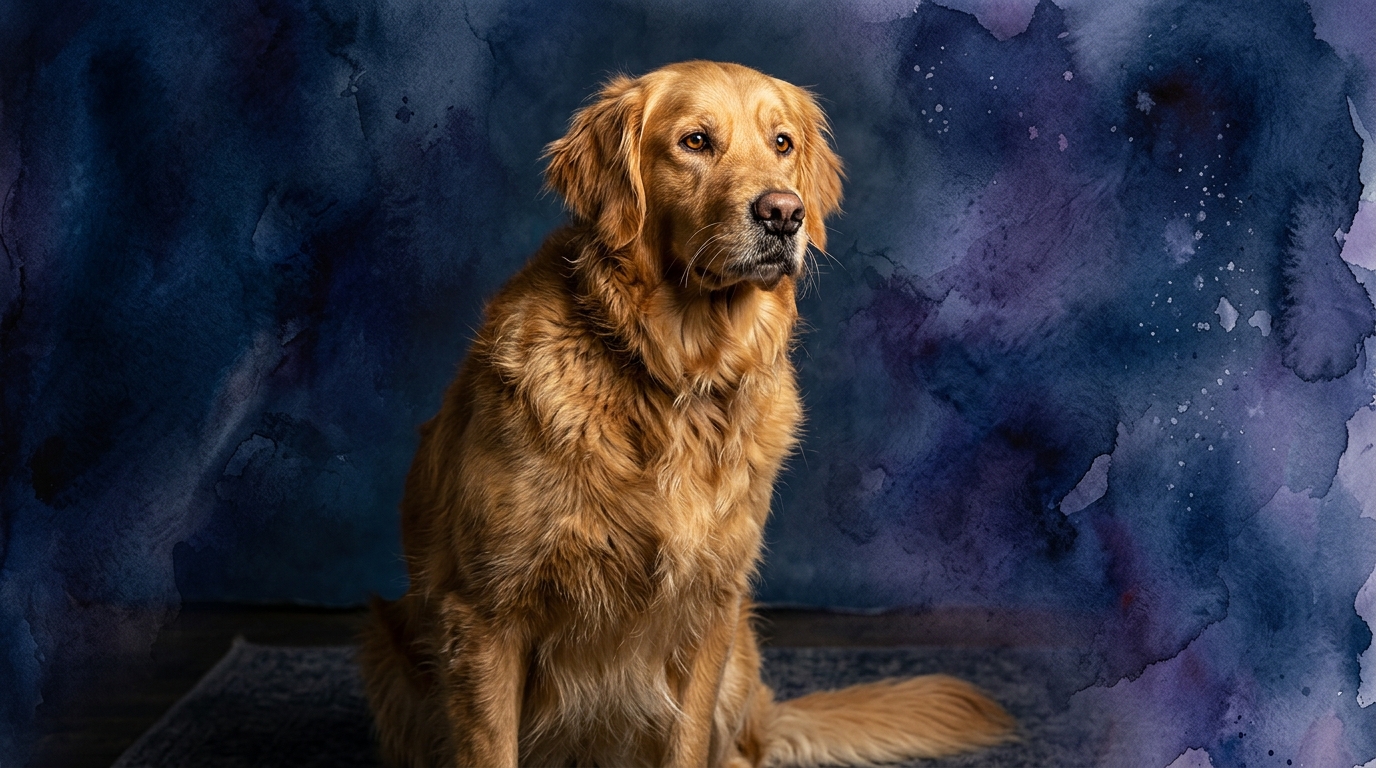

Side-by-Side IQ Profile
The Cosmic Pet Pet IQ Lab employs a five-dimensional framework to assess canine intelligence, offering a granular view of each breed's cognitive strengths. Let's delve into how the Golden Retriever and Manchester Terrier measure up across these specific dimensions.
For the **Golden Retriever (Sporting Group)**, cognitive attributes are generally oriented towards cooperation and responsiveness. Their **Problem Solving (4/5)** demonstrates a strong capacity for figuring out complex tasks, often involving human collaboration or environmental manipulation, by adapting learned strategies. **Training Speed (5/5)** is a standout feature, as these dogs typically grasp new commands and routines with remarkable quickness, making them highly responsive to consistent instruction. Their **Social Intelligence (5/5)** is exceptionally high, reflecting a profound aptitude for understanding human cues, intentions, and emotional states, fostering deep bonds. The **Instinctive Drive (4/5)** is robust, often channeled into productive tasks like retrieving or assistance work, showcasing a natural inclination towards working alongside people. Finally, their **Memory (4/5)** is solid, allowing them to recall learned commands, previous experiences, and object locations reliably.
In contrast, the **Manchester Terrier (Terrier Group)** presents a cognitive profile geared more towards independence and self-reliance. Their **Problem Solving (3/5)** involves a degree of resourcefulness, though it tends to be more independently driven, focusing on immediate environmental manipulation rather than complex, multi-step sequences requiring human input. **Training Speed (3/5)** indicates that while capable of learning, their progression often requires more repetition and patience, as their focus can be internally directed. Their **Social Intelligence (3/5)** suggests a functional understanding of social dynamics but perhaps not the same depth of human-centric empathy or cooperative drive, often preferring a more autonomous relationship. The **Instinctive Drive (3/5)** is rooted in terrier work, involving chasing small prey and independent exploration, manifesting as determined, self-directed focus. Their **Memory (3/5)** is adequate for routines and familiar environments, but recall for less salient details or complex sequential commands might require more reinforcement over time.
Where Golden Retriever Wins Cognitively
The Golden Retriever's cognitive strengths shine particularly in areas demanding cooperative effort and nuanced social understanding. Their superior social intelligence (5/5) means they are exquisitely attuned to human emotions and body language, allowing them to anticipate needs and respond with remarkable empathy. This makes them exceptional candidates for therapy work, assistance roles, and family companionship, where a deep connection and responsive interaction are paramount. Furthermore, their high training speed (5/5) means they not only learn quickly but also retain information effectively (memory 4/5), translating into consistent and reliable performance across various disciplines, from obedience to advanced competitive sports. Their problem-solving abilities (4/5) are often geared towards achieving goals that involve human collaboration, such as navigating agility courses or finding hidden objects on command, demonstrating a thoughtful approach to challenges within a structured environment. This blend of attributes makes them exceptionally adaptable to diverse human-led activities, showcasing a cognitive profile built for partnership.
Where Manchester Terrier Wins Cognitively
While not scoring as high in traditional cooperative intelligence metrics, the Manchester Terrier exhibits a distinct set of cognitive advantages rooted in its terrier heritage. Its problem-solving (3/5) and instinctive drive (3/5) manifest as a tenacious, independent spirit that thrives on self-directed tasks. These dogs are adept at assessing their immediate environment and devising singular, often clever, solutions to achieve their own objectives, such as finding a way to access a hidden toy or circumventing a barrier to explore. This breed's lower social intelligence (3/5) doesn't imply a lack of affection, but rather a cognitive wiring that prioritizes self-reliance and focused pursuit of its own interests over constant human validation. This independence can be a cognitive "win" for owners who appreciate a dog capable of entertaining itself or tackling challenges without continuous human guidance, fostering a relationship built on mutual respect for their distinct autonomies rather than constant collaboration. Their memory (3/5) is sufficient for navigating their world and recalling routines, but it's often applied to practical, self-serving knowledge rather than an extensive repertoire of human-imposed commands.
Which is Easier to Train and Why
Without question, the Golden Retriever is considerably easier to train, a direct reflection of its exceptional training speed (5/5) and social intelligence (5/5). Golden Retrievers possess an innate desire to please their human companions, making them highly motivated by praise and positive reinforcement. When a Golden Retriever learns a new command, their rapid assimilation is often driven by their strong social connection and understanding of human intent, leading to quick and enthusiastic responses. They strive for cooperation, making training sessions feel like a shared endeavor rather than a directive. In contrast, the Manchester Terrier's training speed (3/5) and social intelligence (3/5) indicate a more independent and less outwardly people-pleasing approach. While capable of learning, they require more consistent, patient, and often creative methods to maintain engagement. Their terrier instincts mean they can be easily distracted by environmental stimuli, and their independent streak means they may question the necessity of a command rather than immediately comply. Training a Manchester Terrier is more about convincing them that a task is worthwhile or fun, rather than relying on their inherent desire for human approval, making the process more demanding for the owner.
Which Suits Active Owners vs Relaxed Owners
For owners leading an active lifestyle that includes a canine companion in various adventures, the Golden Retriever often presents a more harmonious match. Their instinctive drive (4/5) is frequently channeled into activities like hiking, swimming, retrieving games, and dog sports, where their collaborative nature and robust stamina make them eager participants. They thrive on shared experiences and mental engagement that involves human interaction, making them excellent partners for energetic individuals or families. Conversely, a Golden Retriever might be too demanding for a truly relaxed owner seeking a low-maintenance companion, as their need for engagement extends beyond just physical exercise to include mental stimulation and social interaction.
The Manchester Terrier, with its instinctive drive (3/5) and independent problem-solving (3/5), can also be suitable for active owners, particularly those who enjoy activities like urban agility, Earthdog trials, or long walks where the dog can explore independently. However, their activity tends to be more self-directed and less focused on constant human collaboration. For a relaxed owner, the Manchester Terrier's need for mental stimulation, which often manifests as independent exploration or chasing, coupled with its moderate physical demands, might still prove challenging. A truly relaxed owner might find the Manchester Terrier's independent cognitive drive and occasional stubbornness a mismatch, as they still require consistent mental engagement to prevent boredom, which can lead to inventive, sometimes undesirable, self-entertainment.
The Verdict
When seeking a highly cooperative, empathetic, and rapidly trainable companion for diverse, human-centric activities, the Golden Retriever is the clear choice.
For individuals who appreciate an independent, tenacious, and clever companion capable of self-directed problem-solving, and who are prepared for a more nuanced training approach, the Manchester Terrier offers a uniquely engaging partnership.
🧠 Find Your Pet's IQ Score
Our Pet IQ Lab assessment covers 25+ tests across 5 cognitive dimensions — personalized to your breed.
Take the Full IQ Test →Frequently Asked Questions
Does the Golden Retriever's social intelligence make it better with children?
Yes, the Golden Retriever's high social intelligence (5/5) often translates to a patient, understanding, and gentle demeanor around children, making them naturally adept at navigating family dynamics with care and responsiveness. They are generally more attuned to subtle social cues, which helps them interact safely and affectionately with younger family members.
How does the Manchester Terrier's instinctive drive manifest in daily life?
The Manchester Terrier's instinctive drive (3/5) is rooted in its terrier heritage, often manifesting as a strong prey drive, a keen interest in digging, and a desire to explore independently. Owners might observe them intently focusing on squirrels, investigating small holes, or showing a persistent determination when pursuing an object of interest.
Is the difference in problem-solving significant for typical pet owners?
For typical pet owners, the difference in problem-solving (Golden Retriever 4/5 vs. Manchester Terrier 3/5) means the Golden Retriever might more readily grasp complex routines or figure out how to manipulate objects to achieve a human-desired outcome. The Manchester Terrier, while clever, might apply its problem-solving more to self-serving objectives, potentially requiring owners to be more proactive in managing environmental challenges.