
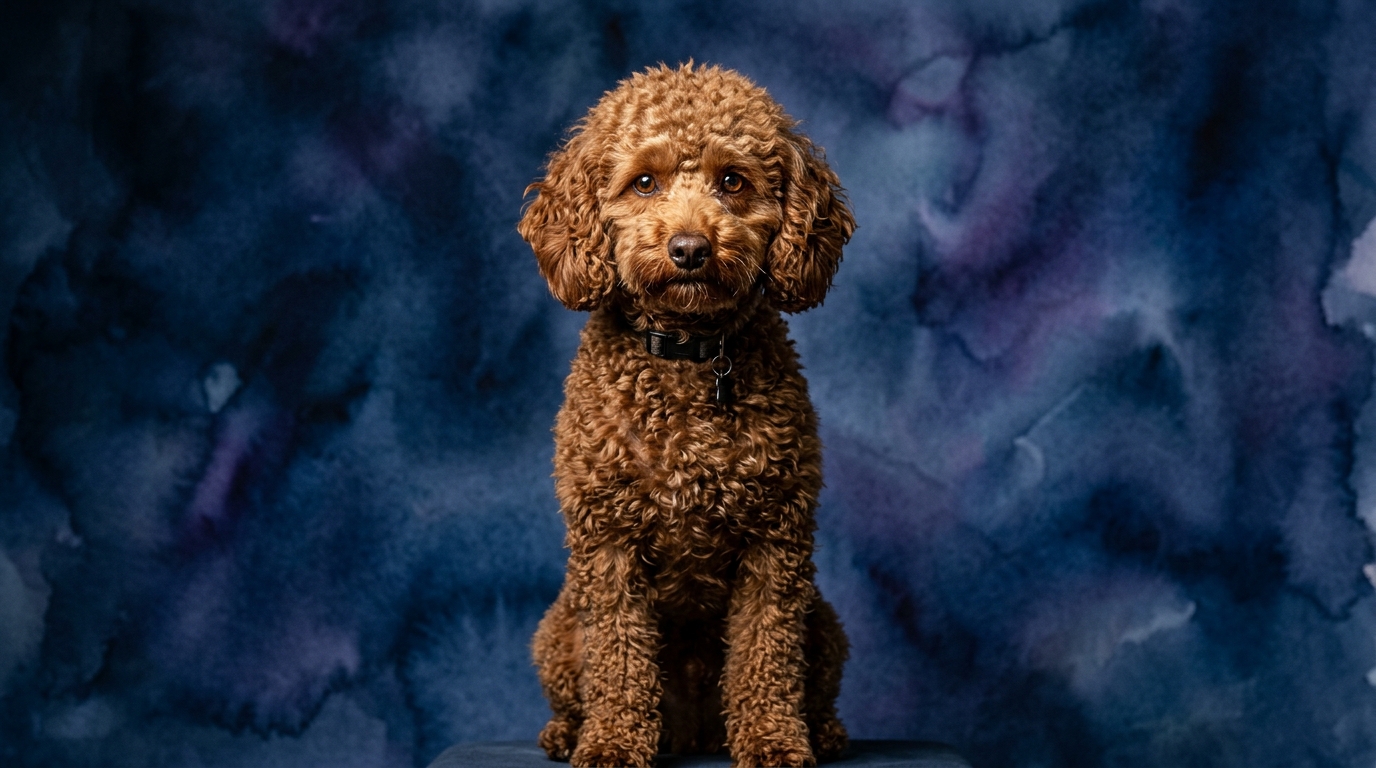
Side-by-Side IQ Profile: Golden Retriever vs. Miniature Poodle
At The Cosmic Pet Pet IQ Lab, we analyze canine cognition across five key dimensions to provide a nuanced understanding of each breed's mental landscape. While both the Golden Retriever (Coren rank #4) and the Miniature Poodle (Coren rank #2) demonstrate remarkable mental capacities, their profiles reveal distinct cognitive leanings.
The Golden Retriever’s profile highlights a balanced blend of cooperative intellect and inherent drive. Their Problem Solving is rated 4/5, indicating a strong capacity for understanding and navigating complex situations, often demonstrating ingenuity in retrieving objects or figuring out how to access desired items. Their problem-solving is often rooted in their purpose, making them adept at tasks requiring sequential actions or spatial awareness. Training Speed earns a perfect 5/5, reflecting their eagerness to please and high motivation, allowing them to grasp new commands and routines with remarkable speed, often requiring only a few repetitions to solidify a behavior. This score reflects their history as working dogs needing to follow intricate instructions. Social Intelligence is another perfect 5/5, a hallmark of the breed, demonstrating an exceptional ability to read human emotions and intentions, forming deep bonds, responding empathetically, and adapting their behavior based on social cues, making them outstanding therapy and service animals. Instinctive Drive is strong at 4/5; their retrieving instinct is a defining characteristic, driving them to carry objects, play fetch, and engage in activities that mimic their historical role, providing a powerful motivational tool for training. Finally, Memory scores 4/5, indicating a robust ability to recall learned behaviors, routines, and specific locations even after periods of inactivity, remembering people and places with clarity, contributing to their consistent performance in various roles.
The Miniature Poodle, though physically smaller, presents a formidable cognitive profile, particularly in abstract reasoning and retention. Their Problem Solving is a stellar 5/5, showcasing an outstanding ability to devise novel solutions and understand abstract concepts, often quick to outsmart puzzles or figure out how to manipulate their environment to achieve a goal. Training Speed matches the Golden at 5/5; they are extraordinarily fast learners, absorbing new commands and advanced sequences with impressive alacrity, their mental agility allowing them to master intricate tricks and multi-step tasks efficiently. Social Intelligence is rated 3/5; while capable of forming strong bonds, Miniature Poodles tend to be more discerning in their social interactions than Goldens, valuing deep connections with their chosen family but perhaps being less universally effusive. Instinctive Drive is 3/5; present but less pronounced or specialized compared to a retriever, their innate urges might not be as singularly focused on a specific task like retrieving, making their motivation more versatile but perhaps less intensely directed. Crucially, their Memory is a perfect 5/5, indicating an exceptional ability to retain vast amounts of information, including complex sequences, detailed routines, and specific associations over long periods, contributing significantly to their prowess in advanced obedience and performance sports.
Where the Golden Retriever Wins Cognitively
Golden Retrievers truly shine in areas demanding robust social cognition and a strong, directed instinctive drive. Their perfect 5/5 score in Social Intelligence means they are unparalleled at interpreting human cues, understanding emotional states, and adapting their behavior to foster harmonious interactions. This cognitive strength is evident when a Golden intuitively offers comfort, anticipates a handler's next move in a task, or patiently interacts with diverse individuals in therapeutic settings. Coupled with a 4/5 in Instinctive Drive, their natural inclination to retrieve and cooperate becomes a powerful cognitive asset. This drive isn't just about fetching a ball; it's about the innate mental framework that predisposes them to cooperative tasks, making them eager partners in activities requiring consistent engagement and a clear purpose, such as assistance work or field trials. Their cognitive architecture is geared towards partnership and purpose-driven action.
Where the Miniature Poodle Wins Cognitively
The Miniature Poodle's cognitive strengths lie in their exceptional problem-solving abilities and superior memory. Scoring a perfect 5/5 in Problem Solving, these dogs demonstrate a remarkable capacity for abstract thought and strategic reasoning. They aren't just following commands; they are often actively dissecting situations, figuring out the most efficient way to achieve a goal, or even devising novel solutions to challenges. This manifests in their ability to quickly learn complex sequential behaviors or navigate intricate agility courses with precision. Their 5/5 Memory score further amplifies this, allowing them to retain vast repertoires of commands, tricks, and routines with enduring clarity. This cognitive advantage means a Miniature Poodle can master and recall an extensive library of learned behaviors, making them exceptional candidates for advanced obedience, competitive dog sports, and even theatrical performances where intricate sequences are required. Their intellectual prowess allows for a depth of learning and retention that is truly outstanding.
Which Is Easier to Train and Why
Both breeds boast a top-tier 5/5 in Training Speed, indicating that both Golden Retrievers and Miniature Poodles assimilate new commands rapidly. However, the *nature* of their training experience can differ due to other cognitive factors. The Golden Retriever's 5/5 Social Intelligence and 4/5 Instinctive Drive often translate into a more overtly cooperative and eager-to-please training partner. They thrive on positive reinforcement and clear communication, often anticipating their handler's desires due to their strong social awareness. This makes them feel “easier” for many owners, as their motivation is often rooted in pleasing their human and engaging in shared activities.
In contrast, the Miniature Poodle's 5/5 Problem Solving and 5/5 Memory mean they excel at *understanding* complex tasks and retaining them, but their 3/5 Social Intelligence and 3/5 Instinctive Drive might mean they require a trainer who can effectively channel their mental energy and maintain engagement without relying solely on their desire to please. They might be more inclined to figure things out for themselves, potentially testing boundaries or seeking novelty, rather than always seeking direct approval. Therefore, while both learn quickly, the Golden might offer a more universally “easier” and consistently cooperative training journey for the average owner, while the Poodle might demand a more intellectually stimulating and nuanced approach to keep them engaged.
Which Suits Active Owners vs. Relaxed Owners
The choice between a Golden Retriever and a Miniature Poodle often hinges on the owner's lifestyle and what kind of engagement they seek. Golden Retrievers, with their 4/5 Instinctive Drive and 5/5 Social Intelligence, are typically best suited for active owners who relish shared outdoor adventures and consistent interaction. Their cognitive profile makes them ideal partners for long hikes, enthusiastic games of fetch, swimming, or participation in dog sports like agility and obedience. They thrive when their physical energy and social needs are met through purposeful activity alongside their human companions. A relaxed owner might find a Golden's innate drive and need for connection overwhelming if not adequately channeled.
Miniature Poodles, while also energetic and capable of high performance in sports, offer a different kind of engagement. Their 5/5 Problem Solving and 5/5 Memory make them excellent companions for owners who enjoy mental challenges, puzzle toys, and complex training routines, but might not require the same constant physical output or intensely social interaction as a Golden. They can adapt well to urban living, provided their minds are kept stimulated. While they certainly enjoy walks and playtime, a more relaxed owner who prioritizes mental stimulation over constant physical exertion might find the Miniature Poodle's cognitive preferences a better fit, as their need for intellectual engagement can be satisfied with less strenuous activity than a Golden's.
The Verdict
Choose a Golden Retriever if you seek a deeply empathetic, socially astute companion eager for shared outdoor activities and cooperative tasks, thriving on connection.
Opt for a Miniature Poodle if you prefer a clever, independent thinker who excels at complex problem-solving and retains vast knowledge, enjoying mental challenges and nuanced engagement.
🧠 Find Your Pet's IQ Score
Our Pet IQ Lab assessment covers 25+ tests across 5 cognitive dimensions — personalized to your breed.
Take the Full IQ Test →Frequently Asked Questions
Is a Golden Retriever or a Miniature Poodle better for first-time dog owners?
A Golden Retriever's high social intelligence and eagerness to please often make them a more forgiving and overtly cooperative choice for first-time owners. The Miniature Poodle's independent problem-solving might require a slightly more experienced hand to channel effectively.
Do Miniature Poodles need less exercise than Golden Retrievers?
While both are active, Miniature Poodles might thrive on more mental stimulation and structured play, potentially requiring less strenuous physical exercise than a Golden Retriever, who often needs extensive outdoor activity to satisfy their strong instinctive drive.
Which breed is generally more affectionate?
Golden Retrievers, with their perfect 5/5 Social Intelligence, are typically more universally affectionate and openly demonstrative of their bonds. Miniature Poodles form strong attachments but might be more discerning and less outwardly effusive with new people or in general social settings.