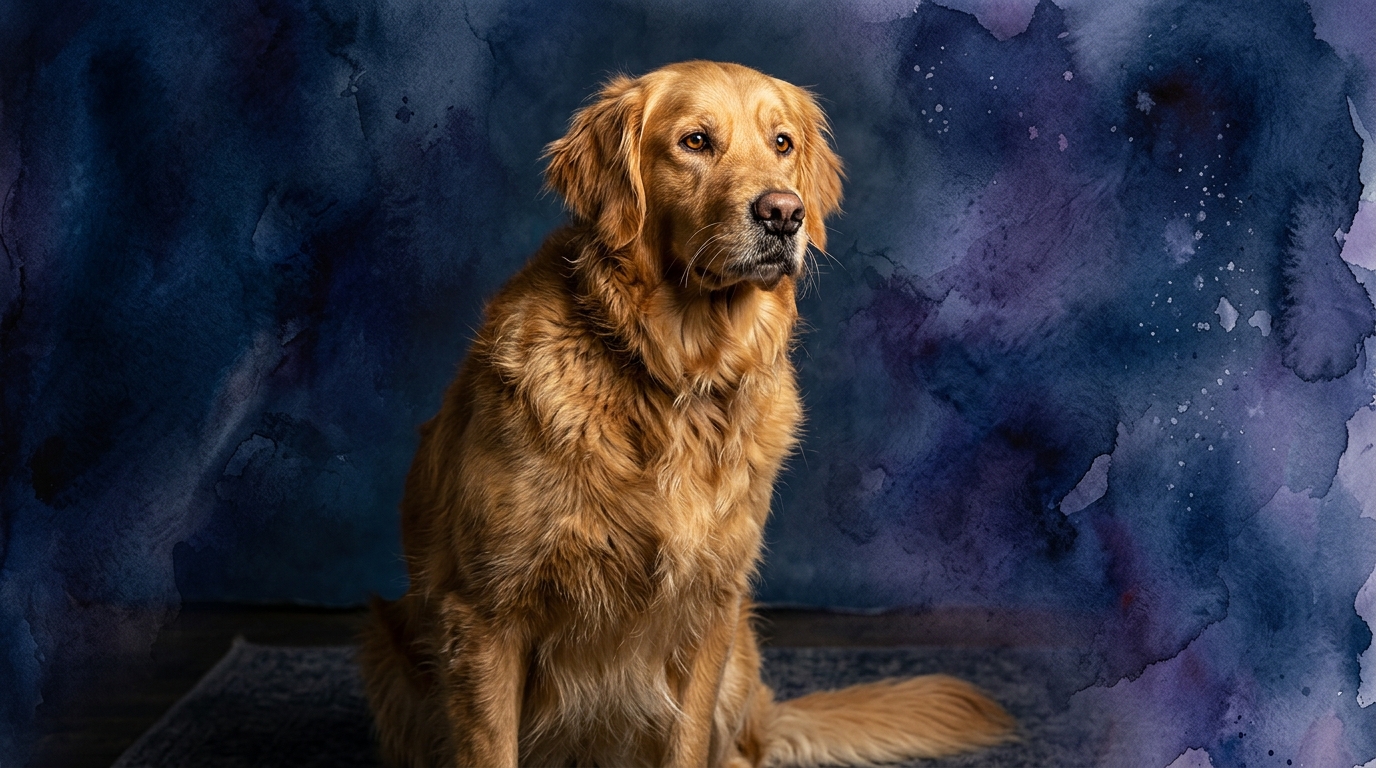
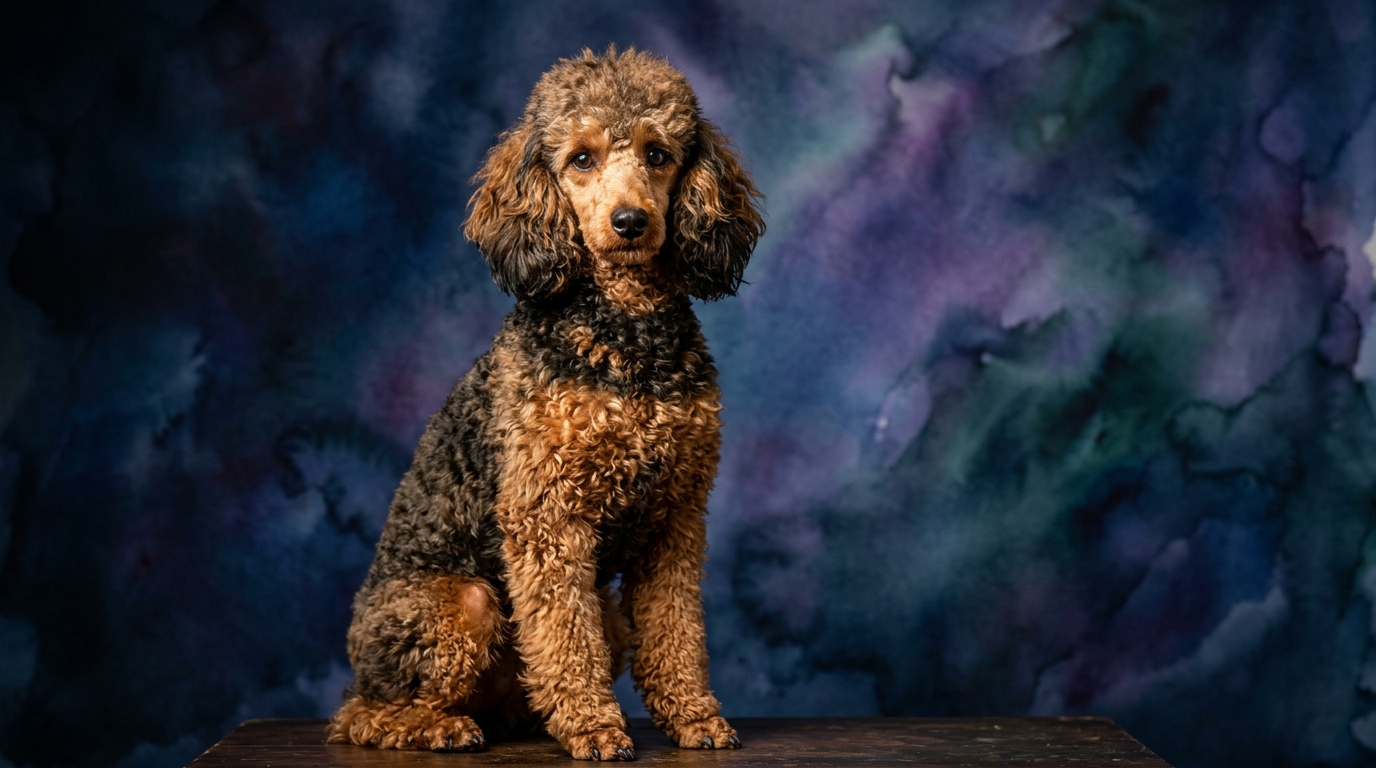
Side-by-Side IQ Profile: Golden Retriever vs. Poodle (Standard)
The Cosmic Pet Pet IQ Lab provides a structured framework for understanding canine cognition, breaking down intelligence into five key dimensions. For the Golden Retriever, a Sporting group member with a Coren rank of #4, its profile shows strong capabilities across the board. Its Problem Solving is rated at 4/5, indicating a practical capacity to navigate challenges, particularly those related to its retrieving instincts. Training Speed shines at a perfect 5/5, reflecting its eagerness and quick assimilation of new commands. Social Intelligence also reaches 5/5, underscoring its profound ability to read human cues and form deep, empathic bonds. Its Instinctive Drive stands at 4/5, speaking to its inherent motivation for tasks like fetching and tracking, while Memory is strong at 4/5, allowing it to retain learned behaviors and routines effectively.
In contrast, the Standard Poodle, classified in the Non-Sporting group and holding a Coren rank of #2, demonstrates an equally impressive, yet subtly different, cognitive makeup. Its Problem Solving capacity is rated 5/5, indicating an exceptional aptitude for analytical thought and adaptive strategies to overcome novel obstacles. Like the Golden, its Training Speed is a top-tier 5/5, signifying rapid learning and enjoyment of complex instruction. Social Intelligence also scores 5/5, highlighting its keen awareness of human emotions and social dynamics, often leading to sensitive and attentive companionship. Its Instinctive Drive is 4/5, reflecting its historical role as a water retriever and its sharp observational skills, while its Memory registers a remarkable 5/5, pointing to superior retention of intricate sequences and long-term learning.
Where the Golden Retriever Excels Cognitively
While both breeds share top scores in Training Speed and Social Intelligence, the Golden Retriever's particular blend of these traits creates a unique cognitive strength centered around cooperative engagement and an unwavering desire to please. Their 5/5 Social Intelligence manifests as an exceptional biddability and empathy; they possess an innate understanding of human intent and actively seek to align their actions with their handler's wishes. This makes them remarkably intuitive partners in activities ranging from therapy work to guiding, where anticipating human needs is paramount. Their Problem Solving at 4/5, though slightly lower than the Poodle's, is highly effective in practical, real-world scenarios, particularly those involving navigation, object retrieval, or tasks that require sustained focus and adherence to a goal set by their human companion.
Furthermore, the Golden Retriever's 5/5 Training Speed, paired with their profound social awareness, often results in a dog that seems to learn effortlessly, not just commands but also the subtle nuances of family routines and social etiquette. They are often more forgiving of handler inconsistencies due to their strong drive for cooperation, making them particularly receptive to diverse training approaches. Their Instinctive Drive (4/5) is channelled effectively into working partnerships, demonstrating a consistent motivation for retrieving games and other handler-directed activities without necessarily demanding the same level of abstract mental challenge as the Standard Poodle.
Where the Poodle (Standard) Excels Cognitively
The Standard Poodle's cognitive profile showcases an edge in analytical depth and memory, making them exceptional learners of intricate systems. Their standout 5/5 Problem Solving capability means they aren't just learning by rote; they are often analyzing situations, devising alternative strategies, and understanding abstract concepts. This enables them to excel in complex dog sports like advanced obedience, agility courses requiring multiple sequential actions, or even roles in detection and service work where independent decision-making based on learned criteria is critical. They are adept at understanding the 'why' behind commands, not just the 'what.'
Coupled with their superior 5/5 Memory, Standard Poodles can retain long and complex sequences of commands, tricks, or routines with impressive accuracy and longevity. This allows for training to build incrementally, creating a vast repertoire of learned behaviors that can be recalled reliably over time. While their Social Intelligence also rates 5/5, it often comes with a heightened sensitivity and perceptiveness, meaning they are exceptionally attuned to their environment and human moods, which can manifest as deep emotional connections but also a need for consistent, clear communication. Their 4/5 Instinctive Drive, rooted in their water retrieval heritage, further demonstrates their capacity for focused work, but it's often augmented by their higher problem-solving skills, allowing them to adapt their natural drives to a wider array of sophisticated tasks.
Which Is Easier to Train and Why?
Both Golden Retrievers and Standard Poodles score 5/5 in Training Speed, indicating that both breeds assimilate new commands quickly. However, the 'ease' of training can vary based on the owner's experience and the type of training desired. Golden Retrievers often appear easier for novice owners due to their exceptional biddability and strong desire to please, stemming from their high Social Intelligence. They are typically less prone to independent thinking that might challenge a command; their Problem Solving (4/5) is frequently directed towards satisfying their handler, making them very cooperative students. This amiable nature means they can be more forgiving of inconsistent training methods and still strive to get it 'right' for their person.
Standard Poodles, while learning just as fast, present a different kind of 'ease.' Their superior Problem Solving (5/5) and Memory (5/5) mean they quickly grasp complex concepts and can execute multi-step commands. For experienced handlers seeking to push cognitive boundaries with advanced obedience, intricate tricks, or specialized work, the Poodle's depth of intellect can make them incredibly rewarding. However, this same sharp intellect also means they are adept at identifying inconsistencies in training or handler weaknesses. A bored or under-stimulated Poodle might apply its problem-solving skills to devising undesirable behaviors, potentially making them more challenging for owners who cannot provide consistent mental engagement and structure.
Ideal Companions: Active vs. Relaxed Owners
For active owners, both breeds offer robust companionship, though their ideal activities might differ. Golden Retrievers, with their 4/5 Instinctive Drive for activity and retrieving, combined with their eager-to-please Social Intelligence (5/5), thrive on shared physical excursions. They are the quintessential partners for long hikes, swimming, fetch in the park, and dog sports like dock diving or field trials. Their practical Problem Solving (4/5) helps them navigate varied environments during these adventures, making them reliable and enthusiastic participants in family outdoor life. They genuinely enjoy being active participants alongside their human companions, soaking up the shared experience.
Standard Poodles also possess a 4/5 Instinctive Drive and are athletic, but their higher Problem Solving (5/5) and Memory (5/5) mean they flourish with mental engagement beyond just physical exertion. Active owners who enjoy teaching complex tricks, participating in dog sports requiring intricate choreography (like advanced obedience or freestyle), or engaging in scent work and puzzle toys will find the Poodle's intellect incredibly stimulating and rewarding. For the truly relaxed owner who prefers minimal mental engagement beyond basic commands, the Golden Retriever's generally more 'go-with-the-flow' temperament might be a slightly better fit, provided their physical needs are still met. A Poodle's cognitive needs are substantial; a lack of mental enrichment could lead to boredom-induced behaviors, while a Golden Retriever might more readily settle for a calmer evening after a good walk, content with proximity to their family.
The Verdict
Choose the Golden Retriever if you prioritize a universally amiable, highly cooperative companion for family life and traditional outdoor activities, valuing an eager-to-please temperament that readily adapts to shared experiences.
Opt for the Standard Poodle if you are an owner who delights in engaging a dog with complex mental challenges, thrives on advanced training, and appreciates a partner with deep analytical capabilities and a strong memory for detailed routines.
🧠 Find Your Pet's IQ Score
Our Pet IQ Lab assessment covers 25+ tests across 5 cognitive dimensions — personalized to your breed.
Take the Full IQ Test →Frequently Asked Questions
Are Golden Retrievers and Standard Poodles good with children?
Both breeds generally possess high social intelligence, making them excellent family dogs. Golden Retrievers are often celebrated for their gentle patience and affectionate nature with children. Standard Poodles are also typically tolerant and playful but may require supervision to ensure children understand their sensitive nature.
Do Standard Poodles require more grooming than Golden Retrievers?
Yes, Standard Poodles typically require more intensive grooming. Their continuously growing, non-shedding coat needs regular professional grooming every 4-6 weeks to prevent matting, along with daily brushing. Golden Retrievers have a dense double coat that sheds and requires regular brushing to manage loose hair and prevent tangles, but generally less frequent professional intervention.
Which breed is more prone to separation anxiety?
Both breeds are highly social and can develop separation anxiety if not properly conditioned to alone time or if left for excessively long periods, especially given their high social intelligence scores. Golden Retrievers often form very strong attachments and thrive on companionship. Standard Poodles, with their heightened sensitivity, can also become distressed if their social and mental needs are consistently unmet during periods of solitude.