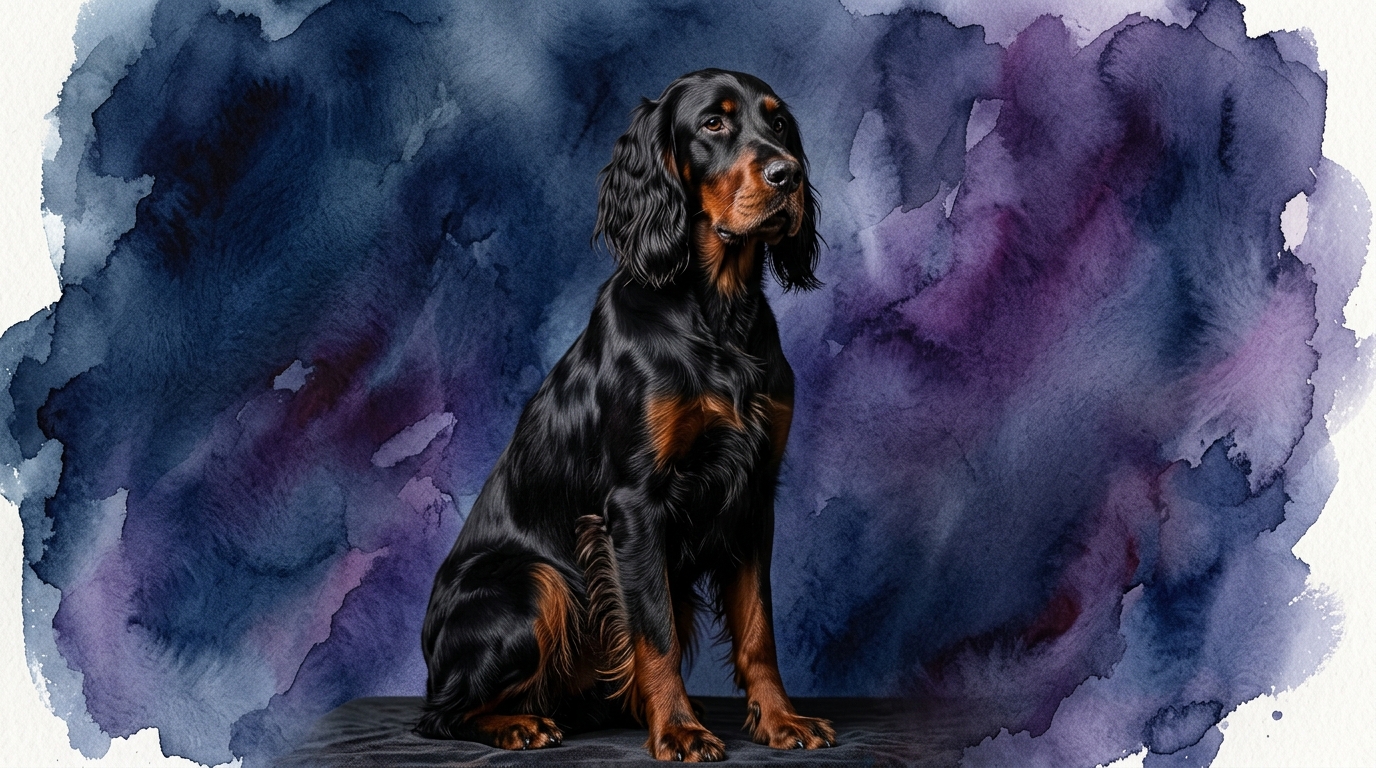

Side-by-Side Cognitive Profiles
The Gordon Setter, recognized by Stanley Coren as ranking #39 in working and obedience intelligence, presents a compelling cognitive profile. Their Problem Solving capability scores a robust 4 out of 5, indicating an aptitude for figuring out novel situations and adapting quickly to new challenges. This breed also demonstrates a Training Speed of 4 out of 5, suggesting they pick up new commands with fewer repetitions and possess an eagerness to learn. Social Intelligence for the Gordon Setter sits at 3 out of 5, meaning they understand human cues effectively, though often with a degree of independent thought. Their Instinctive Drive is also 3 out of 5, reflecting strong hunting instincts that are well-balanced with their trainability. Finally, their Memory is rated 4 out of 5, showcasing an ability to retain learned behaviors and experiences over extended periods, making them reliable in recalling past lessons.
The Wirehaired Pointing Griffon, while not specifically ranked by Coren, demonstrates a consistently practical cognitive makeup across our evaluated dimensions. Their Problem Solving ability is rated 3 out of 5, indicating they approach challenges methodically and tend to rely more on learned patterns than spontaneous innovation. For Training Speed, they score 3 out of 5, meaning they learn consistently, though they may require more repetition to ingrain new commands compared to breeds with higher scores. Social Intelligence for the Griffon is 3 out of 5, suggesting they are attuned to their handler, primarily within a working context, and less prone to engaging with complex social nuances. Their Instinctive Drive, like the Gordon Setter, is 3 out of 5, highlighting robust, practical hunting instincts and a highly focused approach to tasks. Their Memory also stands at 3 out of 5, allowing them to reliably retain commands and routines, though perhaps with less capacity for intricate detail recall compared to higher-scoring breeds.
Where the Gordon Setter Leads Cognitively
The Gordon Setter clearly demonstrates an edge in areas demanding quicker mental processing and retention. With a Problem Solving score of 4/5, they exhibit a greater capacity for independent thought and creative solutions when faced with unfamiliar obstacles. This means a Gordon Setter is more likely to assess a new environment or a puzzle toy and devise a strategy to succeed without constant human intervention, making them adept at navigating complex scenarios in the field or at home. Their superior Training Speed, also at 4/5, translates directly into efficiency during learning sessions. A Gordon Setter will generally grasp new commands and concepts more rapidly, requiring fewer repetitions to achieve proficiency in advanced obedience, trick training, or specialized field work. This allows for a broader and more varied training regimen, keeping the dog engaged and challenged. Furthermore, their 4/5 Memory score means that once a skill or command is learned, it is likely to be retained with greater fidelity over time, reducing the need for frequent refreshers and building a more extensive repertoire of learned behaviors throughout their life. This robust memory contributes to their consistent performance in tasks they have mastered, even after breaks in training.
Where the Wirehaired Pointing Griffon Excels Cognitively
While the Wirehaired Pointing Griffon's scores are consistently 3/5, this uniformity points to a balanced and practical intelligence that excels in specific contexts. Their consistent performance across all cognitive dimensions suggests a less 'fussy' or overthinking approach to tasks, which can be a distinct advantage in working environments. A Griffon's 3/5 in Problem Solving implies they are less likely to deviate from established protocols in search of a novel solution, preferring to apply learned methods efficiently. This makes them exceptionally reliable in repetitive or predictable tasks where consistency is paramount. Their 3/5 Instinctive Drive, while matching the Gordon Setter's numerical score, often manifests as an unwavering, focused application of their hunting prowess. This means a Griffon is less prone to distraction by extraneous stimuli, maintaining a steadfast dedication to their primary objective in the field, such as pointing or retrieving, without getting bogged down by complex social cues or overthinking the situation. Their practical memory and training speed, both 3/5, ensure that once a skill is learned, it is deeply ingrained and consistently applied, making them a dependable and predictable partner for dedicated hunters who value unwavering focus and methodical execution.
Training: Which Breed is Easier?
Based on their cognitive profiles, the Gordon Setter is generally considered easier to train, especially for owners looking to engage in varied and complex activities. Their 4/5 Training Speed means they will pick up new commands and routines with greater alacrity, often showing enthusiasm for learning novel tasks. This breed's 4/5 Problem Solving ability also means they can more readily generalize learned behaviors to new situations and adapt to changes in training methods or environments, making for a more flexible and responsive student. Owners of Gordon Setters often find they can progress through training levels more quickly, moving from basic obedience to advanced field work, agility, or even trick training with relative ease, due to their quicker comprehension and retention of information.
The Wirehaired Pointing Griffon, with a consistent 3/5 in both Training Speed and Problem Solving, may require a more patient and consistent approach to training. While they are certainly capable of learning and becoming highly skilled, they typically benefit from more repetition and a structured, predictable training environment. Their methodical problem-solving means they might not spontaneously offer new behaviors but will reliably perform what they have been taught. Owners should be prepared for a steady, incremental progression, focusing on clear, consistent cues and positive reinforcement to build a solid foundation. Once a Griffon has learned a command, their practical memory ensures it is deeply ingrained, leading to a highly dependable working partner, even if the initial learning phase takes a bit longer.
Matching Breeds to Lifestyles: Active vs. Relaxed Owners
Both the Gordon Setter and the Wirehaired Pointing Griffon are breeds that demand an active lifestyle; neither is suited for truly relaxed or sedentary owners. However, their cognitive differences subtly influence the *type* of activity they thrive on. The Gordon Setter, with its higher problem-solving and memory scores, often appreciates and benefits from a wider variety of mentally stimulating activities beyond just physical exercise. Owners who enjoy engaging their dog in complex training routines, advanced obedience, scent work, or even dog sports like agility will find the Gordon Setter's cognitive flexibility and eagerness to learn highly rewarding. They thrive with owners who can offer diverse challenges that tap into their adaptable intelligence, making them excellent companions for those who love to explore new hobbies with their canine partner.
The Wirehaired Pointing Griffon, while equally energetic, tends to flourish with owners who appreciate a consistent, purposeful application of their strong instinctive drives. Their practical intelligence makes them ideal for dedicated hunters or individuals who enjoy structured outdoor activities that mimic their natural working roles. Owners who provide regular opportunities for field work, long hikes with a purpose, or consistent training drills will find the Griffon to be a steadfast and focused partner. While they can participate in other activities, their cognitive makeup often means they are most content when performing tasks that align with their inherent purpose, offering a dependable and less 'fussy' companion for owners who value consistency and direct application of their dog's abilities.
The Verdict
Choose the Gordon Setter if you seek a cognitively adaptable companion who learns quickly, enjoys diverse mental challenges, and thrives on varied training activities.
Opt for the Wirehaired Pointing Griffon if you value a consistent, reliable working partner with a practical intelligence, excelling in focused, purposeful activities and requiring a steady, patient training approach.
🧠 Find Your Pet's IQ Score
Our Pet IQ Lab assessment covers 25+ tests across 5 cognitive dimensions — personalized to your breed.
Take the Full IQ Test →Frequently Asked Questions
Are Gordon Setters good for first-time dog owners?
Gordon Setters can be suitable for first-time owners who are prepared for their energy levels and eager to engage in consistent training, benefiting from their quicker learning speed and adaptability. Their cognitive flexibility means they can adjust well to various home environments with dedicated guidance.
Do Wirehaired Pointing Griffons need a lot of grooming?
Wirehaired Pointing Griffons have a coarse, protective coat that requires regular grooming, including weekly brushing to prevent matting and occasional hand-stripping to maintain coat texture. This helps keep them clean and comfortable, especially after time spent in the field.
Which breed is more independent?
Both breeds possess a degree of independence characteristic of sporting dogs, but the Gordon Setter's higher problem-solving score suggests a slightly greater propensity for independent thought and action. The Wirehaired Pointing Griffon's consistent 3/5 in social intelligence often translates to a focused handler-attunement within a working context, making them dedicated partners in their primary activities.