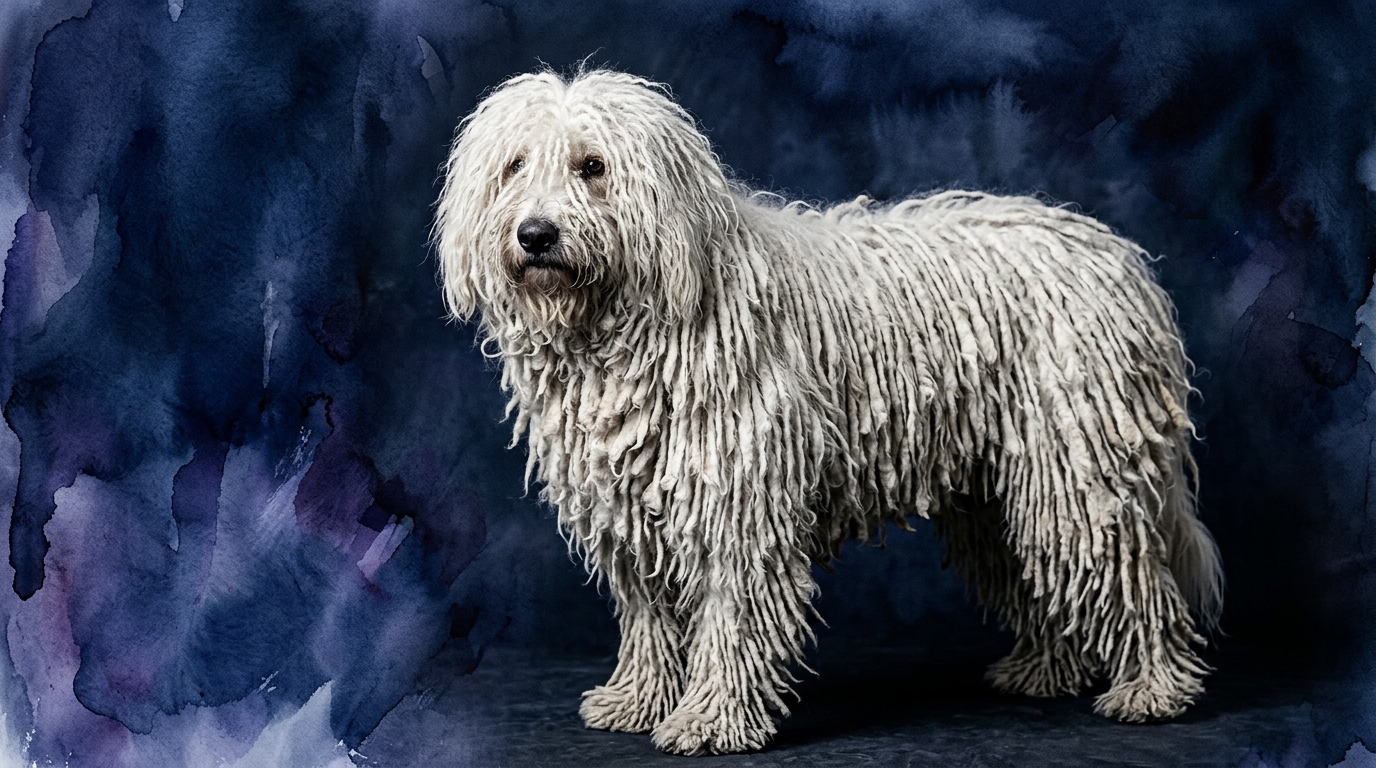

Side-by-Side Cognitive Profile: Komondor vs. Boerboel
The Cosmic Pet Pet IQ Lab assesses canine intelligence across five key dimensions, providing a granular view of a breed’s cognitive makeup. While both the Komondor and Boerboel register identical scores, their application of these abilities is profoundly distinct, reflecting their ancestral duties.
For the **Komondor**, a venerable livestock guardian, its cognitive scores manifest as follows:
**Problem Solving (3/5)**: Excelling in autonomous decision-making, this breed historically assessed livestock threats without direct human command. Their problem-solving involves independent judgment, weighing actions in isolation.
**Training Speed (3/5)**: While capable, the Komondor's independence means it processes commands with self-assessment, often questioning necessity before compliance. This reflects a deliberate, thoughtful approach.
**Social Intelligence (3/5)**: Their social acumen discerns friend from foe within their flock and human family, exhibiting protective yet somewhat aloof behavior towards strangers. They form deep bonds but aren't universally gregarious.
**Instinctive Drive (3/5)**: The Komondor's core drive is livestock protection, manifesting as inherent vigilance and a strong territorial imperative. This deeply ingrained instinct guides their watchful nature.
**Memory (3/5)**: They possess robust memory for routines, commands, and especially for individuals and places within their perceived territory. This aids their long-term guarding efficacy.
The **Boerboel**, a formidable South African farm guardian, demonstrates its cognitive strengths through a different lens:
**Problem Solving (3/5)**: Boerboel problem-solving often involves assessing threats to its human family and property, requiring quick, decisive judgment. Their approach is direct and practical, focused on immediate security concerns.
**Training Speed (3/5)**: This breed learns effectively with strong leadership and clear expectations, processing information with focused intensity. Training speed is influenced by their desire to please primary family members.
**Social Intelligence (3/5)**: Boerboels display profound social intelligence centered around their family unit, discerning moods and intentions accurately. While protective, they are reserved with outsiders.
**Instinctive Drive (3/5)**: Their primary drive is family and property guardianship, manifesting as unwavering loyalty and powerful protective instinct. This fundamental aspect influences responses to perceived threats.
**Memory (3/5)**: Boerboels demonstrate excellent memory for family members, established routines, and territorial boundaries. This strong recall supports consistent protective duties.
Where the Komondor Excels Cognitively
Komondors exhibit a distinct cognitive advantage in independent problem-solving and self-reliance, a mental strength honed by centuries of solitary livestock guarding. Unlike many breeds that rely on human directives, a Komondor is wired to analyze complex situations and make autonomous decisions, often without immediate human command. This manifests as superior situational awareness in dynamic, unsupervised environments, such as a large pasture where threats can emerge unexpectedly. Their memory is particularly adept at retaining intricate territorial maps and identifying subtle changes within their domain, a crucial element for effective, unassisted protection. The Komondor's Coren ranking of #67, while not an IQ score, suggests a capacity for understanding and executing obedience commands, albeit with their characteristic deliberation, which itself is a cognitive strength reflecting their ability to assess the value and necessity of a command before compliance.
Where the Boerboel Excels Cognitively
The Boerboel shows a particular cognitive edge in practical, family-centric problem-solving and a profound social intelligence deeply integrated with its human pack. Their problem-solving is often rooted in immediate, decisive action to protect their family and property, requiring rapid assessment and a robust understanding of social dynamics within the household. This breed's social intelligence allows them to interpret human emotions and intentions with remarkable accuracy, fostering a strong, responsive bond with their owners. Their instinctive drive for guardianship is channeled directly into family protection, demanding a specific kind of cognitive agility: one focused on quick, unwavering response and loyalty rather than the Komondor's more detached, independent vigilance. This makes them highly attuned to their family's needs and perceived threats within that specific context.
Ease of Training: Behavioral Differences
Determining which breed is "easier" to train depends heavily on the owner's experience and desired outcomes. With both scoring 3/5 in training speed, neither is inherently a quick study in the traditional sense, but their approaches differ significantly. The Komondor, despite its Coren ranking, often exhibits independent thought during training; it will learn, but its compliance stems from a logical understanding of a command's value rather than simple eagerness to please. This demands patience, consistency, and an ability to convince the Komondor the command is worthwhile. The Boerboel, while equally robust in will, often demonstrates a stronger desire to work *with* its human family, potentially making it more receptive to reward-based training and consistent leadership. Its powerful protective instincts mean early, consistent socialization is paramount; without it, training becomes challenging due to inherent wariness. For an experienced owner establishing clear leadership, the Boerboel might feel more responsive in daily obedience. The Komondor requires an owner who respects its independent nature and values thoughtful, deliberate compliance.
Suitability for Active vs. Relaxed Owners
Neither the Komondor nor the Boerboel fits the mold of a truly "relaxed" owner's companion, as both are working breeds requiring substantial mental and physical engagement. However, their specific needs diverge. An active owner for a Boerboel means someone deeply committed to consistent training, extensive socialization, and structured physical activity to channel its formidable protective drive constructively. Boerboels thrive on purpose and being an integral part of their family's activities, demanding a proactive approach to management and interaction. For a Komondor, "active" might mean an owner who provides ample space for patrolling, respects its independent nature, and offers mental stimulation through problem-solving tasks rather than constant, direct interaction. While they need regular exercise, Komondors are content to observe and guard their domain, suitable for owners appreciating a self-sufficient companion. Owners seeking constant direct engagement might find the Boerboel more fulfilling, while those appreciating a watchful, independent guardian might lean towards the Komondor.
The Verdict
Select the Komondor if you value an independent, self-reliant guardian capable of autonomous decision-making and possess the patience to work with its thoughtful, deliberate nature. This breed thrives with owners who respect its ancient purpose and can provide a secure, expansive territory to patrol.
Opt for the Boerboel if you seek a deeply loyal, family-centric protector willing to work closely with a confident, consistent leader, and you are prepared for extensive socialization and training demands. This breed flourishes with active owners who integrate them fully into their daily lives and provide plenty of structured activity.
🧠 Find Your Pet's IQ Score
Our Pet IQ Lab assessment covers 25+ tests across 5 cognitive dimensions — personalized to your breed.
Take the Full IQ Test →Frequently Asked Questions
How does their Coren ranking impact their intelligence comparison?
The Komondor's Coren rank of #67 suggests it's generally more responsive to obedience training than many other breeds, indicating a specific type of cognitive processing. The Boerboel's unranked status doesn't imply lower intelligence but rather that it may not fit traditional obedience measures as readily, often requiring a different training approach.
Do their guarding instincts affect their social intelligence scores?
Yes, their guarding instincts profoundly shape their social intelligence. Both breeds score 3/5, but the Komondor's social intelligence is geared towards independent discernment of threats, while the Boerboel's is focused on its immediate family unit, leading to distinct social behaviors.
Given identical IQ scores, what's the most significant differentiator for owners?
The most significant differentiator is their approach to independence versus partnership. Komondors are inherently more self-reliant and make autonomous decisions, whereas Boerboels, while strong-willed, are more inclined to work in close partnership with and under the direction of their human family.