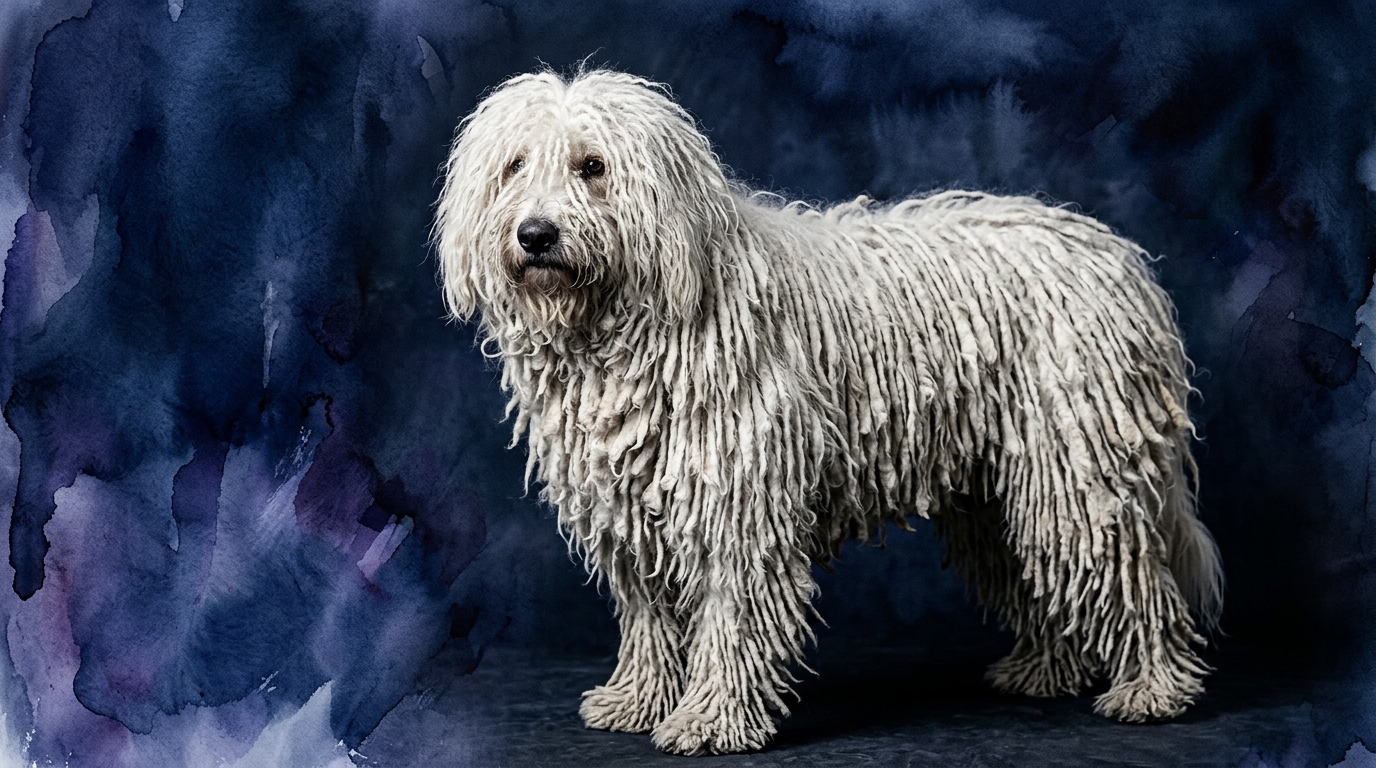

Side-by-Side IQ Profile: Komondor
The Komondor's cognitive makeup, reflected in its consistent 3/5 scores across the board, is profoundly shaped by its ancient role as a livestock guardian. Its Problem Solving (3/5) isn't about learning complex tricks, but about assessing dynamic situations involving perceived threats and making autonomous decisions to protect its flock or family. This involves nuanced situational judgment, often without direct human command, rather than rote memorization or simple obedience. Training Speed (3/5) indicates an independent thinker; the Komondor isn't inherently eager to please in the conventional sense. Training requires immense patience, consistency, and a deep understanding of their guardian mindset, framing commands as collaborative efforts rather than direct orders, as they respond best when they perceive the logic and value in an action. Social Intelligence (3/5) means they are highly discerning, forming deep bonds with their family unit but naturally wary and reserved with strangers, a critical trait for a guardian whose role is to identify friend from potential foe. Their Instinctive Drive (3/5) is dominated by a powerful guarding instinct, manifesting as strong territoriality, vigilance, and an unwavering protective urge towards their perceived flock or family members. Finally, their Memory (3/5) is excellent for recalling family members, routines, and perceived threats or safe zones, allowing them to apply past learning to future security situations with remarkable consistency.
Side-by-Side IQ Profile: Redbone Coonhound
In stark contrast, the Redbone Coonhound's 3/5 cognitive scores are intricately linked to its heritage as a dedicated scent hound. Its Problem Solving (3/5) excels in the field, where it must decipher complex scent trails, navigate varied terrain, and persist through obstacles to locate quarry. This is an adaptive, sensory-driven form of intelligence, requiring the interpretation of subtle environmental cues and olfactory data. Training Speed (3/5), while present, is often tempered by its powerful scent drive. While capable of learning commands, a Redbone can be single-minded when on a compelling trail, making consistent recall or focus on human commands a significant challenge against its innate instincts. Social Intelligence (3/5) sees them generally affable and sociable within their family, but their primary 'social' focus in the field is cooperative hunting with human partners or other hounds, prioritizing the shared goal of pursuit. Their Instinctive Drive (3/5) is overwhelmingly dominated by scent and the unwavering desire to track. This manifests as a relentless pursuit, distinctive vocalization (baying), and an innate, powerful urge to follow a trail to its conclusion. Their Memory (3/5) is exceptional for scents and terrain, allowing them to retrace complex paths or recognize familiar hunting grounds and the nuances of various quarry scents over time.
Where the Komondor Wins Cognitively
The Komondor's cognitive strengths shine brightest in scenarios demanding independent judgment and protective discernment, a testament to its livestock guardian heritage. Their 3/5 problem-solving isn't about solving abstract puzzles for treats, but about assessing dynamic situations involving perceived threats to their charge or territory. Unlike many breeds that might defer entirely to human command in uncertain situations, a Komondor is uniquely wired to make autonomous, real-time decisions to protect its flock or family. This manifests as a nuanced ability to differentiate between a harmless visitor and a genuine intruder, a sophisticated application of their social intelligence score. Their memory serves to recall past interactions and apply learned caution, making them proactive, rather than merely reactive, guardians. This self-reliant vigilance, where they take initiative in security matters and act decisively based on their assessment, is a unique cognitive advantage tailored precisely for their historical role and a hallmark of their specific form of intelligence.
Where the Redbone Coonhound Wins Cognitively
Conversely, the Redbone Coonhound demonstrates a distinct cognitive superiority in the realm of complex sensory processing and persistent, goal-directed pursuit. Their 3/5 problem-solving is a masterclass in interpreting a vast array of olfactory information, piecing together a scent puzzle across varied environments, over diverse terrains, and often over extended periods. This isn't just about following a linear path; it involves discriminating between fresh and old scents, identifying specific animal tracks amidst a cacophony of other smells, and adapting their strategy based on environmental cues like wind direction or ground cover. Their instinctive drive, also rated 3/5, fuels an unparalleled stamina and single-mindedness in tracking, allowing them to maintain intense focus for hours, ignoring distractions that would deter other breeds. This specialized cognitive wiring for intricate trail work and sustained hunting effort, deeply rooted in their evolutionary purpose, is where the Redbone truly excels, showcasing a profound connection between their olfactory memory and their relentless pursuit drive.
Training Dynamics: Komondor vs. Redbone Coonhound
When it comes to training ease, both breeds present unique challenges despite their identical 3/5 training speed rating, making a blanket statement difficult. The Komondor's independence, a direct result of its self-reliant guarding role, means it's not naturally inclined to blindly obey. Training a Komondor requires an owner who can earn its respect and frame commands as mutually beneficial agreements rather than strict orders. They respond best to consistent, fair methods and can be stubborn if they don't perceive the value or logic in a command. Their problem-solving is geared towards autonomous decision-making, not compliance with repetitive drills. In contrast, the Redbone Coonhound's primary training hurdle is its overwhelming instinctive drive and powerful nose. While generally good-natured, once a Redbone catches a compelling scent, all other stimuli, including human commands, can fade into the background. Recall can be particularly challenging outdoors, as their memory and problem-solving are focused on tracking rather than returning to their handler. Therefore, for an owner seeking a highly biddable companion for obedience sports, neither is an obvious choice. However, for a novice, the Komondor's willful independence might be a steeper learning curve than managing a Redbone's scent-driven distractions, provided the Redbone is given ample outlets for its natural drives.
Suitability for Active vs. Relaxed Owners
The activity levels and engagement styles required by these breeds diverge significantly. The Komondor, despite its large size, is not a hyperactive dog requiring constant, vigorous exercise. Its activity is more purposeful: patrolling its territory, supervising its family, and engaging in moderate walks. It thrives with owners who can provide a secure, spacious environment where it can fulfill its guardian instincts, coupled with consistent mental stimulation. While it appreciates a relaxed indoor environment with its family, it's not suited for a truly 'relaxed' owner who cannot provide confident leadership and a sense of purpose. Its independence means it needs an owner who understands its unique psychological makeup and can integrate it into the family structure as a respected protector. The Redbone Coonhound, however, is unequivocally a breed for active owners. Its boundless energy, stemming from its hunting heritage, demands substantial daily exercise, including opportunities for long, vigorous runs or hikes. Crucially, they need outlets for their powerful scent drive, such as scent work, tracking games, or secure off-leash exploration in appropriate environments. A relaxed owner will quickly find themselves overwhelmed by a Redbone's unmet energy and vocalizations. This breed suits those who enjoy outdoor activities and are prepared to engage with their dog's natural instincts through consistent training and physical exertion.
The Verdict
Choose a Komondor if you are an experienced, confident owner seeking a profoundly loyal and independent guardian, prepared to respect its autonomous nature and provide a secure, stable environment for its protective instincts to flourish. You must appreciate a dog that thinks for itself and values its family above all else.
Opt for a Redbone Coonhound if you are an active, outdoors-loving individual or family, eager to engage with a dog's powerful scent drive and energy, and committed to providing extensive exercise and mental stimulation through tracking or similar activities. You must be prepared for their vocalizations and single-mindedness on a trail.
🧠 Find Your Pet's IQ Score
Our Pet IQ Lab assessment covers 25+ tests across 5 cognitive dimensions — personalized to your breed.
Take the Full IQ Test →Frequently Asked Questions
Are Komondors good with children?
Komondors can be devoted family protectors, often gentle with children within their established 'flock.' However, their guardian instincts mean they need early socialization and supervision, as they may be wary of unfamiliar children or boisterous play that they perceive as a threat to their family.
Do Redbone Coonhounds bark a lot?
Redbone Coonhounds are known for their distinctive 'baying' vocalizations, which are an integral part of their hunting heritage. While they don't bark incessantly without reason, they will bay to alert, express excitement, or when on a scent, making them less suitable for quiet urban living.
Can either breed live in an apartment?
Neither breed is ideally suited for apartment living. The Komondor needs space to patrol and a secure yard for its protective nature, while the Redbone Coonhound requires extensive exercise and outlets for its powerful scent drive, which are challenging to provide in a confined space.