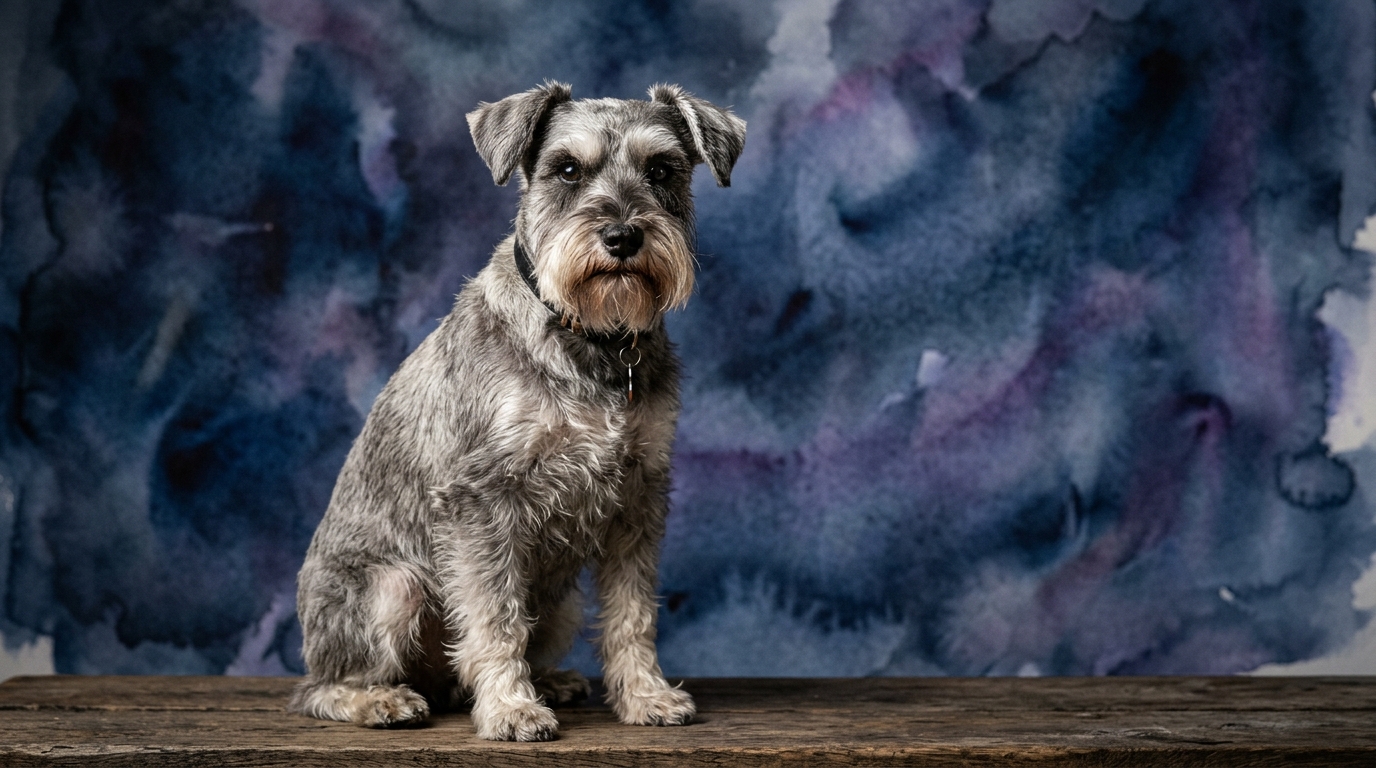
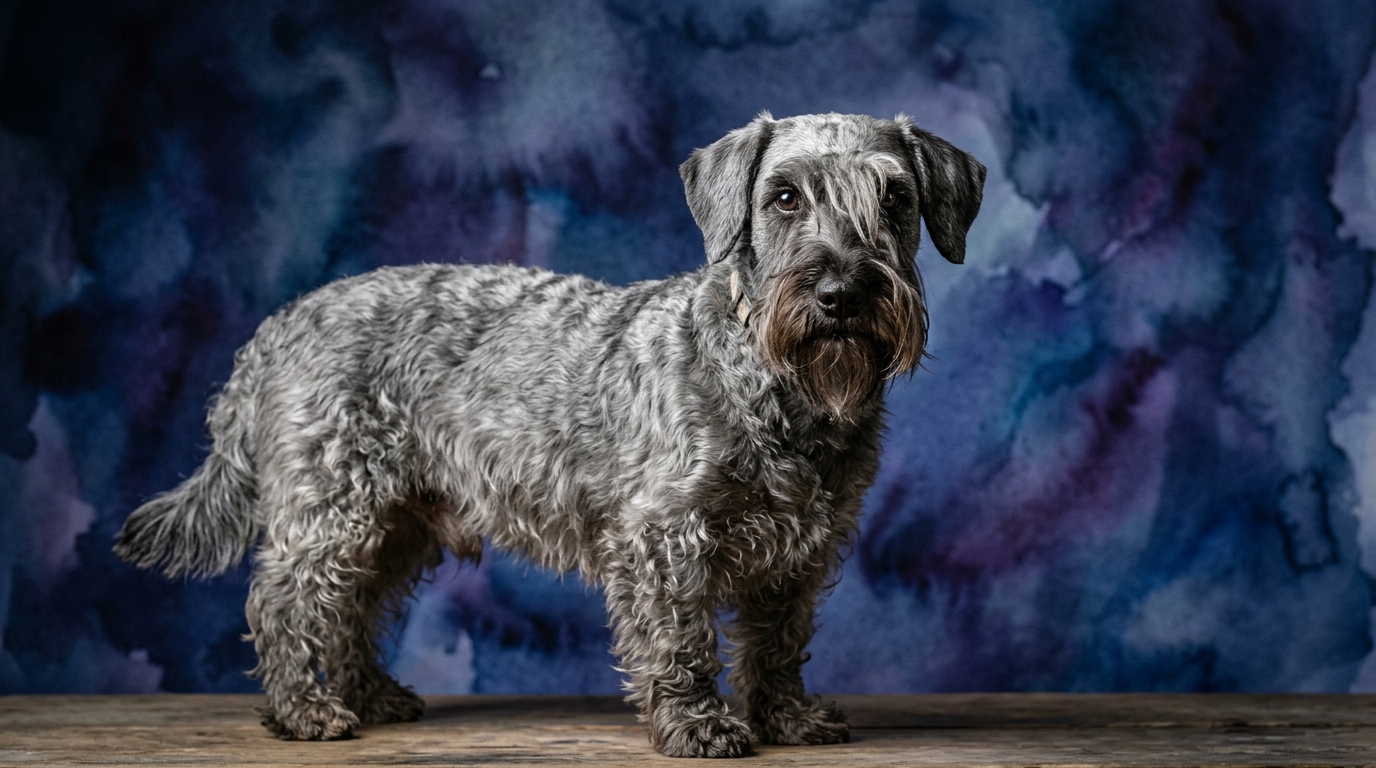
Side-by-Side IQ Profile: Miniature Schnauzer vs. Cesky Terrier
The Cosmic Pet Pet IQ Lab employs five key dimensions to evaluate canine intelligence, offering a nuanced understanding of a breed's cognitive strengths. For the Miniature Schnauzer, these scores paint a picture of a quick-witted and adaptable companion, while the Cesky Terrier presents a more deliberate, perhaps less outwardly demonstrative, cognitive style.
The Miniature Schnauzer, recognized by Coren as rank #12, exhibits a Problem Solving score of 4/5. This indicates a strong capacity to independently navigate novel situations and figure out solutions, often through trial and error or by applying learned concepts. Their Training Speed is an impressive 5/5, suggesting they rapidly form associations between commands and actions, requiring minimal repetitions to master new skills. Social Intelligence, rated 4/5, points to their adeptness at interpreting human cues and adapting their behavior accordingly, fostering strong bonds. An Instinctive Drive of 4/5 highlights a robust inherent motivation for typical terrier pursuits like chasing or digging, but often manageable within a household setting. Finally, their Memory at 4/5 signifies a reliable retention of learned information and routines.
The Cesky Terrier, not included in Coren's ranking, shows a more uniform cognitive profile across the board. Their Problem Solving score of 3/5 suggests they can resolve challenges, but might take a more considered approach or require more guidance than a Miniature Schnauzer. Training Speed also stands at 3/5, meaning they are capable of learning new commands, but typically require more patience and consistency in training sessions to solidify behaviors. Social Intelligence at 3/5 implies they are aware of human interactions but might interpret complex social signals less readily, often preferring a more straightforward engagement. Their Instinctive Drive, also 3/5, suggests a present but generally more moderate expression of typical terrier instincts, making them potentially less intense in their pursuit of prey or digging. A Memory score of 3/5 indicates they retain information effectively, particularly with consistent reinforcement, but might not recall as swiftly or broadly as a breed with higher scores.
Where Miniature Schnauzer Wins Cognitively
The Miniature Schnauzer's cognitive profile demonstrates a clear advantage in areas demanding quick uptake and flexible application of knowledge. Their 5/5 Training Speed means they absorb new commands and routines with remarkable efficiency, making complex sequences or advanced obedience work more accessible. This rapid learning translates directly into a broader behavioral repertoire, allowing them to adapt quickly to new environments or expectations, such as different household rules or travel scenarios.
Furthermore, their 4/5 Problem Solving capacity allows them to tackle cognitive challenges with greater independence. Owners often observe Schnauzers strategizing to retrieve a toy from under furniture or figuring out how to open a gate, demonstrating an intrinsic drive to overcome obstacles. This self-reliance in problem-solving, combined with a 4/5 Social Intelligence, enables them to navigate intricate family dynamics and respond appropriately to nuanced human emotions, making them highly responsive and interactive companions.
Where Cesky Terrier Wins Cognitively
While the Cesky Terrier's scores might appear lower, their specific cognitive profile offers unique advantages, particularly for owners seeking a more composed terrier presence. Their 3/5 Instinctive Drive, for instance, means they possess the inherent terrier tenacity but often express it with less intensity than many other breeds in the group, including the Miniature Schnauzer. This can translate to a more manageable prey drive in urban settings or a reduced inclination for relentless digging, offering a calmer daily dynamic.
The Cesky's 3/5 scores in Problem Solving and Training Speed, while indicating a more measured approach, also suggest a certain steadfastness. They may take longer to grasp new concepts, but once learned, these behaviors are often deeply ingrained, leading to a reliable and consistent performance over time. Their 3/5 Social Intelligence, while less overtly demonstrative, often results in a more stable and less reactive temperament; they are observant but not always driven to actively intervene in complex social situations, preferring a calm presence rather than constant engagement. This can be a cognitive 'win' for owners who appreciate a dog that is less prone to over-analysis of subtle human cues and more content with a predictable routine.
Which is Easier to Train and Why
Based on their cognitive profiles, the Miniature Schnauzer is generally easier to train than the Cesky Terrier, primarily due to their superior Training Speed (5/5 vs. 3/5). A Miniature Schnauzer will typically grasp a new command or trick in significantly fewer repetitions, often showing understanding after just a handful of attempts. This makes them highly rewarding for owners who enjoy teaching complex sequences or participating in dog sports like agility or obedience, where quick learning is paramount. Their 4/5 Memory also ensures that once a command is learned, it is reliably retained.
The Cesky Terrier, with a 3/5 Training Speed, requires a more patient and consistent approach. They are not incapable of learning, but they need more repetition and a clear, unwavering method to solidify new behaviors. Owners might find that while a Schnauzer picks up 'sit' in one session, a Cesky might need several, spread across a few days, to truly internalize it. Their slightly lower Social Intelligence also means they might be less inclined to 'people-please' and require stronger motivation, often food-based, to maintain engagement during training sessions. Success with a Cesky hinges on consistency, positive reinforcement, and understanding that progress may be slower, but ultimately durable.
Which Suits Active Owners vs. Relaxed Owners
For active owners who thrive on engagement and mental stimulation, the Miniature Schnauzer presents an excellent match. Their 4/5 Problem Solving and 4/5 Instinctive Drive mean they flourish with consistent mental challenges, structured training, and opportunities to apply their intelligence. They enjoy learning new tricks, participating in dog sports, or engaging in complex puzzle toys. A Schnauzer's high energy and desire for interaction necessitate an owner who can commit to daily walks, training sessions, and varied activities to prevent boredom and channel their cognitive energy constructively. Their robust social intelligence makes them eager participants in family life and outings.
The Cesky Terrier, with its more moderate cognitive scores across the board, including a 3/5 Instinctive Drive, tends to be a better fit for more relaxed owners, provided their needs for routine activity are still met. While they still require regular exercise and mental engagement to prevent stagnation, they are generally less demanding in terms of constant high-intensity activity or complex intellectual tasks. A Cesky often appreciates consistent walks, predictable routines, and calm companionship. Their slightly lower Social Intelligence might mean they are content to observe rather than always be the center of attention, making them suitable for households where a dog's presence is valued without the expectation of constant, overt interaction. They are adaptable but thrive in a more predictable, serene environment.
The Verdict
Choose the Miniature Schnauzer if you seek a highly trainable, quick-witted companion eager to engage in complex learning and problem-solving activities, thriving on constant mental stimulation and social interaction.
Opt for the Cesky Terrier if you appreciate a more steadfast and moderately driven terrier, willing to learn at a deliberate pace and offer a calmer, more consistent presence, fitting well into a predictable, less intensely active household.
🧠 Find Your Pet's IQ Score
Our Pet IQ Lab assessment covers 25+ tests across 5 cognitive dimensions — personalized to your breed.
Take the Full IQ Test →Frequently Asked Questions
How does Coren's ranking relate to these IQ scores?
Coren's ranking primarily assesses a dog's working and obedience intelligence, aligning closely with our 'Training Speed' dimension. The Miniature Schnauzer's #12 rank reflects their exceptional ability to learn commands quickly, while the Cesky Terrier's absence from this list simply means they haven't been as widely studied or recognized in that specific context, not that they lack intellect.
Do these intelligence scores mean one breed is 'smarter' than the other overall?
These scores highlight different cognitive strengths and learning styles, rather than an absolute measure of 'smartness.' The Miniature Schnauzer demonstrates quicker learning and problem-solving, while the Cesky Terrier's profile suggests a more deliberate, perhaps less intense, approach to cognitive tasks, which can be advantageous in different living situations and for different owner preferences.
Can training improve a Cesky Terrier's 'Training Speed' score?
Consistent, positive reinforcement training can absolutely enhance a Cesky Terrier's ability to learn and respond to commands, making them more proficient. While their inherent 'Training Speed' might remain a 3/5, effective training methods can maximize their potential, improve their responsiveness, and strengthen their memory for learned behaviors, making them capable and well-behaved companions.