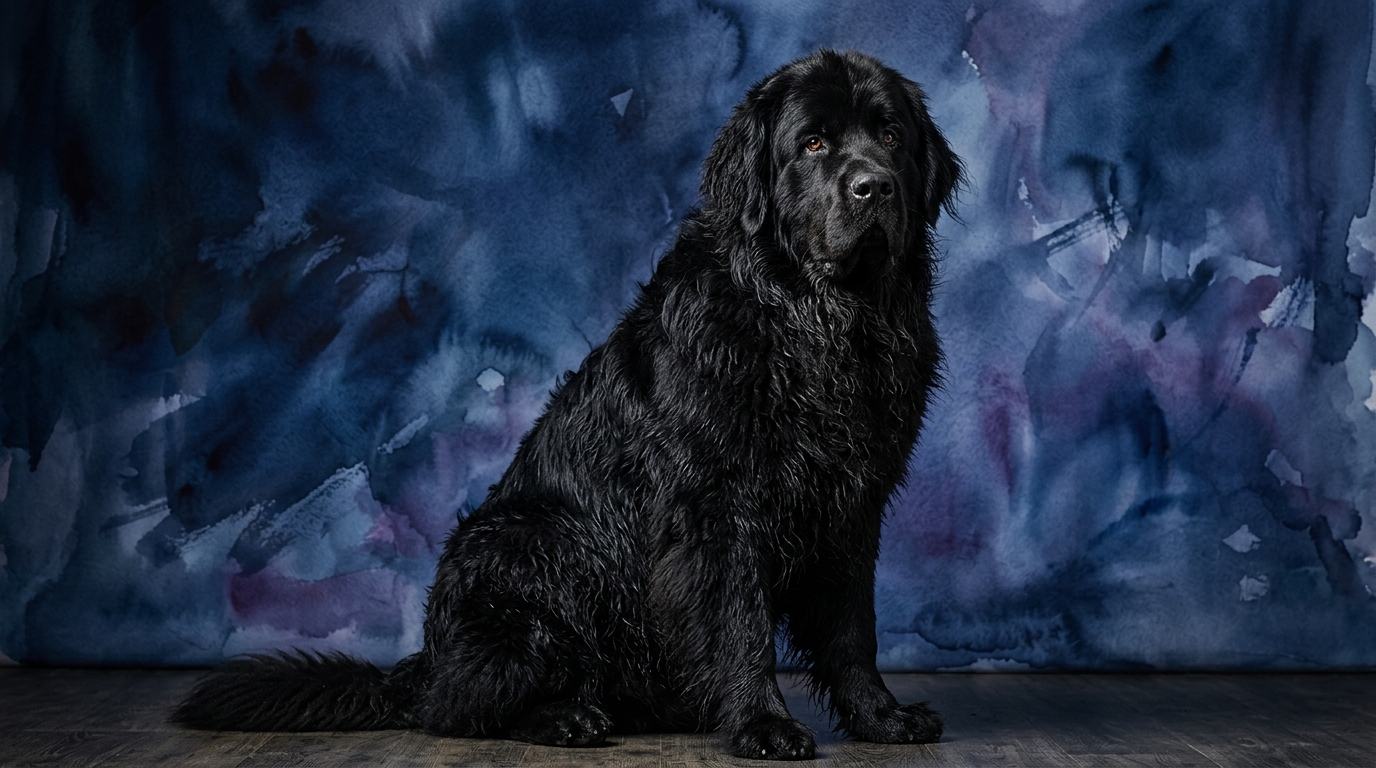

Side-by-Side Cognitive Profiles: Newfoundland vs. Bluetick Coonhound
At The Cosmic Pet Pet IQ Lab, we evaluate canine cognition across five distinct dimensions, offering a nuanced view beyond simple labels. For the Newfoundland, a Working breed ranked #34 by Coren, its profile reflects its historical role as a devoted helper: Problem Solving 3/5, Training Speed 4/5, Social Intelligence 5/5, Instinctive Drive 5/5, and Memory 4/5. This paints a picture of a dog that excels in cooperative tasks and understanding human intent.
The Bluetick Coonhound, a Hound breed not featured in Coren's ranking, presents a different cognitive blueprint, tailored for its specialized hunting role: Problem Solving 3/5, Training Speed 3/5, Social Intelligence 3/5, Instinctive Drive 3/5, and Memory 3/5. While these scores might seem lower across the board, it's crucial to understand they reflect a distinct cognitive specialization rather than a general deficit. Their abilities are finely tuned for their specific purpose.
Where the Newfoundland Excels Cognitively
The Newfoundland's standout cognitive strength lies in its exceptional Social Intelligence (5/5). This breed possesses a remarkable capacity for reading human emotions and intentions, making them intuitive companions and natural fits for roles requiring empathy and cooperation. This manifests in their ability to offer comfort without explicit prompting, their gentle interactions with children, and their readiness to collaborate on tasks, anticipating their human's needs with subtle cues. Their problem-solving, rated 3/5, often involves practical, strength-based solutions, particularly in water rescue scenarios where their instinctive drive (5/5) to assist is profoundly engaged.
Furthermore, their Training Speed (4/5) and Memory (4/5) contribute to a generally smoother learning curve compared to many breeds. Newfoundlands are typically eager to please and responsive to positive reinforcement, retaining commands and routines with relative ease. This combination of strong social understanding and a willingness to learn makes them adaptable to various family environments and diverse expectations, allowing them to integrate seamlessly into complex social structures and routines.
Where the Bluetick Coonhound's Cognition Shines
While both breeds score 3/5 in general Problem Solving, the Bluetick Coonhound's cognitive prowess is uniquely specialized in scent-based problem-solving. Their ability to decipher, track, and interpret complex olfactory information is a highly sophisticated form of intelligence, allowing them to navigate intricate environments and isolate specific trails over vast distances. This isn't about abstract puzzles but about a profound, biologically driven mastery of their primary sensory world.
The Bluetick's Instinctive Drive (3/5), though numerically lower than the Newfoundland's, represents an unwavering, singular focus on a scent trail that can override almost all other stimuli. This tenacity is a cognitive asset in its intended role, enabling relentless pursuit and perseverance through challenging conditions. Their memory (3/5) is particularly strong for scent patterns and successful hunting strategies, reinforcing their effectiveness in their specialized field. This breed's cognition prioritizes independent, sustained effort in pursuit, a stark contrast to the Newfoundland's collaborative, socially-oriented problem-solving.
Ease of Training: Behavioral Differences
Training a Newfoundland is generally a more straightforward endeavor due to their elevated Social Intelligence (5/5) and Training Speed (4/5). They possess a strong desire to please their human companions and are highly attuned to their handler's moods and expectations. This means they often respond well to positive reinforcement, grasping new commands and routines with fewer repetitions. For example, a Newfoundland is likely to prioritize a 'stay' command, understanding the human's intent for stillness, even if a minor distraction arises, thanks to their collaborative nature and good memory (4/5). Their inherent desire to be a helpful family member translates into a willingness to cooperate.
The Bluetick Coonhound, conversely, presents a greater training challenge, with scores of 3/5 in both Training Speed and Social Intelligence. Their powerful Instinctive Drive (3/5) to follow a scent trail is often their primary motivator, making it difficult for them to prioritize human commands over an enticing smell. A Bluetick might consistently 'forget' a recall command if a compelling scent crosses their path, as their cognitive focus becomes singularly directed by their nose. Training requires exceptional patience, consistency, and an understanding that their natural inclination is to hunt independently, not always to defer to human directives. Their memory (3/5) serves them well for tracking patterns but may not translate to consistent obedience in distracting, varied environments.
Suitability for Active vs. Relaxed Owners
Newfoundlands, despite their massive size, are surprisingly well-suited for owners who appreciate a generally relaxed home environment but are committed to consistent, moderate activity. They are not high-energy dogs requiring constant intense exercise, but they do thrive on regular walks, opportunities for swimming, and mental engagement to prevent boredom. Their high social intelligence means they genuinely enjoy being part of family activities and interaction, making them a good fit for present and engaged owners who might not be extreme athletes but can provide daily strolls and backyard playtime. They require space and significant grooming, but their exercise needs are typically manageable for an active family.
Bluetick Coonhounds are unequivocally for active owners, particularly those who enjoy extensive outdoor pursuits like hiking, running, or are willing to engage in scent work or dog sports. Their powerful instinctive drive and need for both physical and mental stimulation demand significant daily exercise, often involving long periods of off-leash activity in secure areas or dedicated tracking. A relaxed owner who cannot provide appropriate outlets for their strong scent drive and endurance will likely find a Bluetick challenging, as boredom can lead to undesirable behaviors such as destructive chewing, excessive baying, or attempts to escape and follow a trail. They are not content with short walks; they need to work their bodies and minds rigorously.
The Verdict
Select a Newfoundland if you seek a deeply empathetic, cooperative companion that excels in social interaction and family integration, and you appreciate a calm demeanor combined with a willingness to engage in moderate activities like swimming.
Opt for a Bluetick Coonhound if you are an active, outdoors-oriented individual or family dedicated to providing extensive exercise and mental stimulation through scent work or hunting, and you value an independent, tenacious partner.
🧠 Find Your Pet's IQ Score
Our Pet IQ Lab assessment covers 25+ tests across 5 cognitive dimensions — personalized to your breed.
Take the Full IQ Test →Frequently Asked Questions
Are Newfoundlands good for first-time dog owners?
Yes, their cooperative nature, eagerness to please, and high social intelligence often make them suitable for first-time owners willing to commit to their grooming and moderate exercise needs. Their calm temperament and responsiveness to training are significant advantages.
Can Bluetick Coonhounds live in apartments?
While possible, it's generally not ideal. Bluetick Coonhounds require substantial daily exercise and mental stimulation, preferably in a yard or through extensive outdoor activities, to prevent boredom and destructive behaviors. An apartment lifestyle would necessitate exceptional dedication to their exercise requirements.
Do Newfoundlands bark a lot?
Newfoundlands are not typically excessive barkers. They may bark to alert their family to strangers or unusual events, but their barks are usually deep and measured, reflecting their calm and watchful nature rather than constant vocalization.