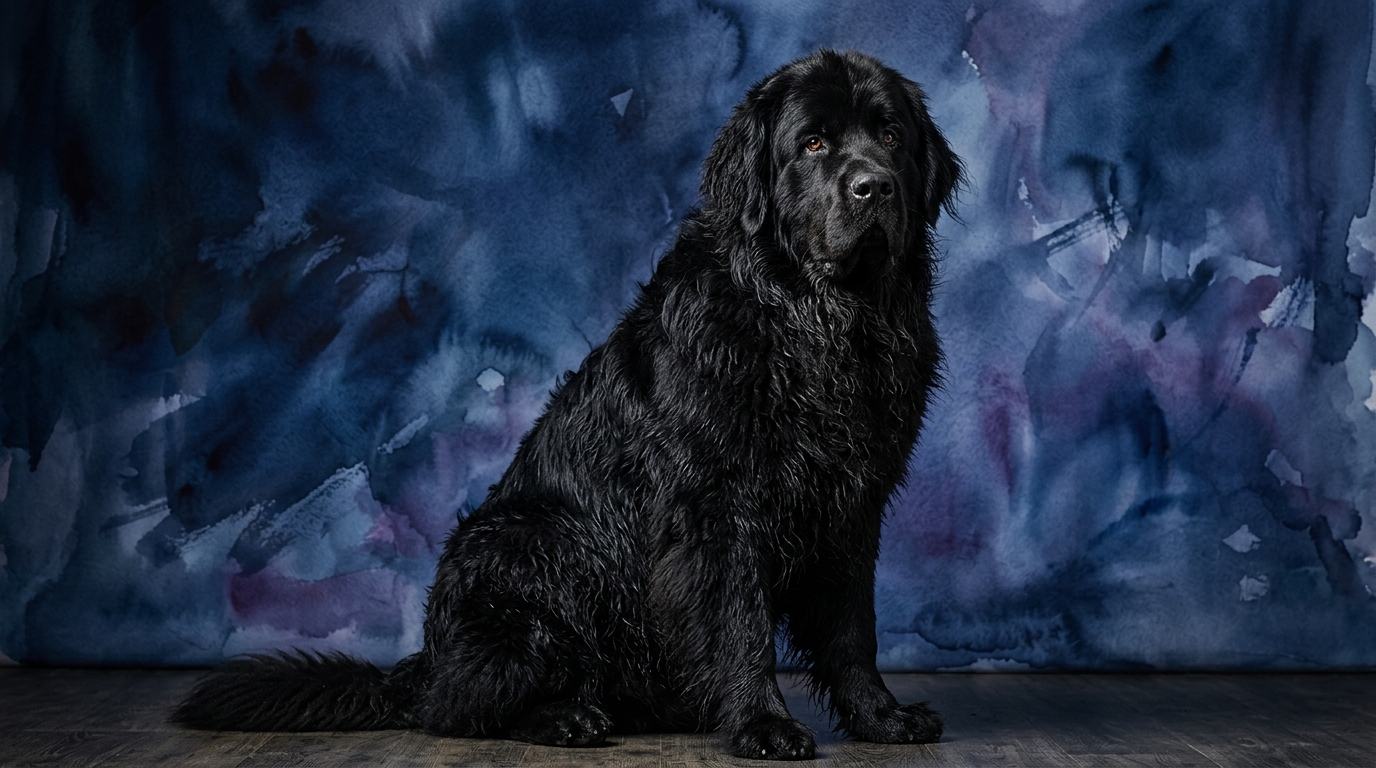

Side-by-Side IQ Profile: Newfoundland vs. Brittany
The Cosmic Pet Pet IQ Lab employs five distinct dimensions to assess canine intelligence, offering a nuanced view beyond simple obedience. For the Newfoundland, a dog from the Working Group with a Coren rank of #34, we observe a unique blend of strengths. Their Problem Solving is rated 3/5, indicating a moderate ability to devise novel solutions, often preferring established routines. Training Speed is strong at 4/5, reflecting their willingness and capacity to quickly grasp new commands. Where Newfoundlands truly shine is in Social Intelligence, scoring a perfect 5/5; they possess an extraordinary ability to read human emotions and integrate seamlessly into family dynamics. Their Instinctive Drive also scores 5/5, manifesting as a deep-seated desire to protect, rescue, and provide companionship. Finally, their Memory is rated 4/5, showing good retention of experiences and learned behaviors. This profile paints a picture of a dog whose cognitive strengths lie in empathy, loyalty, and purpose-driven action.
In contrast, the Brittany, a Sporting Group dog with a higher Coren rank of #19, presents a different cognitive landscape. Their Problem Solving capability is rated 4/5, suggesting a more pronounced aptitude for tackling new challenges and finding practical solutions, particularly in field-related tasks. Like the Newfoundland, their Training Speed is 4/5, indicating they are quick learners, eager to engage in structured activities. Social Intelligence for the Brittany is 3/5, meaning they are affable but perhaps less focused on intricate human emotional cues, often prioritizing tasks over purely social interaction. Their Instinctive Drive is 3/5, primarily channeled into their strong prey drive and retrieving instincts, rather than the broad utility seen in Newfoundlands. The Brittany's standout cognitive dimension is Memory, earning a perfect 5/5; they possess an exceptional capacity for recalling complex sequences, scent patterns, and intricate training cues. This profile highlights a breed whose intelligence is geared towards precision, task mastery, and remarkable recall.
Where Newfoundland Wins Cognitively
The Newfoundland's cognitive superiority often manifests in areas demanding profound emotional and social understanding. Their perfect 5/5 Social Intelligence score isn't just about being friendly; it reflects an innate ability to perceive and respond to human moods, needs, and subtle cues with remarkable accuracy. This makes them unparalleled therapy dogs and intuitive family companions, often anticipating a child's distress or an owner's anxiety before it's overtly expressed. Coupled with their 5/5 Instinctive Drive, Newfoundlands possess a deep, intrinsic motivation to be useful and protective, particularly in water rescue or as gentle guardians. This drive isn't about external rewards; it’s an internal compass guiding their actions towards companionship and service. While a Brittany might excel at remembering a complex retrieve pattern, a Newfoundland's brain is wired for connection, empathy, and a gentle, unwavering loyalty that forms the bedrock of their cognitive prowess. They excel in situations requiring patience, calm under pressure, and a profound understanding of their human companions, making them cognitive leaders in emotional support and protective companionship rather than complex puzzle-solving.
Where Brittany Wins Cognitively
The Brittany's cognitive strengths lie squarely in areas demanding sharp recall, focused attention, and practical problem-solving, particularly within dynamic environments. Their perfect 5/5 Memory score is a significant advantage, allowing them to retain vast amounts of information, from intricate scent trails to multi-step commands and the locations of various objects. This exceptional memory is crucial for a sporting dog, enabling them to execute complex field maneuvers with precision and consistency, even after long periods. Furthermore, their 4/5 Problem Solving ability means they are adept at navigating obstacles, adapting strategies on the fly, and figuring out how to achieve a goal, whether it's finding a hidden toy or retrieving a bird from challenging terrain. While their Social Intelligence (3/5) is moderate, it means their focus is less on human emotional states and more on the task at hand, which can be an asset when precision and independence are required. A Brittany’s brain is a finely tuned instrument for learning, retaining, and applying information to specific, often challenging, tasks, making them cognitive champions in fields requiring acute sensory processing and precise execution.
Which is Easier to Train and Why
When considering which breed is 'easier' to train, both the Newfoundland and the Brittany score a commendable 4/5 in Training Speed, indicating they both pick up new commands with relative ease. However, the nature of their trainability and the motivations that drive them differ significantly, influencing the training experience. The Newfoundland, with its perfect 5/5 Social Intelligence and 5/5 Instinctive Drive, is often perceived as 'easier' for general obedience and companionship training. Their profound desire to please their owners and fulfill their role as a devoted companion means they are highly cooperative and responsive to positive reinforcement rooted in social praise and connection. They thrive on being part of the 'pack' and will actively seek to understand and comply with human directives, making them very amenable to learning basic obedience, house manners, and even complex tasks like water rescue. Their training journey is often characterized by a strong bond and mutual understanding.
The Brittany, conversely, while also a quick learner, is motivated more by the task itself and the inherent rewards of the activity, rather than solely by human approval. Their exceptional 5/5 Memory and 4/5 Problem Solving mean they excel at learning intricate sequences and retaining them, making them ideal for specialized training like agility, field trials, or advanced hunting commands. However, their moderate 3/5 Social Intelligence means they might be less concerned with purely 'pleasing' their owner and more focused on the challenge or the hunt. This might require trainers to use more task-oriented rewards, such as a successful retrieve or the opportunity to work, rather than relying solely on social connection. Therefore, for an owner seeking a highly cooperative and emotionally responsive companion for general family life, the Newfoundland might feel 'easier' to train due to their innate desire to connect and comply. For an owner focused on specific, complex tasks and who can harness a dog's drive for work, the Brittany offers a rewarding and efficient training partner, excelling in retention and execution.
Which Suits Active Owners vs. Relaxed Owners
The choice between a Newfoundland and a Brittany also hinges significantly on an owner's lifestyle and activity level, as their cognitive profiles align with different needs for engagement. For the more relaxed owner, or one seeking a gentle giant companion, the Newfoundland often proves to be an ideal match. While they are large dogs and require regular, moderate exercise to maintain their health, their high Social Intelligence and profound Instinctive Drive mean much of their cognitive and emotional fulfillment comes from deep companionship and being an integral part of the family unit. They are content with leisurely walks, supervised outdoor play, and most importantly, quality time with their humans. Their cognitive output is less about constant physical exertion and more about emotional presence and connection, making them suitable for owners who value a calm, steadfast companion over an athletic partner.
In stark contrast, the Brittany is perfectly suited for active owners who thrive on outdoor adventures and structured activities. Their sporting background, combined with their 4/5 Problem Solving and exceptional 5/5 Memory, means they possess a keen mind that needs consistent mental and physical stimulation. They are built for endurance and precision, excelling in activities like hiking, running, agility, flyball, or hunting. Without adequate outlets for their energy and cognitive abilities, a Brittany can become bored and potentially destructive. Owners who enjoy training for dog sports, spending hours in the field, or integrating their dog into a highly active lifestyle will find the Brittany to be an unparalleled and enthusiastic partner, whose intelligence is best expressed through vigorous engagement and problem-solving on the move.
The Verdict
Choose the Newfoundland if you seek a deeply empathetic, gentle, and protective companion who thrives on profound social connection and finds purpose in being an integral part of your family. Their calm demeanor and intuitive understanding make them unparalleled emotional anchors.
Opt for the Brittany if you are an active owner who enjoys engaging in dog sports, hunting, or requires a partner for complex, task-oriented activities, valuing their sharp memory, agility, and keen problem-solving skills in dynamic environments.
🧠 Find Your Pet's IQ Score
Our Pet IQ Lab assessment covers 25+ tests across 5 cognitive dimensions — personalized to your breed.
Take the Full IQ Test →Frequently Asked Questions
Do Newfoundlands make good family dogs?
Yes, their exceptional social intelligence and strong instinctive drive for companionship make them outstanding family members, especially with children. Their gentle and protective nature allows them to integrate seamlessly and lovingly into any household, offering unwavering loyalty and comfort.
Are Brittanys difficult to train?
Not at all; Brittanys possess a strong memory and good problem-solving abilities, enabling them to learn commands quickly and retain them effectively. They excel with consistent, engaging, and task-oriented training that taps into their natural working drives, making them highly capable students.
Which breed requires more exercise?
The Brittany generally requires more consistent, vigorous physical and mental exercise due to their sporting background and energetic disposition. The Newfoundland, though large, is often content with moderate activity and finds significant fulfillment in strong social interaction and companionship, requiring less intense physical demands.