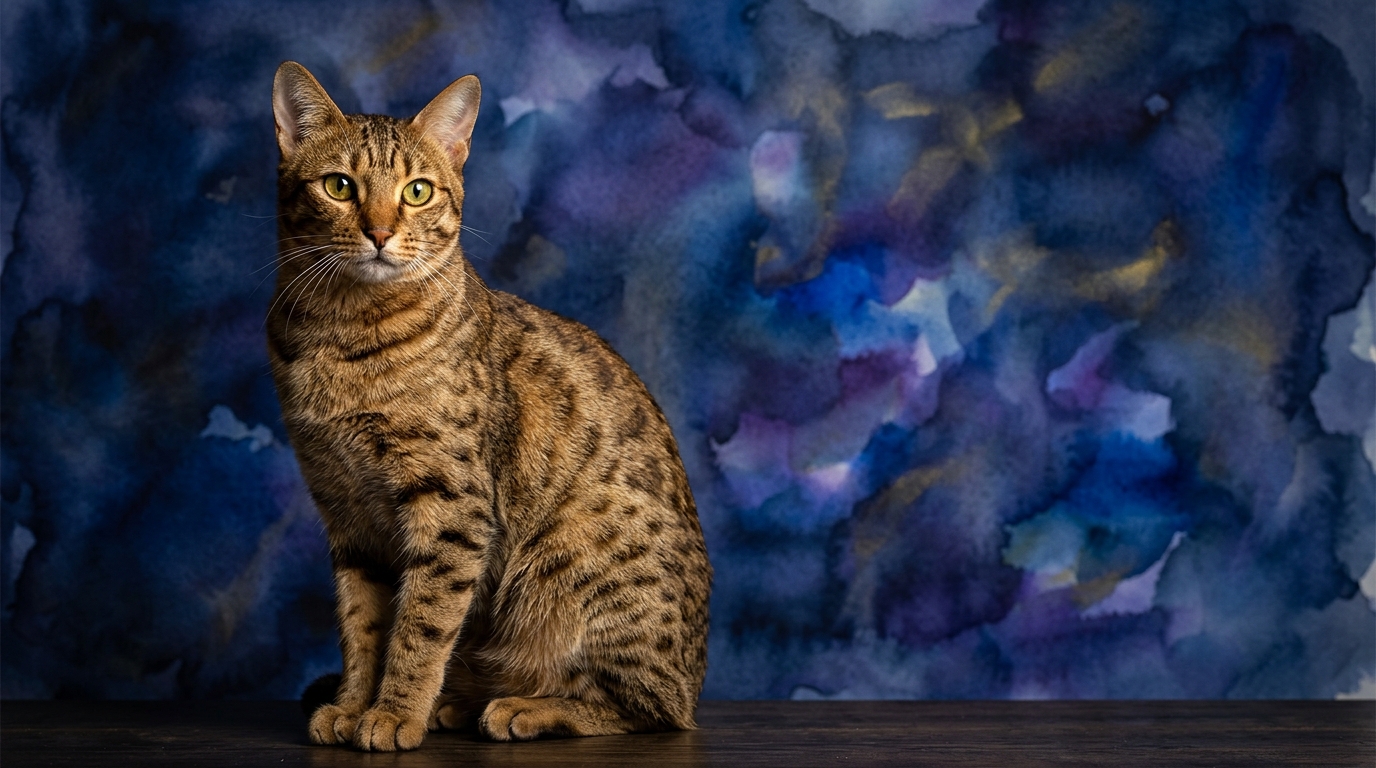

A Side-by-Side Look at Feline IQ Profiles
The Cosmic Pet Pet IQ Lab employs a five-dimensional framework to assess feline intelligence, providing a detailed understanding beyond mere anecdotes. For the Ocicat, we observe a robust cognitive profile: Problem Solving at 4/5, Training Speed at an exceptional 5/5, Social Intelligence at 4/5, Instinctive Drive at 4/5, and Memory also at 4/5. This suggests a cat that is not only quick to learn but also adept at navigating its environment and understanding social cues. Their high scores across the board paint a picture of an engaged and mentally agile companion.
In contrast, the Bombay presents a more uniformly moderate cognitive profile, with consistent scores of 3/5 across all five dimensions: Problem Solving, Training Speed, Social Intelligence, Instinctive Drive, and Memory. This indicates a cat that is capable and competent in its daily interactions and learning, but perhaps without the same intensity or rapid acquisition seen in breeds with higher scores. Their consistent 3/5 suggests a reliable and predictable cognitive temperament, rather than a less capable one, emphasizing balance over exceptionalism in any single area.
Where the Ocicat Cognitively Excels
The Ocicat's cognitive strength is most pronounced in its Training Speed, rated at an impressive 5/5. This indicates a neurological wiring that allows for remarkably rapid acquisition of new commands and behaviors, making them exceptionally responsive to positive reinforcement techniques. Owners often report Ocicats learning complex tricks or routines with fewer repetitions than many other breeds, demonstrating a keen capacity for associative learning and pattern recognition.
Furthermore, their 4/5 Problem Solving ability means Ocicats are naturally inclined to figure things out. This manifests in their adeptness with puzzle toys, their capacity to open cabinets, or their resourceful methods for accessing desired objects. This cognitive dimension, combined with their strong Memory (4/5), enables them to retain solutions to challenges and apply learned strategies to new, similar situations, showcasing a flexible and adaptive intellect that thrives on mental engagement.
Where the Bombay's Cognitive Profile Shines Uniquely
While the Bombay's individual scores are 3/5 across the board, this consistent cognitive profile offers a unique advantage: predictability and a lower demand for constant, intense mental stimulation. A 3/5 in Problem Solving means they are capable of navigating typical household challenges and learning routines, but they may not be constantly seeking out novel puzzles or finding mischievous ways to outsmart their environment. This can translate to a more serene home life, where their cognitive needs are met through consistent interaction rather than complex challenges.
The Bombay's 3/5 Social Intelligence, when combined with their affectionate nature, means they form deep bonds based on consistent presence and interaction. They are attuned to their owner's general mood and routines, providing companionship without necessarily needing to decode every subtle human emotional shift. Their 3/5 Instinctive Drive suggests they enjoy play, but might not possess the same relentless hunting focus or require elaborate predatory simulations as a breed with a higher drive, making them content with moderate, interactive play sessions.
Ease of Training: Ocicat vs. Bombay
When it comes to trainability, the Ocicat holds a distinct advantage, primarily due to its 5/5 Training Speed and 4/5 Memory. Ocicats are often described as 'dog-like' in their eagerness to learn and participate in training sessions. They respond exceptionally well to clicker training and positive reinforcement, quickly grasping concepts like leash walking, fetching, or even more intricate commands. Their high problem-solving skills mean they often figure out what is expected of them quite rapidly, making the training process a rewarding and efficient experience for both cat and owner. Their strong memory ensures these learned behaviors are retained over time, requiring less frequent reinforcement.
The Bombay, with its 3/5 Training Speed, is certainly trainable, but owners should approach the process with more patience and consistency. They will learn basic commands and routines, but the acquisition may take more repetitions compared to an Ocicat. Bombays excel when training is integrated into their daily routine and kept positive and engaging, focusing on their desire for companionship. While they may not pick up complex tricks as quickly, their consistent memory (3/5) means that once a behavior is learned, it is likely to stick, though perhaps requiring more initial effort to establish.
Matching Cognitive Profiles to Owner Lifestyles
For active owners seeking a feline companion that thrives on mental engagement and interactive participation, the Ocicat is an ideal match. Their 4/5 Problem Solving and 4/5 Instinctive Drive mean they require significant environmental enrichment, including puzzle feeders, climbing structures, and regular interactive play to satisfy their keen intellect and predatory instincts. These cats often enjoy learning to walk on a leash or playing games of fetch, seamlessly integrating into a dynamic household that can provide consistent mental and physical challenges. Owners who enjoy teaching tricks and engaging in stimulating activities will find the Ocicat a rewarding partner.
Conversely, the Bombay's balanced 3/5 cognitive profile across all dimensions makes them exceptionally well-suited for more relaxed owners who appreciate a devoted, predictable, and affectionate companion. While they enjoy play and interaction, their cognitive needs are generally met through consistent companionship, moderate play sessions, and a stable routine. Their 3/5 Social Intelligence means they are happy to curl up on a lap or follow their owners around, providing a comforting presence without demanding constant intellectual stimulation. They are less prone to boredom-induced destructive behaviors if not constantly challenged, making them excellent companions for those who prefer a more tranquil home environment.
The Verdict
Choose an Ocicat if you are an active owner seeking a highly trainable, mentally agile companion who thrives on challenges, interactive play, and learns new behaviors with remarkable speed.
Opt for a Bombay if you desire a devoted, affectionate companion with a consistent and predictable cognitive profile, content with stable routines and close, comforting interactions without requiring intense mental stimulation.
🧠 Find Your Pet's IQ Score
Our Pet IQ Lab assessment covers 25+ tests across 5 cognitive dimensions — personalized to your breed.
Take the Full IQ Test →Frequently Asked Questions
Are Ocicats good with puzzle toys?
Yes, Ocicats excel with puzzle toys. Their 4/5 problem-solving ability and 4/5 instinctive drive mean they are adept at figuring out how to retrieve treats or operate mechanisms, making these toys excellent tools for mental enrichment.
Do Bombays learn tricks easily?
Bombays can learn tricks, but their 3/5 training speed means it will require more patience and consistent positive reinforcement from the owner. They are capable of learning basic commands and routines, but perhaps not with the same rapid acquisition as an Ocicat.
Which cat is more independent, Ocicat or Bombay?
While both breeds enjoy companionship, Ocicats' higher cognitive drive often leads them to seek out independent exploration and problem-solving within their environment. Bombays, with their consistent 3/5 social intelligence, tend to be more content with consistent owner interaction and presence rather than constant independent cognitive pursuits.