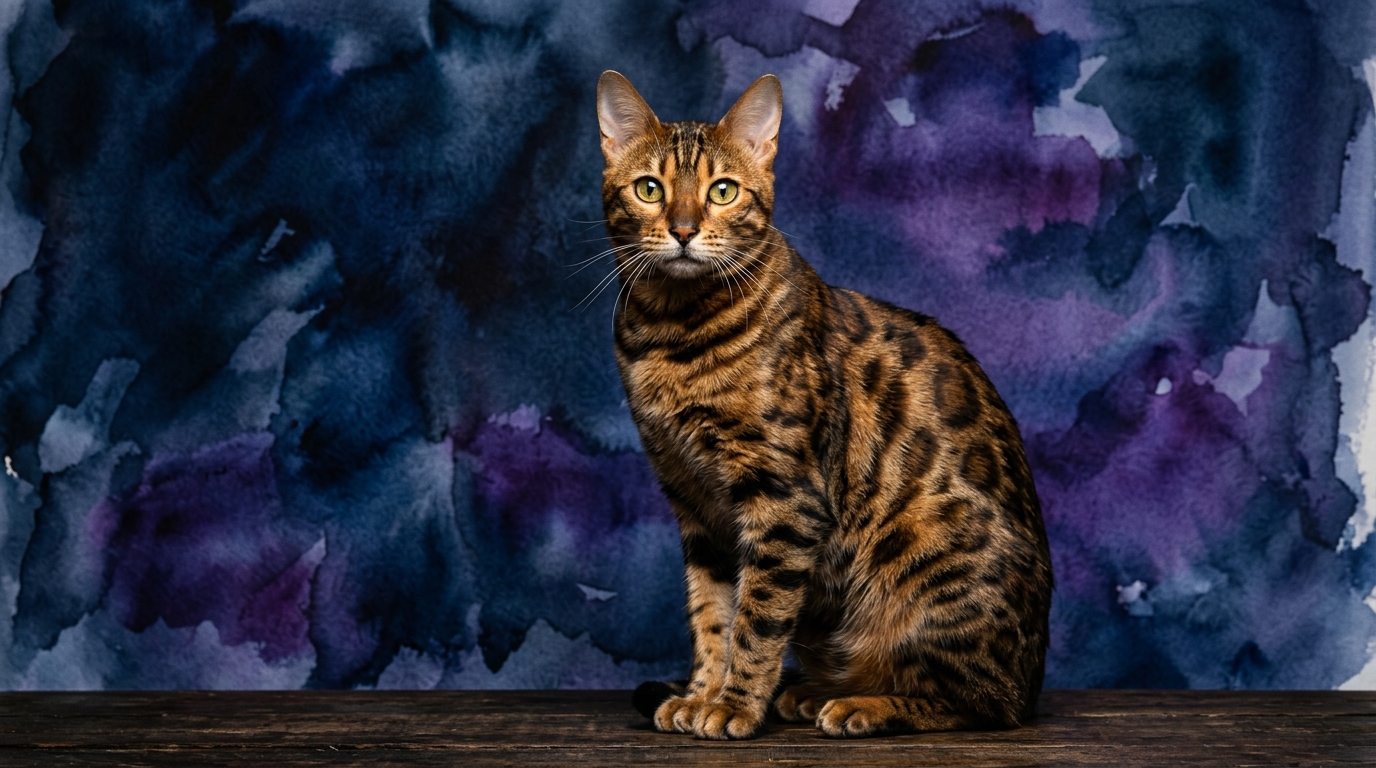
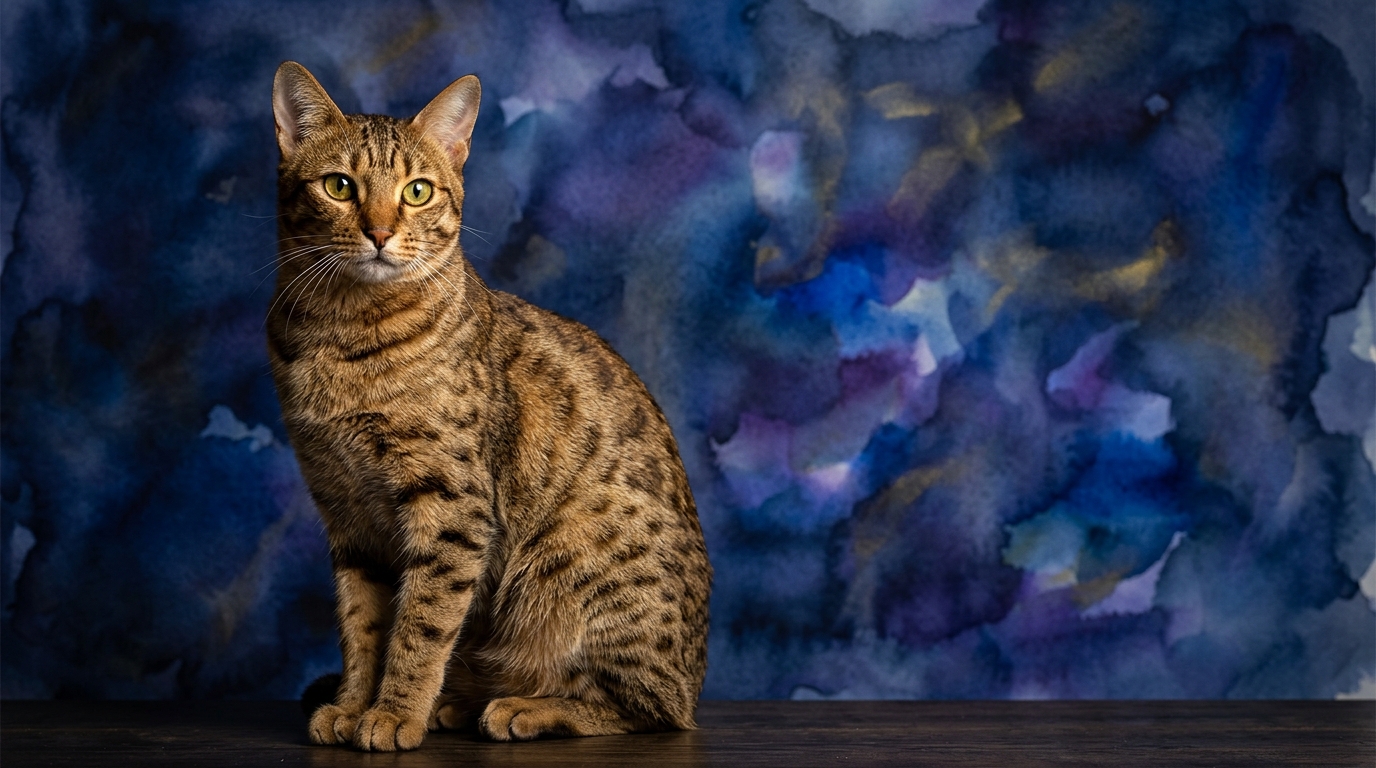
Side-by-Side IQ Profile: Bengal vs. Ocicat
The Cosmic Pet Pet IQ Lab employs five key dimensions to assess feline intelligence, providing a nuanced view of each breed’s mental strengths. Here’s how the Bengal and Ocicat compare across these cognitive benchmarks.
Problem Solving: The Bengal, with a perfect 5/5, excels at navigating complex environmental challenges, such as methodically figuring out how to open latched cabinets, manipulating faucet handles for flowing water, or devising strategies to access out-of-reach objects, demonstrating a persistent and strategic approach to overcoming obstacles. The Ocicat, scoring 4/5, also exhibits cleverness in navigating their environment and solving practical puzzles like finding hidden treats within a new toy, often relying on observation and a direct, efficient approach rather than intricate manipulation, showcasing good adaptive intelligence in familiar settings.
Training Speed: The Ocicat stands out with a 5/5 for its rapid assimilation of commands and tricks, often picking up new behaviors like “sit,” “stay,” or even walking on a leash with impressive quickness and consistency, driven by a natural eagerness to engage and cooperate with their human companions. The Bengal, scoring 4/5, learns swiftly as well, capable of mastering intricate sequences and understanding complex cues, but their independent streak means they might choose whether or not to perform a learned behavior based on their current interest or a perceived reward, rather than pure compliance to a command.
Social Intelligence: Both breeds score 4/5, indicating a strong capacity for interaction. The Bengal forms deep, often singular bonds with a chosen human, reading their emotions and intentions with remarkable accuracy and sometimes displaying a nuanced understanding of household dynamics, responding to subtle shifts in mood. The Ocicat is generally more gregarious, easily integrating into family life and forming affectionate relationships with multiple family members and even other pets, adapting well to social cues, household routines, and the presence of visitors with a friendly demeanor.
Instinctive Drive: The Bengal, with a 5/5, possesses a profound instinctive drive, reminiscent of its wild ancestry, manifesting as an intense desire to hunt, climb, and explore every nook and cranny of their territory, constantly seeking opportunities to engage their predatory behaviors through vigorous play or real-world investigation. The Ocicat, scoring 4/5, is also a lively and playful cat with a healthy prey drive, enjoying interactive toys and simulated hunts, readily engaging in chasing and pouncing games, but typically with a less intense, persistent, or all-consuming focus on primal instincts than the Bengal.
Memory: With a score of 5/5, the Bengal demonstrates exceptional long-term memory, recalling intricate routines, the exact location of favored toys hidden months ago, and past interactions with people or other pets, sometimes holding onto preferences or aversions for extended periods, making them highly attuned to their environment's history. The Ocicat, scoring 4/5, shows reliable memory for daily schedules, familiar faces, and learned commands, consistently remembering where their food is stored, the sound of their owner's car, or the specific sequence for a treat dispenser, making them predictable and adaptable within established routines.
Where the Bengal Wins Cognitively
The Bengal's cognitive edge lies primarily in its superior problem-solving capabilities and robust, long-term memory. These cats display a remarkable capacity for abstract thought, often observed meticulously planning routes to high shelves, devising methods to retrieve toys from seemingly inaccessible spots, or even figuring out how to operate simple household mechanisms, a true testament to their strategic thinking. Their memory allows them to retain complex sequences of actions and intricate environmental layouts, enabling them to revisit successful strategies or avoid past failures with precision, making them persistent learners. This combination fuels an insatiable curiosity, driving them to explore and interact with their surroundings in a highly analytical manner, constantly testing boundaries and discovering new possibilities within their domain. They aren't just reacting to stimuli; they are actively engaging with, manipulating, and attempting to master their environment, often surprising owners with their ingenuity.
Where the Ocicat Wins Cognitively
The Ocicat distinguishes itself with its exceptional training speed, making it a standout performer in structured learning environments and an absolute joy for owners who love to teach. Their willingness to engage and inherent desire for positive interaction translates into a rapid acquisition of new commands, tricks, and even complex agility courses, often surprising observers with how quickly they grasp new concepts. This cognitive strength is rooted in their attentiveness and responsiveness to human cues, allowing them to quickly form strong associations between actions, verbal instructions, and rewards. Unlike some breeds that might ponder an instruction or require extensive repetition, the Ocicat often processes and executes with an impressive alacrity, making them particularly rewarding for owners who enjoy teaching and bonding through consistent, engaging training sessions. Their cognitive profile leans towards efficient learning and application within a guided framework, showcasing a keen understanding of cause and effect in human interactions and a strong desire to cooperate.
Which is Easier to Train and Why
For many owners, the Ocicat will prove to be the easier cat to train, primarily due to their higher training speed score and generally more compliant, eager-to-please nature. They thrive on positive reinforcement and consistent routines, eagerly participating in sessions and quickly associating verbal cues or hand signals with desired behaviors, often showing a genuine enthusiasm for learning. Their social intelligence, while equal to the Bengal's, often manifests as a greater desire to please their human companions and a lower propensity for independent “mischief” during training, making them highly receptive students. This contrasts with the Bengal, whose problem-solving prowess and strong instinctive drive can sometimes lead to an independent approach to training; they might learn quickly but then decide if and when to perform a learned behavior based on their own assessment of the situation, their current interests, or if a more exciting “problem” presents itself. While Bengals can be trained to perform complex tasks, it often requires more creative methods to keep their attention, channel their natural exploratory urges, and manage their occasional wilfulness, whereas Ocicats typically embrace the structure of training more readily and consistently.
Which Suits Active Owners vs. Relaxed Owners
The choice between a Bengal and an Ocicat significantly depends on an owner's lifestyle and their capacity for consistent engagement. An active owner, one who relishes daily interactive play sessions, enjoys teaching advanced tricks, and provides a stimulating environment rich with puzzle toys, climbing structures, and perhaps even leash walks or outdoor adventures, will find the Bengal an incredibly rewarding, albeit demanding, companion. Their 5/5 scores in Problem Solving, Instinctive Drive, and Memory mean they require constant mental and physical outlets to prevent boredom-driven mischief and to satisfy their innate drive to explore and manipulate. They are ideal for individuals who actively seek to channel their cat's abundant energy and profound curiosity, thriving on a dynamic partnership.
Conversely, while still playful and engaging, the Ocicat might be a more suitable choice for an owner seeking a pet that integrates seamlessly into a moderately active household without the same intensity of cognitive demands. Their 5/5 Training Speed means they are adaptable and quickly learn household rules and routines, fitting well into family life and enjoying regular interactive play. They enjoy affection and consistent interaction but typically don't possess the same relentless investigative drive or potential for complex, self-directed “mischief” as a Bengal. A relaxed owner who enjoys regular, but not necessarily constant, play sessions and values a companion that adapts readily to established patterns and enjoys family company will find the Ocicat's balanced temperament and trainability a comforting fit.
The Verdict
If you are an owner prepared for a mentally robust and physically dynamic companion, one who will challenge you with their ingenious problem-solving and require extensive environmental enrichment to satisfy their deep-seated exploratory drives, then the Bengal is your ideal match.
If you seek a highly trainable, socially adept cat eager to learn and integrate into a structured family environment, offering consistent companionship without the intense, often self-directed, cognitive demands of a Bengal, then the Ocicat will be a delightful addition.
🧠 Find Your Pet's IQ Score
Our Pet IQ Lab assessment covers 25+ tests across 5 cognitive dimensions — personalized to your breed.
Take the Full IQ Test →Frequently Asked Questions
Are Bengals prone to destructive behaviors due to their high problem-solving skills?
Bengals' superior problem-solving and instinctive drive mean they will actively explore and manipulate their environment. Without sufficient mental and physical enrichment, this can lead to behaviors like opening cabinets or finding ways onto forbidden surfaces, but with proper stimulation, these behaviors are usually channeled positively.
Do Ocicats get bored easily if not mentally stimulated?
Ocicats are active and social cats that do require regular mental and physical engagement through play and interaction. While they may not exhibit the same level of independent “investigative” boredom as a Bengal, a lack of stimulation can still lead to restlessness or seeking attention.
Which breed is better with children or other pets?
Both breeds score 4/5 in social intelligence, indicating good adaptability. Ocicats often integrate smoothly due to their generally gregarious nature and eagerness to please, while Bengals can form strong bonds but might be more selective, requiring careful introductions and supervision to ensure positive interactions with children or other pets.