
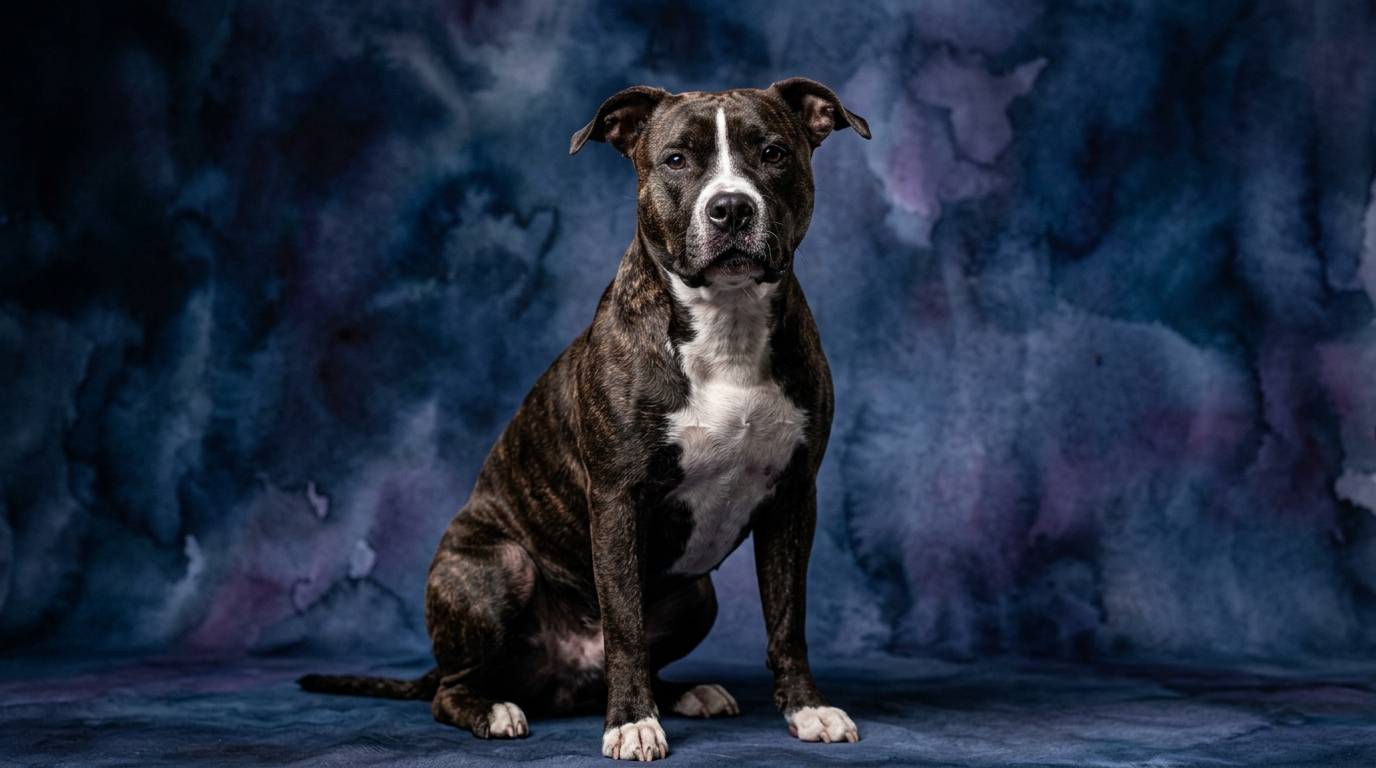
Side-by-Side IQ Profile: OES vs. AmStaff
The Cosmic Pet Pet IQ Lab's framework provides a granular view into canine cognition, assessing five key dimensions. For both the Old English Sheepdog (Coren rank #44) and the American Staffordshire Terrier (Coren rank #48), their scores in Problem Solving, Training Speed, and Social Intelligence all register at 3/5, while their Instinctive Drive also sits at 3/5, and Memory shines at 4/5. These identical numerical standings, however, are merely a starting point for understanding their distinct cognitive landscapes.
Delving into Problem Solving (3/5), the Old English Sheepdog often applies this capacity to navigating complex environments or figuring out how to gather scattered 'flock' members, whether they are actual sheep or human family. This manifests as an aptitude for spatial reasoning within a dynamic, living system. The American Staffordshire Terrier, also at 3/5, typically directs its problem-solving towards overcoming physical obstacles or strategizing during play, demonstrating a more direct, often physical approach to challenges, such as figuring out how to retrieve a deeply lodged toy or outmaneuver a playmate.
Training Speed (3/5) for the Old English Sheepdog often reflects a methodical approach to learning, capable of absorbing multi-step commands and routines, particularly those involving cooperation and movement. They tend to respond well to consistent, positive reinforcement that builds on established patterns. The American Staffordshire Terrier, with the same score, often exhibits a focused intensity during training sessions, capable of quickly grasping specific cues and performing tasks with enthusiasm, though their learning can be influenced by their strong drive and need for engaging activities.
Social Intelligence (3/5) in the Old English Sheepdog is frequently expressed through their sensitivity to human emotions and group dynamics, a remnant of their herding role where understanding the mood and movement of a flock was paramount. They often form deep bonds and display an awareness of their family's routines and feelings. The American Staffordshire Terrier, also at 3/5, demonstrates its social aptitude through clear communication in play, an ability to read intentions in familiar humans, and a strong desire to be an integrated part of their immediate family unit, often seeking physical closeness and interaction.
Instinctive Drive (3/5) for the Old English Sheepdog is undeniably rooted in its herding heritage, manifesting as an inclination to gather, patrol, and keep its 'flock' together, even if that flock is a household of children. This drive can translate into a watchful nature and a desire for order. The American Staffordshire Terrier's Instinctive Drive (3/5) often stems from its terrier lineage, showcasing a robust prey drive, a strong inclination towards digging, and a resolute determination when pursuing a task or engaging in play, coupled with a protective streak towards its family.
Finally, Memory (4/5) for the Old English Sheepdog is particularly evident in their ability to recall complex routes, remember specific commands learned long ago, and retain knowledge of routines, making them dependable companions in familiar settings. The American Staffordshire Terrier, also scoring 4/5, exhibits a strong memory for specific training sequences, the location of favored objects, and the recognition of individuals, remembering both positive and negative past interactions with considerable accuracy.
Where Old English Sheepdog Wins Cognitively
The Old English Sheepdog's cognitive strengths frequently shine in areas demanding nuanced social understanding and the application of learned patterns to dynamic situations. Their herding background has honed an ability to perceive and respond to the subtle cues of a group, whether animal or human. This means they often excel at anticipating needs or reactions within a family unit, making them exceptionally attuned to their household's rhythm.
Their memory, scoring 4/5, is particularly adept at storing and retrieving complex sequences and spatial information. An OES can remember intricate agility courses or multi-step household routines with impressive accuracy, allowing them to participate actively in daily life without constant prompting. This capacity for remembering detailed processes contributes to their reliability and consistency, making them effective partners in structured activities or daily chores that require a predictable sequence of actions.
Where American Staffordshire Terrier Wins Cognitively
The American Staffordshire Terrier often demonstrates a distinct cognitive edge in tasks requiring grit, focused determination, and a direct approach to problem-solving. Their terrier heritage imbues them with a tenacious spirit, enabling them to persist at challenges until a solution is found, particularly when the task involves physical manipulation or overcoming obstacles. This translates into a robust capacity for independent thought when faced with a tangible puzzle.
Their memory (4/5) is highly effective for recalling specific, task-oriented information and associating particular actions with outcomes. An AmStaff can quickly learn and retain complex commands for obedience or sport, performing them with precision and enthusiasm. This breed's cognitive architecture supports a strong drive for mastery in specific activities, often displaying a remarkable capacity to recall and apply training in varied contexts, especially when motivated by engaging rewards or a strong bond with their handler.
Which is Easier to Train and Why
While both breeds share a Training Speed score of 3/5, their behavioral predispositions influence the ease of their training. The Old English Sheepdog's inherent desire to cooperate and its aptitude for following established routines can make training feel more fluid and predictable. They often respond well to consistent, gentle methods, thriving on structure and positive reinforcement that acknowledges their role within the 'flock.' Their social intelligence allows them to quickly understand what is expected, and their memory helps them retain those lessons over time, particularly for tasks that involve coordination or sequence.
The American Staffordshire Terrier, despite the same training speed score, can present a different training dynamic due to its strong drive and independent streak. While capable of learning quickly and with great focus, they often require a handler who can channel their determination and maintain engagement. Training an AmStaff benefits from high-value rewards, varied exercises to prevent boredom, and firm, consistent leadership. Their problem-solving capacity means they might occasionally 'test' boundaries, requiring a handler who can be equally persistent and clear in their expectations. For an owner who understands how to harness their drive, the AmStaff can be an exceptionally responsive and eager student, but consistency is paramount to avoid their independent nature from leading to self-directed actions.
Which Suits Active Owners vs. Relaxed Owners
The Old English Sheepdog, with its herding background and robust physical build, typically suits active owners who enjoy regular, moderate-to-vigorous outdoor activities. Their instinctive drive to patrol and gather means they thrive with opportunities for structured exercise, long walks, or even dog sports like agility or herding trials. While they can adapt to periods of relaxation, a truly content OES is one whose mind and body are regularly engaged in purposeful activity, often alongside their human companions. Their social intelligence also means they value companionship during these activities.
The American Staffordshire Terrier also benefits immensely from active owners who can provide consistent physical exercise and mental stimulation. Their tenacious nature and muscular build mean they excel in activities like hiking, running, or structured play sessions. However, their social intelligence and strong bond with family also make them excellent companions for relaxed owners once their exercise needs are met. An AmStaff can transition well from an energetic play session to a calm cuddle on the couch, provided they've had sufficient outlets for their physical and mental energy. Owners who appreciate a dog with both a zest for activity and a capacity for deep companionship will find the AmStaff a fitting choice.
The Verdict
Choose the Old English Sheepdog if you seek a companion attuned to group dynamics, who excels at recalling complex routines, and thrives with structured, cooperative activities.
Opt for the American Staffordshire Terrier if you value a tenacious problem-solver, a focused learner in specific tasks, and a deeply bonded companion who appreciates both vigorous activity and relaxed companionship.
🧠 Find Your Pet's IQ Score
Our Pet IQ Lab assessment covers 25+ tests across 5 cognitive dimensions — personalized to your breed.
Take the Full IQ Test →Frequently Asked Questions
Do Old English Sheepdogs and American Staffordshire Terriers learn at the same pace?
While both breeds score 3/5 in Training Speed, their learning styles differ. The OES often learns through consistent repetition and understanding its role in a sequence, while the AmStaff learns quickly with focused attention and high motivation, often needing variety to maintain engagement.
How do their social intelligence scores manifest differently?
The Old English Sheepdog's social intelligence (3/5) often appears as an intuitive understanding of family moods and group dynamics, a legacy of their herding past. The American Staffordshire Terrier's (3/5) manifests as a strong bond with immediate family, clear communication in play, and a desire for close physical connection, showing a deep loyalty to their inner circle.
Which breed is better for first-time dog owners?
Neither breed is inherently 'easier' for a first-time owner, as both require commitment. An OES might be more forgiving of minor inconsistencies due to its cooperative nature, while an AmStaff demands a confident, consistent owner to channel its strong drive and independent streak effectively. Researching breed-specific needs is crucial for any first-time owner.