
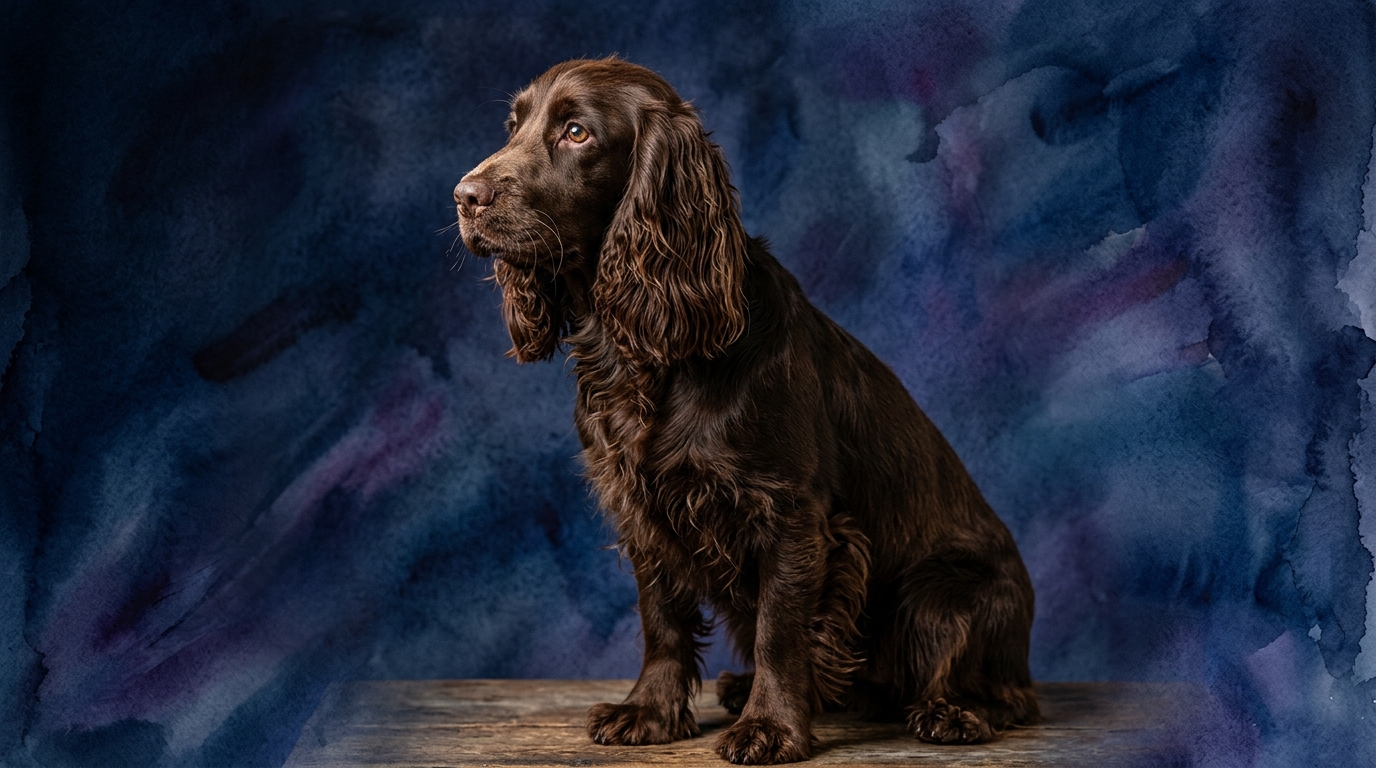
Side-by-Side IQ Profile: Old English Sheepdog vs. Field Spaniel
At The Cosmic Pet Pet IQ Lab, we dissect canine cognition into five core dimensions, revealing distinct mental landscapes for each breed. The Old English Sheepdog, a venerable member of the Herding group, registers a Problem Solving score of 3/5, indicating a solid capacity for navigating novel challenges. Its Training Speed also stands at 3/5, suggesting a moderate pace for acquiring new commands, while its Social Intelligence matches this at 3/5, reflecting a balanced understanding of human and canine cues. Instinctive Drive, crucial for its herding heritage, is also 3/5, but its Memory truly shines at 4/5, marking a superior ability to recall learned behaviors and routines. Notably, the Old English Sheepdog holds a Coren rank of #44 among breeds for working and obedience intelligence.
The Field Spaniel, a distinguished Sporting dog, presents a remarkably consistent cognitive profile across most dimensions. Its Problem Solving ability is rated at 3/5, on par with the Old English Sheepdog, demonstrating a similar foundational capacity for figuring things out. Training Speed is also 3/5, suggesting a comparable rate of learning new tasks. In Social Intelligence and Instinctive Drive, the Field Spaniel again scores 3/5, reflecting a well-rounded aptitude for interaction and a balanced drive linked to its retrieving and flushing roles. Its Memory, however, is rated at 3/5, which is competent but slightly less pronounced than its Herding counterpart. The Field Spaniel does not currently hold a specific Coren rank, indicating its cognitive strengths are perhaps less about formal obedience competition and more about practical, field-oriented application.
Where the Old English Sheepdog Wins Cognitively
The Old English Sheepdog’s primary cognitive advantage lies in its superior Memory, scoring 4/5 compared to the Field Spaniel’s 3/5. This enhanced recall means an OES is generally more adept at retaining complex sequences of commands, remembering routines, and recalling specific locations or objects over time. For an owner, this translates into a dog that might solidify learned behaviors with fewer repetitions in the long run and can be particularly good at remembering boundaries or specific household rules. Its herding background, requiring the recall of intricate patterns and the recognition of individual flock members, likely contributed to the development of this robust memory capacity.
Furthermore, its Coren ranking of #44 places the Old English Sheepdog within the upper-middle tier for working and obedience intelligence, suggesting a general aptitude for understanding and executing commands more readily than many other breeds. While its Problem Solving and Training Speed scores are equal to the Field Spaniel, this Coren ranking provides a broader context for its overall trainability and capacity for formal learning. The OES's instinctive drive, while rated 3/5, is geared towards managing and organizing, a cognitive function that requires forward-thinking and an ability to respond to dynamic situations, which can be channeled into sophisticated tasks beyond basic obedience.
Where the Field Spaniel Wins Cognitively
While the Field Spaniel’s individual scores are mostly on par with or slightly lower than the Old English Sheepdog, its cognitive 'wins' are more about the *application* and *balance* of its abilities within its working context. A uniform 3/5 across Problem Solving, Training Speed, Social Intelligence, and Instinctive Drive indicates a highly balanced and practical mind. This breed excels in sustained focus and independent problem-solving in dynamic outdoor environments, typical of a sporting dog. Its instinctive drive, while also 3/5, is finely tuned for scent work, tracking, and retrieving, requiring a different kind of focused mental energy and tenacity that might not be captured by a formal obedience ranking.
The Field Spaniel's cognitive profile suggests a dog that is consistently capable and adaptable, less reliant on a single dominant cognitive strength like the OES's memory. This balance makes it a versatile companion for tasks requiring steady application of learned skills and an ability to work cooperatively yet independently. Its inherent curiosity and drive to explore, coupled with its moderate social intelligence, allow it to thrive in environments where it can utilize its senses to engage with the world, making it particularly adept at scent games, agility, or field trials that demand both physical and mental engagement.
Which Is Easier to Train and Why?
Both the Old English Sheepdog and the Field Spaniel share a Training Speed score of 3/5, suggesting they learn at a moderate pace. However, the OES often presents as easier to train in complex, multi-step obedience tasks due to its superior Memory (4/5). This means while it might take a similar initial effort to teach a command, the OES is more likely to retain that information over time, requiring less frequent refreshers. Its Coren ranking of #44 further supports its aptitude for formal obedience, indicating a breed that generally responds well to consistent, positive reinforcement training. The OES's herding instinct, while powerful, can be channeled into structured activities like herding trials or even agility, where its cognitive abilities for sequencing and recall are highly valuable. However, its independent streak and tendency to think for itself, characteristic of herding breeds, can sometimes make initial training a test of patience and consistency.
The Field Spaniel, with a Training Speed and Memory of 3/5, is certainly trainable, but its approach may differ. Its sporting background means it's often eager to please and highly motivated by food or toys, making initial training sessions engaging. However, its slightly lower memory score compared to the OES might mean that more repetition is needed to solidify complex behaviors, and consistency is paramount to prevent skills from fading. Furthermore, the Field Spaniel's strong scent drive and independent nature, while assets in the field, can be distractions in a training environment. Owners must work to capture and maintain its focus against the allure of interesting smells or sights, which requires creative and engaging training methods to leverage its natural curiosity and drive rather than fighting against it. For both breeds, early socialization and consistent, positive reinforcement are key, but the OES's memory gives it a slight edge in long-term retention of elaborate commands.
Which Suits Active Owners vs. Relaxed Owners?
Neither the Old English Sheepdog nor the Field Spaniel are suited for truly 'relaxed' owners in the sense of being sedentary couch companions; both possess a working heritage that demands mental and physical engagement. However, the *type* of activity they thrive on differs. Active owners who enjoy structured activities, multi-step training, or even dog sports like herding, rally, or advanced obedience will find the Old English Sheepdog a rewarding partner. Its robust memory and drive to perform tasks make it well-suited for owners who can provide consistent mental challenges and a schedule that incorporates regular, purposeful 'work.' While they enjoy walks, their shaggy coats and historical role mean they are built for endurance and intelligent application of effort rather than explosive sprints.
The Field Spaniel, conversely, also requires an active owner, but perhaps one whose definition of 'active' leans more towards outdoor adventures, long scent-driven walks, retrieving games, and exploring varied terrains. Its sporting instincts mean it thrives on opportunities to use its nose and pursue objects, making it an excellent companion for hiking, trail running, or field activities. While equally capable of structured training, its cognitive profile suggests it might be most fulfilled by activities that tap into its natural instincts for flushing and retrieving. A 'relaxed' owner for a Field Spaniel might be one who enjoys a more free-form, exploratory type of activity rather than strictly regimented tasks, but still provides ample daily exercise and mental stimulation to prevent boredom and channel its energetic nature.
The Verdict: When to Choose Each Breed
The Verdict
Choose the Old English Sheepdog if you're an owner seeking a companion with a formidable memory, capable of mastering complex routines and thriving on structured, multi-step tasks that challenge its herding intellect. You should be prepared for its independent thinking and commit to consistent, engaging training that leverages its retention abilities.
Opt for the Field Spaniel if you desire a balanced, adaptable companion whose cognitive strengths lie in consistent application and focused instinct, particularly for outdoor exploration, scent work, and retrieving games. This breed will flourish with an owner who can provide varied physical activity and engaging mental stimulation that taps into its sporting drive and tenacious spirit.
🧠 Find Your Pet's IQ Score
Our Pet IQ Lab assessment covers 25+ tests across 5 cognitive dimensions — personalized to your breed.
Take the Full IQ Test →Frequently Asked Questions
How do their problem-solving skills compare in a home environment?
Both breeds score 3/5 in problem-solving, meaning they are equally capable of figuring out everyday challenges like opening cabinets or navigating obstacles. The Old English Sheepdog might remember which specific cabinet holds treats more reliably due to its superior memory, while the Field Spaniel might use its keen senses to locate a hidden toy with persistent, focused effort.
Which breed is more adaptable to new situations or environments?
The Field Spaniel, with its balanced cognitive profile and sporting background, tends to be highly adaptable to new environments and varied situations, often approaching them with curiosity and tenacity. The Old English Sheepdog is also adaptable, but its strong memory and ingrained routines might make it slightly more comfortable in familiar settings, though it learns new ones effectively.
Do their social intelligence scores mean they interact similarly with people?
Both breeds score 3/5 in social intelligence, indicating a good understanding of social cues, but their historical roles shape their interactions. The Old English Sheepdog, as a herder, often displays a watchful and protective social presence, while the Field Spaniel, a sporting dog, typically exhibits a more eager-to-please, companionable, and sometimes more independent social demeanor, particularly when focused on a task.