
Side-by-Side IQ Profile: Herding Wit vs. Sighthound Instinct
The Old English Sheepdog, a member of the Herding group, holds a respectable Coren rank of #44, indicating a solid capacity for obedience and adaptive intelligence. Its IQ profile scores it 3/5 for Problem Solving, reflecting an ability to navigate complex situations typical of livestock management. Training Speed also sits at 3/5, suggesting a good pace for learning commands and routines, while Social Intelligence is 3/5, underscoring its capacity to interpret human cues and work collaboratively. Its Instinctive Drive is 3/5, specifically geared towards its herding origins, and critically, its Memory scores 4/5, enabling it to retain intricate patterns and multi-step directives over time.
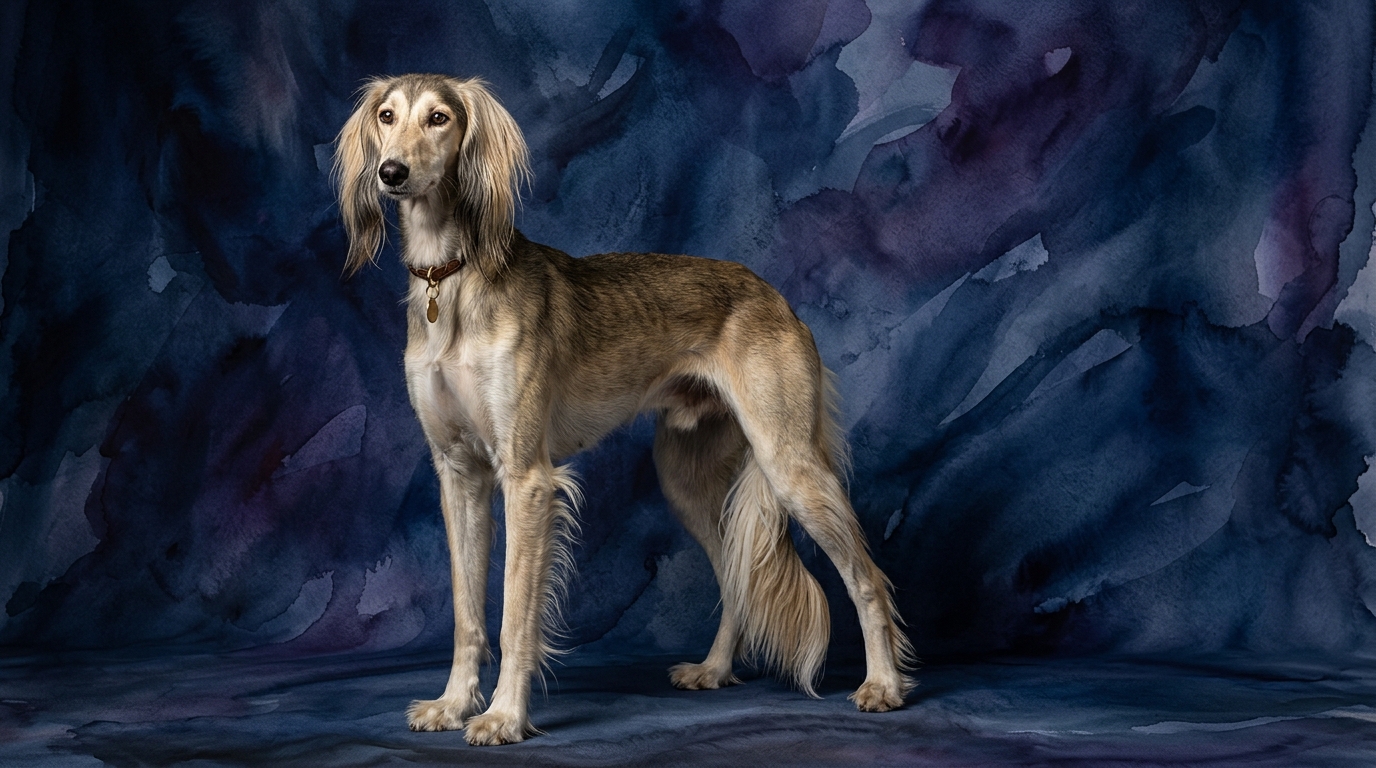
In contrast, the Saluki, an ancient Sighthound, does not appear on Stanley Coren's ranking, which often favors breeds with a strong inclination towards obedience. Its IQ profile largely mirrors the Old English Sheepdog in several dimensions, with Problem Solving at 3/5, Training Speed at 3/5, Social Intelligence at 3/5, and Instinctive Drive also at 3/5. However, a key difference emerges in its Memory, which is rated 3/5. This profile suggests a breed whose cognitive abilities are honed for independent action and swift decision-making rather than the cooperative, detail-oriented work of a herder.
Where the Old English Sheepdog Excels Cognitively
The Old English Sheepdog's cognitive strengths are deeply rooted in its pastoral heritage, where its intelligence facilitated complex, dynamic tasks. Its superior Memory, rated at 4/5, is a significant asset, allowing it to recall intricate herding patterns, the specific locations of individual sheep, and sequences of commands from a handler even amidst the chaos of a moving flock. This robust memory underpins its reliability and effectiveness in managing livestock.
Its Problem Solving at 3/5, combined with a 3/5 for Training Speed, translates into an ability to learn and adapt to varied environmental challenges, such as navigating difficult terrain or re-gathering dispersed animals. This isn't abstract problem-solving, but rather practical application—identifying the most efficient route to bring sheep to the pen or understanding when to apply gentle pressure versus a more assertive nudge. The OES’s Social Intelligence at 3/5 ensures it is attuned to a handler's subtle signals, making it an excellent partner in collaborative work where nuanced communication is paramount.
Where the Saluki Shines Cognitively
The Saluki's cognitive profile, while sharing some numerical similarities, points to a fundamentally different operational intelligence, shaped by millennia of independent hunting in vast, open spaces. Its Problem Solving at 3/5 is less about cooperative tasks and more about autonomous decision-making in pursuit: calculating optimal interception paths, predicting prey movements, and navigating complex landscapes at high speeds. This is a swift, instinct-driven application of intellect, where a split-second decision can mean success or failure.
The Saluki's Instinctive Drive, also 3/5, is almost entirely directed towards its sighthound purpose: identifying, pursuing, and capturing prey. This intense focus means its 'social intelligence' at 3/5 might manifest as an understanding of human intent but a prioritization of its own strong prey drive when triggered. Its Memory at 3/5 is perfectly adequate for recalling hunting grounds, favored routes, and the general layout of its territory, rather than needing to store multi-step sequential commands for a human partner. The Saluki's brilliance lies in its self-reliance and the elegance of its predatory strategy.
Training Dynamics: Old English Sheepdog vs. Saluki
When it comes to training, both breeds score 3/5 for Training Speed, but their motivations and approaches differ significantly. The Old English Sheepdog, with its Coren rank of #44 and strong herding background, generally approaches training with an eagerness to engage and a desire to work in partnership. Their 4/5 memory helps them quickly solidify commands and routines, making them responsive to consistent, positive reinforcement. An OES often thrives on having a 'job' and will find satisfaction in mastering new tasks and pleasing its handler, making structured obedience training a rewarding experience for both.
The Saluki, while capable of learning at a similar pace (3/5 Training Speed), often presents a different training challenge due to its independent nature and powerful instinctive drive (3/5 for hunting). A Saluki might understand a command perfectly but choose not to comply if it doesn't perceive immediate value or if a more compelling stimulus (like a squirrel) captures its attention. Training a Saluki requires immense patience, creativity, and a deep understanding of sighthound temperament, leveraging their intelligence to make training a game rather than a command-and-obey dynamic. Consistency and positive reinforcement are key, but handlers must acknowledge their dog's inherent self-direction.
Matching Lifestyles: Active Owners vs. Relaxed Owners
For owners seeking an active and mentally engaged companion, the Old English Sheepdog is an excellent choice. While their physical exercise needs are moderate to high, their cognitive needs are substantial. They thrive with owners who can provide consistent training, puzzle toys, and activities that tap into their problem-solving and memory skills, such as agility, rally obedience, or even mock herding. An OES needs a sense of purpose and will become bored and potentially destructive without adequate mental stimulation and interaction, making them ideal for owners who enjoy structured activities and a true working partnership.
The Saluki, while requiring significant physical exercise—ideally daily opportunities to run at full speed in a secure area—often possesses a more relaxed demeanor indoors once their exercise needs are met. Their cognitive engagement is less about cooperative problem-solving and more about independent exploration and observation. Owners suited for a Saluki appreciate their quiet dignity and independence, providing outlets for their prey drive through lure coursing or secure off-leash running, but not necessarily demanding intense, continuous mental 'work' in the same way an OES does. They are perfect for owners who understand and respect a sighthound's self-possessed nature and enjoy quiet companionship after vigorous activity.
The Verdict: When to Choose Each Breed
The Verdict
Choose the Old English Sheepdog if you desire a highly engaged, cooperative companion eager to learn complex tasks and participate in structured activities, thriving on a partnership with its handler. Its memory and social intelligence make it a rewarding project for owners committed to consistent training and mental stimulation.
Opt for the Saluki if you appreciate an independent, elegant companion whose intelligence is geared towards swift, autonomous decision-making and whose loyalty is earned through respect rather than constant directives. This breed suits owners who can provide ample space for running and understand the unique, often self-directed, sighthound personality.
🧠 Find Your Pet's IQ Score
Our Pet IQ Lab assessment covers 25+ tests across 5 cognitive dimensions — personalized to your breed.
Take the Full IQ Test →Frequently Asked Questions
Is the Old English Sheepdog truly 'smarter' than a Saluki, given Coren's ranking?
Coren's ranking primarily assesses obedience intelligence, which the Old English Sheepdog's herding background makes it naturally adept at. The Saluki's intelligence is different, focused on independent problem-solving and instinctual prowess, which isn't directly measured by Coren's specific obedience-centric criteria. Both breeds possess significant cognitive abilities tailored to their historical roles.
What are the biggest training challenges for each breed?
For the Old English Sheepdog, the challenge lies in ensuring consistent mental engagement to prevent boredom, as their intelligence demands a 'job' or stimulating activities. For the Saluki, the primary challenge is their strong independent streak and prey drive, which means they might learn commands quickly but often choose whether to obey based on their own assessment of the situation or competing instincts. Patience and understanding their motivations are crucial.
Which breed is better suited for a first-time dog owner?
The Old English Sheepdog, with its cooperative nature and eagerness to please, might be a more manageable choice for a first-time owner willing to commit to regular training and mental stimulation. The Saluki's independence and intense prey drive often require an owner with prior experience managing sighthound traits and a deep understanding of their unique needs and motivations. Neither is truly 'easy' but the OES is generally more handler-focused.