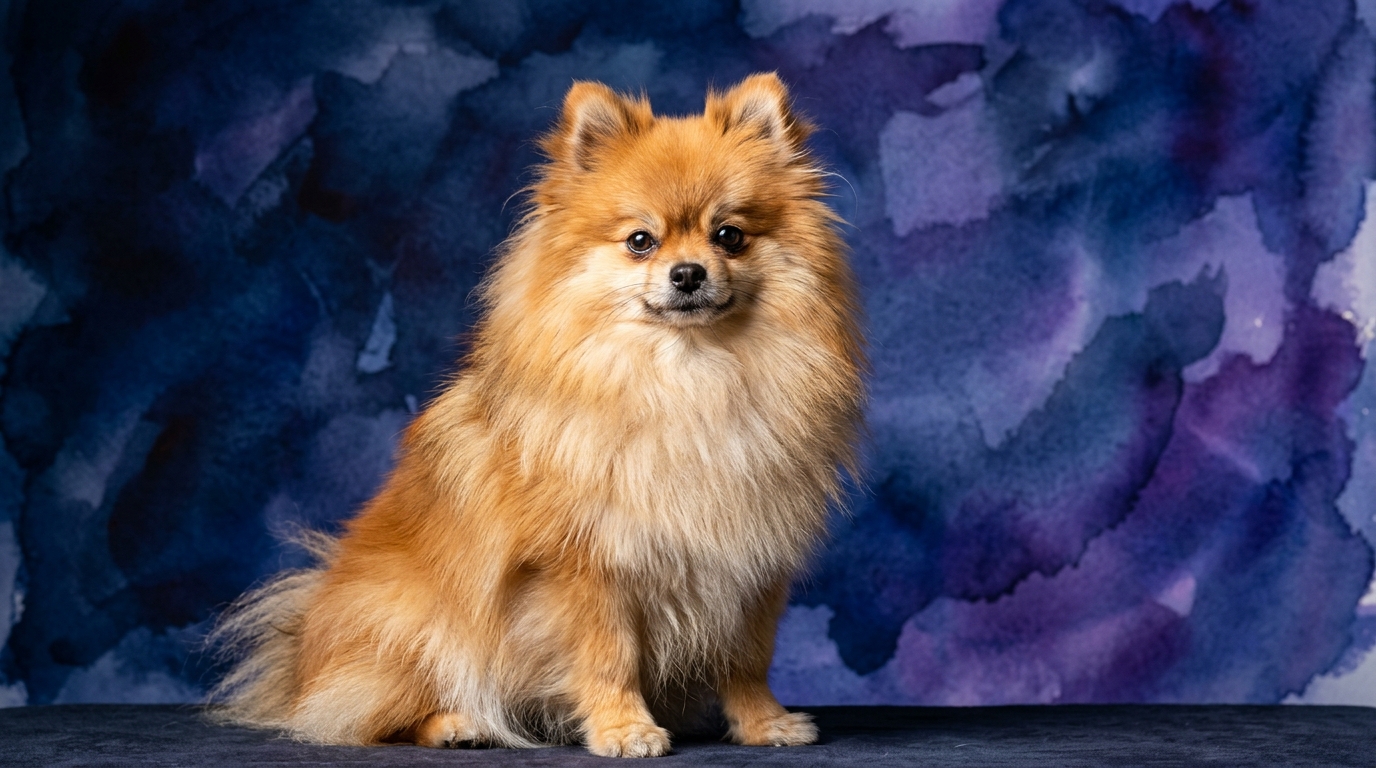

Side-by-Side IQ Profile: Pomeranian vs. Briard
The Cosmic Pet Pet IQ Lab employs a comprehensive framework to assess canine cognition, breaking down intelligence into five key dimensions. For the Pomeranian, a breed often celebrated for its lively personality, its Coren rank of #23 places it commendably high in working and obedience intelligence. Its cognitive profile is marked by a strong 4 out of 5 in Problem Solving, indicating an aptitude for navigating complex situations and figuring out novel solutions. Training Speed also registers at an impressive 4/5, suggesting a quick grasp of new commands and routines. Social Intelligence, crucial for interacting with humans and other animals, stands at a robust 4/5, while its Instinctive Drive, though present, is a moderate 3/5. Finally, the Pomeranian exhibits excellent Memory, scoring 4/5, allowing it to retain learned behaviors and experiences effectively.
In contrast, the Briard, a majestic Herding breed, holds a Coren rank of #30, still a respectable position reflecting its capacity for structured tasks. Its Problem Solving ability mirrors the Pomeranian's at 4/5, demonstrating an equal capacity for adaptive thinking. Similarly, its Training Speed is a solid 4/5, indicating it can learn new tasks with comparable efficiency. Where the Briard shows a slight divergence is in Social Intelligence, scoring 3/5, which suggests it might be a bit more reserved or less overtly attuned to subtle human social cues compared to the Pomeranian. Its Instinctive Drive is also a 3/5, reflecting its heritage but perhaps not as intensely as some other herding breeds. Memory, like the Pomeranian, is strong at 4/5, underscoring its ability to remember commands and routines over time.
Where the Pomeranian Wins Cognitively
The Pomeranian's cognitive edge becomes apparent when we examine its Social Intelligence score, which stands at 4/5 compared to the Briard's 3/5. This higher rating suggests a more acute sensitivity to human emotions, intentions, and social dynamics. A Pomeranian is often described as highly perceptive, quickly picking up on changes in its owner's mood or household atmosphere. This translates into a dog that might more readily seek out interaction, offering comfort or companionship precisely when needed, or understanding subtle non-verbal cues during daily interactions without explicit instruction. Their strong social acumen allows them to integrate seamlessly into family life, often becoming deeply bonded and responsive companions.
This enhanced social understanding also influences their capacity for what some might call 'people pleasing.' While both breeds score equally in training speed, the Pomeranian’s social intelligence can make the application of that speed feel more fluid in a domestic context. They often anticipate human desires, making collaborative activities like trick training or even just following household rules feel less like a chore and more like an intuitive partnership. This isn't just about learning commands; it's about understanding the context and purpose of those commands within the human social structure, an area where the Pomeranian's cognitive profile shines brightly.
Where the Briard Wins Cognitively
While the raw numerical scores for Problem Solving, Training Speed, Instinctive Drive, and Memory are identical or slightly lower for the Briard compared to the Pomeranian, it's crucial to interpret these metrics through the lens of breed function and application. The Briard, as a historical guardian and herding dog, applies its 4/5 Problem Solving and 4/5 Memory in contexts demanding sustained focus and independent decision-making over vast territories. Its problem-solving isn't just about figuring out a puzzle toy; it's about assessing environmental threats, managing livestock, or navigating complex outdoor scenarios with a robust, enduring mental effort. This breed's cognitive strengths are geared towards practical, often physically demanding, tasks that require resilience and self-reliance.
Furthermore, the Briard's instinctive drive, rated at 3/5, while numerically matching the Pomeranian, manifests differently. In a Briard, this drive is often channeled into protective behaviors and a strong sense of duty, requiring them to remember complex patterns and make judgments in dynamic situations, such as maneuvering a flock or patrolling property lines. Their cognitive processing is often less about quick social mirroring and more about methodical analysis and consistent execution in a working environment. This enduring cognitive stamina, coupled with a memory that serves long-term, complex tasks, allows the Briard to excel in roles demanding both physical and mental fortitude, a distinct cognitive advantage in specific working domains.
Which Is Easier to Train and Why
Both the Pomeranian and the Briard boast an impressive Training Speed score of 4/5, suggesting they are equally capable of learning new commands and routines quickly. However, the overall experience of training can differ significantly due to other cognitive factors. The Pomeranian’s superior Social Intelligence (4/5) often translates into a more eager-to-please demeanor and a heightened attunement to human cues, which can make initial training sessions feel more intuitive and responsive. They are often highly motivated by positive reinforcement stemming from human approval and attention, making them generally delightful to teach tricks or basic obedience. Their smaller size also means they are physically easier to manage during training, reducing potential challenges.
The Briard, while equally capable of learning commands efficiently (4/5 Training Speed), might present different training dynamics due to its slightly lower Social Intelligence (3/5) and strong herding instincts. While not less capable, a Briard might require a more structured and consistent approach, sometimes needing clearer, more direct instructions rather than relying on subtle social cues. Their inherent drive, even at 3/5, can mean they might be more easily distracted by environmental stimuli related to their herding or guarding instincts, necessitating greater focus from the trainer to maintain attention. Furthermore, their large size and strength mean that early, consistent training in manners and obedience is not just desirable but essential for a harmonious household. Therefore, while both learn quickly, the Pomeranian often feels "easier" to train in a typical companion setting due to its social eagerness and manageable physical presence.
Which Suits Active Owners vs. Relaxed Owners
The choice between a Pomeranian and a Briard largely hinges on an owner's lifestyle and capacity for engagement. For the more relaxed owner, the Pomeranian often presents a compelling option. Its smaller stature means its exercise requirements are modest, often satisfied with indoor play and short, regular walks. Its high Social Intelligence and memory make it an adaptable companion perfectly suited to apartment living or smaller homes, thriving on human companionship and mental stimulation through interactive games or learning new tricks within a domestic setting. They are typically content to curl up on the couch, offering affectionate presence, while still possessing the mental agility to engage in bursts of activity.
Conversely, the Briard is undeniably a match for active owners. As a Herding breed, its robust physical and mental attributes demand significant outlets. Its problem-solving and memory, coupled with its instinctive drive, mean it requires consistent, challenging mental stimulation beyond basic obedience. Long daily walks, hikes, or engaging in dog sports like agility, herding trials, or even advanced obedience are crucial to channel its energy and cognitive capacity constructively. A Briard thrives when given a "job," whether it's guarding the home, participating in structured training, or accompanying its owner on extensive outdoor adventures. Without sufficient engagement, its formidable intelligence and drive can lead to boredom and potentially destructive behaviors, making it less suitable for owners seeking a low-maintenance, sedentary companion.
The Verdict
Choose a Pomeranian if you seek a highly socially attuned, adaptable companion for a more relaxed lifestyle, appreciating its quick learning in a domestic context.
Opt for a Briard if you're an active owner committed to providing extensive physical and mental challenges for a robust, independent-thinking working companion.
🧠 Find Your Pet's IQ Score
Our Pet IQ Lab assessment covers 25+ tests across 5 cognitive dimensions — personalized to your breed.
Take the Full IQ Test →Frequently Asked Questions
Do Pomeranians and Briards have similar memory capabilities?
Yes, both breeds score an impressive 4/5 in memory according to the Pet IQ Lab, indicating a strong capacity for retaining learned behaviors, commands, and experiences over time. This cognitive strength benefits both breeds in various aspects of training and daily interaction.
How does social intelligence impact their suitability as family pets?
A Pomeranian's higher social intelligence (4/5) suggests it may be more attuned to family dynamics and human emotions, potentially making it more adaptable and overtly affectionate. A Briard's 3/5 social intelligence indicates it might be more reserved initially, requiring consistent, positive interaction to form strong bonds.
Are there any significant differences in their problem-solving skills?
Numerically, both breeds achieve a 4/5 in problem-solving. The distinction lies more in the application of this skill; a Pomeranian might apply it to navigating a home, while a Briard uses it for more complex, enduring tasks typical of a herding or guardian role.