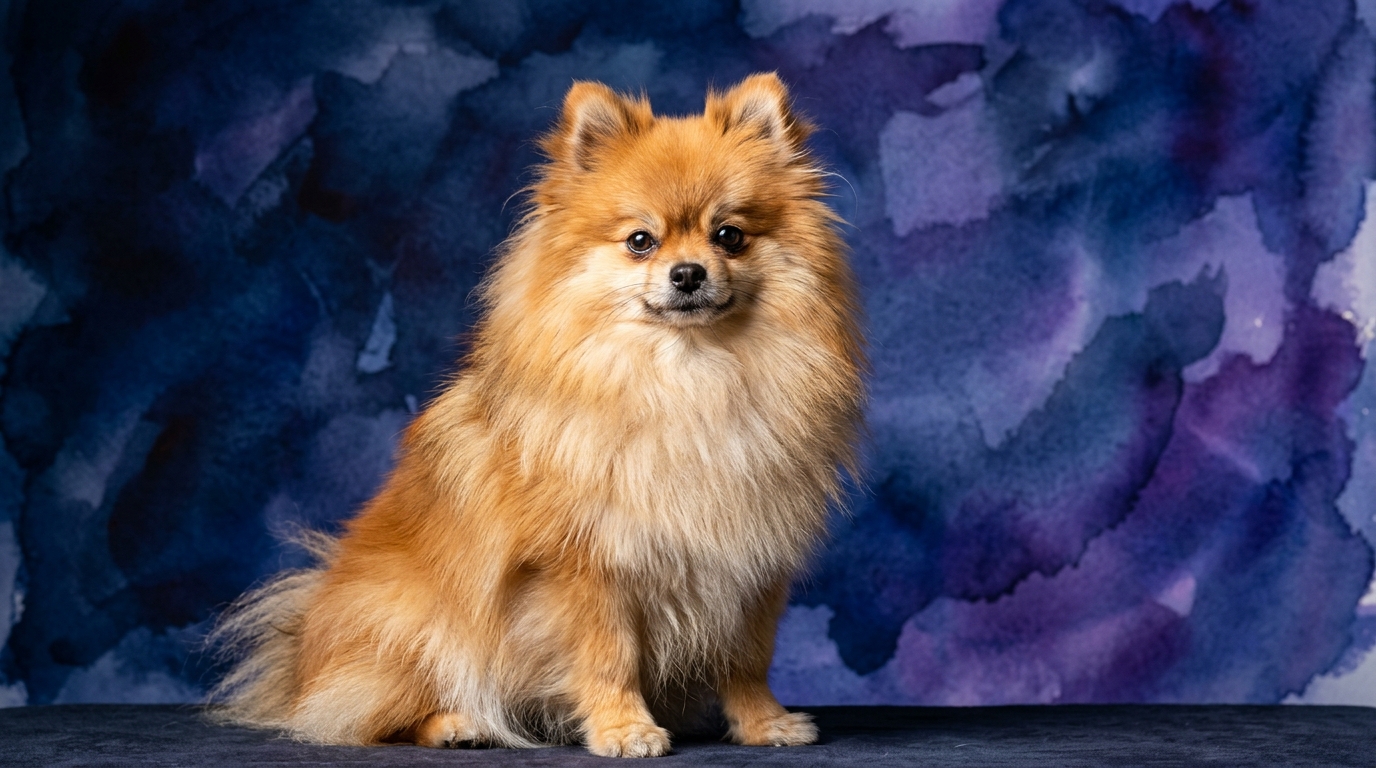

Side-by-Side Cognitive Profiles: Pomeranian vs. Rhodesian Ridgeback
The Cosmic Pet Pet IQ Lab's assessment offers a granular look into the cognitive strengths of these two distinct breeds. The Pomeranian, a Toy group member with a Coren rank of #23, consistently demonstrates elevated scores across most intelligence dimensions. Its Problem Solving is rated 4/5, indicating a strong capacity for navigating novel situations and figuring out puzzles. Training Speed also sits at 4/5, suggesting a quick uptake of new commands and routines. Social Intelligence, at 4/5, points to a keen awareness of human cues and emotional states, while Memory, also 4/5, reflects a solid retention of learned behaviors and experiences. Its Instinctive Drive, however, is a moderate 3/5, often manifesting as alertness and watchfulness.
In contrast, the Rhodesian Ridgeback, a Hound group member with a Coren rank of #52, exhibits a more uniform and slightly lower cognitive profile in our assessment. Its Problem Solving capability is rated 3/5, implying a thoughtful but perhaps less immediate approach to new challenges. Training Speed is also 3/5, indicating a steady learning pace that may require more consistent reinforcement. Social Intelligence scores 3/5, suggesting a deep bond with its inner circle but often a reserved demeanor towards outsiders. Its Instinctive Drive, matching the Pomeranian at 3/5, is geared towards its historical hunting and guarding roles, while Memory, at 3/5, indicates a practical retention of information pertinent to its environment and tasks.
Where the Pomeranian Shines Cognitively
The Pomeranian's cognitive strengths are evident in its quick-witted adaptability and responsiveness. With a Problem Solving score of 4/5, Pomeranians often demonstrate an impressive ability to work through household conundrums or quickly adapt to new environments. This breed's 4/5 Training Speed means they frequently pick up new commands and tricks with remarkable alacrity, making them engaging participants in positive reinforcement sessions. Their superior Social Intelligence (4/5) allows them to adeptly read human emotions and intentions, fostering highly communicative relationships and often anticipating their owner's next move. Furthermore, their strong Memory (4/5) ensures they retain these learned behaviors and social nuances over extended periods, contributing to their reputation as responsive and consistent companions.
Unique Aptitudes of the Rhodesian Ridgeback
While the Rhodesian Ridgeback's scores might appear lower across several metrics, its cognitive profile is uniquely suited to its historical role as a hunter and guardian, embodying a different kind of operational intelligence. Their Problem Solving, rated 3/5, is often applied to complex, real-world scenarios requiring endurance and strategic thinking, such as tracking, rather than quick parlor tricks. Their Instinctive Drive, also 3/5, manifests as a formidable capacity for independent decision-making in pursuit, exhibiting a self-reliant intelligence crucial for tracking and holding large game. This drive is not about speed of thought in a domestic setting, but rather persistence and focus in demanding outdoor environments. The breed's Memory, though 3/5, is particularly effective for remembering terrain, scents, and the nuances of their environment, critical for their original purpose.
Trainability: A Tale of Two Temperaments
When considering ease of training, the Pomeranian generally presents as the more straightforward student. Their higher Training Speed score of 4/5 means they typically grasp new commands and routines with greater alacrity, often showing eagerness to engage in learning sessions. Their superior Social Intelligence also contributes significantly, making them highly attuned to human cues and motivations, which streamlines the communication process during training. This combination often results in a dog that is keen to please and quick to integrate new behaviors into its repertoire, responding well to varied training techniques and quickly forming associations.
Rhodesian Ridgebacks, while certainly capable learners with a Training Speed of 3/5, tend to require more consistent, patient, and engaging training methods. Their inherent independence and strong instinctive drives, stemming from their hound heritage, mean they might require more motivation to comply, often weighing the command against their own inclinations or environmental distractions. Training success with a Ridgeback often relies on building a strong, trust-based relationship and making the learning process a collaborative, rewarding experience, rather than simple rote memorization. Owners need to understand their deliberate nature and work with it, rather than against it, to achieve consistent results.
Matching Canine Cognition to Owner Lifestyles
The cognitive makeup of these breeds significantly influences their suitability for different owner lifestyles. A Pomeranian, with its high Problem Solving, Training Speed, Social Intelligence, and Memory, thrives with owners who enjoy interactive play, can provide consistent mental stimulation, and appreciate a companion that is readily available for engagement. While small, they are not purely 'lap dogs' and flourish when given opportunities to engage their minds through puzzle toys, trick training, or short, frequent walks that stimulate their senses. Their alertness also makes them excellent watchdogs, quick to signal changes in their environment.
The Rhodesian Ridgeback's cognitive profile, characterized by its independent Problem Solving and strong Instinctive Drive, suits owners who are prepared for significant physical activity and who can provide structured mental challenges. Their sustained drive and sturdy build mean they excel in activities like hiking, running, or scent work, requiring an owner capable of matching their energy and providing ample outdoor exploration. Their independent nature also suits owners who appreciate a dog that can be self-sufficient at times, but still thrives on a strong, leadership-based bond and clear boundaries, fostering a companion that is protective and discerning.
The Verdict
Choose a Pomeranian if you seek a highly responsive, socially attuned companion who enjoys interactive learning and thrives in a stimulating, communicative home environment.
Opt for a Rhodesian Ridgeback if you are an active owner prepared to offer consistent physical challenges and patient, trust-based training to a self-reliant companion with a strong sense of purpose.
🧠 Find Your Pet's IQ Score
Our Pet IQ Lab assessment covers 25+ tests across 5 cognitive dimensions — personalized to your breed.
Take the Full IQ Test →Frequently Asked Questions
Do Pomeranians bark a lot due to their intelligence?
Pomeranians' alertness and social intelligence mean they are often quick to vocalize perceived threats or excitement, a trait tied to their watchfulness and their role as small but effective alarm systems rather than a lack of cognitive control.
Are Rhodesian Ridgebacks stubborn?
Rhodesian Ridgebacks are not stubborn in the sense of being unintelligent; rather, their independent problem-solving and strong instinctive drives mean they often make their own assessments, requiring owners to establish clear, consistent communication and motivation during training.
Can a Rhodesian Ridgeback live in an apartment?
While adaptable, a Rhodesian Ridgeback's substantial size and need for considerable physical exercise and mental engagement make a spacious home with yard access or a very active owner committed to daily outdoor adventures more suitable than a typical apartment setting.