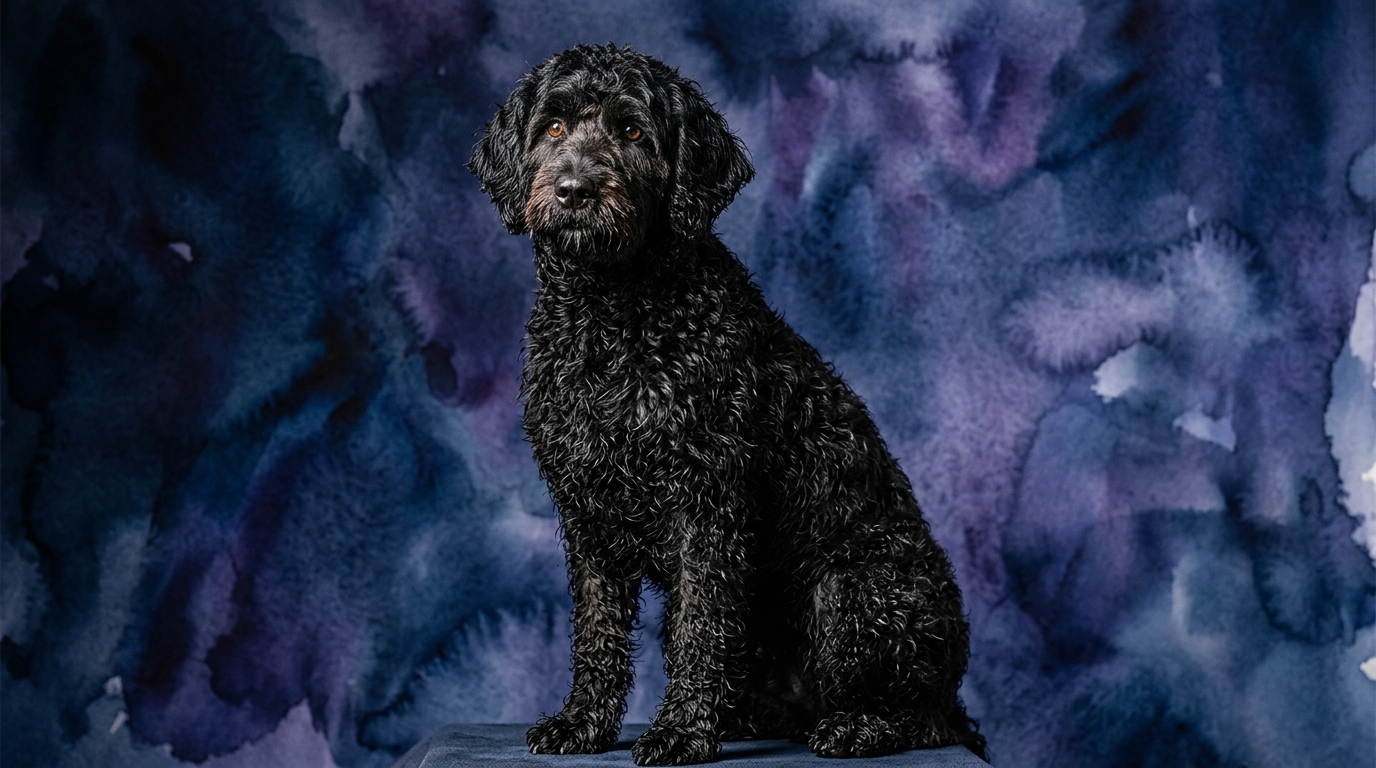

Side-by-Side Cognitive Profile: Portuguese Water Dog vs. Leonberger
The Cosmic Pet Pet IQ Lab employs a five-dimensional framework to assess canine intelligence, providing a granular view beyond simple obedience. Both the Portuguese Water Dog (PWD) and the Leonberger register identical scores across all five dimensions: Problem Solving 3/5, Training Speed 3/5, Social Intelligence 3/5, Instinctive Drive 3/5, and Memory 3/5. This symmetrical scoring indicates that neither breed holds an inherent 'smarter' advantage in overall cognitive capacity, but rather, their intelligence manifests in different, breed-appropriate ways.
For Problem Solving (3/5), both breeds demonstrate a solid capacity to navigate moderately complex challenges. The PWD, historically a fisherman's companion, might apply this to figuring out how to retrieve a specific object from water or manipulating a novel puzzle toy with enthusiasm. Their problem-solving often involves physical interaction with their environment, driven by a desire to work alongside their human. The Leonberger, a majestic family guardian, might exhibit their problem-solving by understanding household routines, figuring out how to comfort a distressed family member, or subtly navigating a crowded room to stay close to their people. Their approach tends to be more deliberate, often rooted in social observation and environmental awareness.
Training Speed (3/5) indicates that both breeds learn new commands and routines at a moderate pace, requiring consistent and positive reinforcement. A PWD often approaches training with an eager, energetic demeanor, quick to engage and repeat actions for a reward, whether it's a treat or a joyful interaction. They thrive on variety and physical challenges, making them apt pupils for agility or complex trick sequences. The Leonberger, while equally capable of learning, typically processes information with a more thoughtful, sometimes independent, disposition. They might take a moment longer to internalize a command but once they understand its purpose and their role, they perform with unwavering reliability. Their motivation often stems from pleasing their family and maintaining harmony.
Social Intelligence (3/5) highlights a good understanding of human cues and social dynamics in both breeds. The PWD's social intelligence often manifests as a keen awareness of their handler's subtle body language and vocal inflections, which is crucial for their cooperative working heritage. They are adept at forming strong bonds and often seek to be involved in all family activities, interpreting human moods and responding with playful or comforting gestures. The Leonberger's social intelligence is deeply rooted in their role as a family companion and guardian. They are remarkably perceptive of emotional states within their human 'pack,' often offering quiet comfort or a reassuring presence. Their ability to discern friend from stranger, and to understand the nuanced social hierarchy of a home, is a testament to their strong social cognition.
Instinctive Drive (3/5) points to moderate, but distinct, inherent motivations. The PWD's drive is heavily influenced by their aquatic heritage and their role as a working dog. This translates into a strong desire to retrieve, swim, and engage in tasks that require physical exertion and mental focus, often directed by a human partner. Their drive for engagement is palpable. The Leonberger's instinctive drive is primarily centered on companionship, loyalty, and a gentle guardianship of their family. While not typically a high-energy working dog in the same vein as a PWD, their drive to be a protective, comforting presence is profound. They possess a natural inclination to stay close to their family, observing and responding to their needs.
Memory (3/5) signifies that both breeds possess a solid capacity for recalling commands, routines, and past experiences over time. A PWD might retain complex sequences of commands for advanced sports or remember intricate routes taken during adventures, associating them with specific actions or rewards. Their memory is often tied to dynamic, interactive experiences. The Leonberger's memory is robust for recognizing individuals, remembering household rules, and recalling specific interactions, which contributes to their stable and predictable temperament within a family setting. They are excellent at remembering faces and routines, making them reliable and consistent companions.
Where the Portuguese Water Dog Excels Cognitively
While their IQ scores are identical, the Portuguese Water Dog often demonstrates an edge in cognitive application where agility, rapid adaptability to changing environments, and cooperative problem-solving are paramount. Their historical role as 'fishing dogs' required them to think quickly on their feet (or paws), retrieving lost gear, herding fish into nets, and relaying messages between boats and shore. This heritage imbues them with a remarkable capacity for dynamic problem-solving, where the 'problem' itself might be constantly shifting. A PWD excels at tasks that demand both physical prowess and mental processing, such as navigating an intricate agility course or figuring out how to unlatch a gate while carrying an object. Their training speed, while a 3/5, feels quicker in contexts requiring high energy and handler interaction, as their enthusiasm and desire to engage often translate into faster uptake of new, active commands. Their social intelligence is finely tuned to human instruction and collaboration, making them exceptionally responsive partners in tasks where precise, real-time communication is key.
Where the Leonberger Excels Cognitively
The Leonberger, despite its matching IQ scores, reveals its cognitive strengths in areas requiring calm discernment, profound social empathy, and a stable, reliable temperament. Their heritage as multi-purpose farm dogs and noble companions equipped them with an exceptional capacity for discerning intent and maintaining a peaceful presence. A Leonberger’s problem-solving, also a 3/5, often manifests in subtle ways, such as understanding the complex dynamics of a multi-pet household or figuring out how to position themselves to offer comfort to a child without being overly intrusive. Their social intelligence is particularly strong in recognizing and responding to human emotional states, acting as a gentle, reassuring presence. This breed excels in situations demanding patience and a deep understanding of social cues, making them exceptional therapy dogs or family companions who intuitively know when to be playful and when to be quietly supportive. Their memory (3/5) is particularly robust for people and routines, contributing to their consistent and trustworthy nature, allowing them to form deep, lasting bonds and reliable household behaviors.
Training Dynamics: PWD vs. Leonberger
Given their identical Training Speed scores of 3/5, neither breed is inherently 'easier' to train in terms of raw learning capacity, but their behavioral differences necessitate distinct approaches. The Portuguese Water Dog's inherent enthusiasm, high energy, and eagerness to work cooperatively with their human partner can make them appear to learn faster in active, engaging training sessions. They thrive on variety, consistent positive reinforcement, and tasks that challenge both their minds and bodies. Their strong instinctive drive for interaction and retrieving means they are often highly motivated by toys and play, making training feel like a game. Owners must be prepared to provide consistent mental stimulation and physical outlets to channel this energy constructively, as an under-stimulated PWD can become quite creative in finding their own 'work,' which might not always align with human preferences.
The Leonberger, while equally capable of learning, often approaches training with a more deliberate and thoughtful pace. Their motivation is often rooted in pleasing their family and maintaining a harmonious environment, rather than a relentless drive for activity. Training a Leonberger requires patience, gentle consistency, and an understanding of their sensitive nature. They respond best to positive reinforcement and clear, calm communication, and can be sensitive to harsh corrections. Once a Leonberger understands a command and its purpose, their memory and desire to comply ensure remarkable reliability. However, their independent streak means they may occasionally require more motivation to *initiate* a task, especially if they don't immediately see its relevance. For both breeds, early socialization and consistent training are critical for harnessing their cognitive potential effectively.
Lifestyle Match: Active Owners vs. Relaxed Owners
The choice between a Portuguese Water Dog and a Leonberger often comes down to an owner's lifestyle and energy levels, despite their similar IQ scores. The Portuguese Water Dog is an ideal match for active owners who seek a canine partner for adventures and structured activities. Their historical role demands a significant outlet for their physical and mental energy, making them excellent companions for hiking, swimming, dog sports like agility or dock diving, and extensive daily walks. They thrive in environments where they are consistently challenged and involved in family activities, providing a constant source of engagement and spirited interaction. Owners who can commit to providing regular, vigorous exercise and mental stimulation will find a PWD to be an exceptionally rewarding and bright companion.
Conversely, the Leonberger is better suited for owners who appreciate a more relaxed, yet deeply devoted, companion. While they do require moderate daily exercise to maintain their physical and mental well-being, their needs are typically less intense than those of a PWD. They enjoy leisurely walks, playtime in a securely fenced yard, and most importantly, being an integral part of their family's daily life. Their calm demeanor and strong social intelligence make them wonderful companions for families, often content to lounge near their loved ones, observing and offering quiet companionship. Owners looking for a gentle giant with a protective instinct and a loving, steady presence will find the Leonberger to be an excellent fit.
The Verdict: When to Choose Each Breed
The Verdict
Choose the Portuguese Water Dog if you are an active individual or family seeking an energetic, highly interactive canine partner for sports, outdoor adventures, and consistent mental challenges.
Opt for the Leonberger if you desire a calm, devoted, and gentle giant who thrives on deep family bonds, offering a steady, protective presence with moderate exercise needs.
🧠 Find Your Pet's IQ Score
Our Pet IQ Lab assessment covers 25+ tests across 5 cognitive dimensions — personalized to your breed.
Take the Full IQ Test →Frequently Asked Questions
Do Portuguese Water Dogs and Leonbergers have the same intelligence?
According to The Cosmic Pet Pet IQ Lab, both breeds share identical scores across all five cognitive dimensions: Problem Solving 3/5, Training Speed 3/5, Social Intelligence 3/5, Instinctive Drive 3/5, and Memory 3/5. This indicates a comparable overall cognitive capacity, though their intelligence manifests in breed-specific behavioral nuances.
Which breed is easier to train, PWD or Leonberger?
Both breeds have a Training Speed of 3/5, meaning they learn at a moderate pace. The PWD's high energy and eagerness to please might make them seem quicker in active training, while the Leonberger's thoughtful nature requires more patience but yields reliable, consistent results once motivated. The 'easier' breed depends on the owner's training style and what motivates the individual dog.
Are Portuguese Water Dogs good family dogs?
Yes, Portuguese Water Dogs can be excellent family dogs, especially for active families willing to provide consistent exercise and mental stimulation. They form strong bonds, are playful, and thrive on being included in family activities, demonstrating strong social intelligence and a desire for interaction.