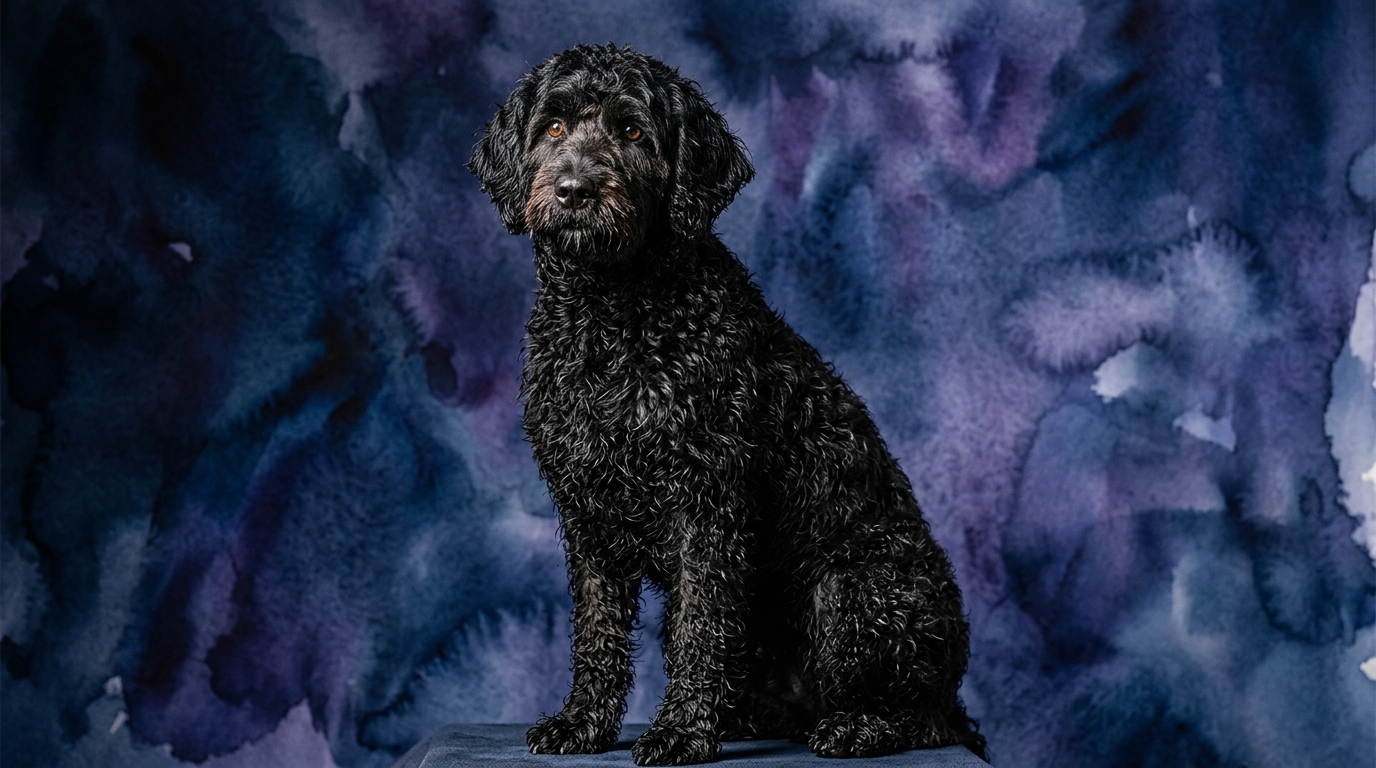
Portuguese Water Dog at a glance
| IQ Rank / Score | 18/25 |
|---|---|
| Trainability | ★★★★☆ (4/5) |
| Social Intelligence | ★★★★☆ (4/5) |
| Lifespan | 11-14 years |
| Shedding | Low to moderate |
| Exercise Needs | High (60+ min/day + training) |
| Origin | Portugal |
The Dynamic Aquatic Mind: A Legacy of Versatility
The Portuguese Water Dog's intelligence is fundamentally shaped by its historical role as an indispensable maritime assistant. Unlike many land-based working breeds, the PWD wasn't merely a retriever; it was a multi-modal problem-solver, adept at tasks ranging from herding fish into nets and retrieving lost gear from treacherous waters to delivering messages between boats and shore. This demanded not just obedience, but independent thought, adaptability to changing conditions, and a proactive approach to complex, fluid environments.
This unique heritage instilled in the PWD a cognitive framework prioritizing ingenuity and resourcefulness over rote memorization. They learned to assess dynamic situations—like swift currents or a submerged fishing net—and devise effective solutions, often out of direct sight or command. This translates today into a dog that thrives on mental challenges, exhibiting a remarkable capacity for creative problem-solving and an innate desire for a "job" to do, however unconventional.
Centuries of Seafaring Savvy: The PWD's Cognitive Evolution
The historical demands placed on the Portuguese Water Dog fostered a profound cognitive versatility. Their tasks required not only physical prowess in the water but also sophisticated discrimination skills. For instance, distinguishing between different types of fishing gear or identifying the correct boat for message delivery demonstrates advanced associative learning and object recognition. This level of discernment goes beyond basic instinct, pointing to a high degree of cognitive processing crucial for their partnership with human fishermen.
Moreover, the PWD's historical tasks often involved a significant degree of independence. While working alongside their human companions, they frequently operated at a distance, making crucial decisions about navigation, retrieval strategy, and even timing without direct instruction. This cultivated strong spatial awareness, memory for complex sequences, and an internal motivation to complete tasks, reflecting a self-directed problem-solving capability rare in many breeds.
Beyond Basic Brains: Problem-Solving & Adaptability
PWDs excel in problem-solving scenarios that require more than simple trial-and-error. Their intelligence is characterized by an ability to analyze situations, anticipate outcomes, and adjust their strategy on the fly. This trait is evident when they tackle puzzle toys with determined focus or figure out how to access forbidden areas, often by manipulating objects or overcoming barriers with surprising ingenuity. This makes them highly engaging but also demanding companions for owners who appreciate a truly thinking dog.
Adaptability is another hallmark of the Portuguese Water Dog's cognitive profile. Bred to work in diverse aquatic conditions, from calm harbors to rough open seas, they learned to quickly adjust their behavior and tactics to new stimuli and environments. This cognitive flexibility means they can often excel in a variety of modern dog sports, from agility and obedience to dock diving and rally, readily learning new rules and adapting to different performance settings with enthusiasm.
Unleashing the Instinct: Purpose-Driven Intelligence
The PWD possesses an exceptionally strong instinctive drive for purposeful activity, rooted in their working heritage. This isn't merely a desire to play; it's an innate need to engage in tasks that feel meaningful. Their high retrieve drive extends beyond fetching a ball; they often demonstrate a deep satisfaction from 'helping' by carrying items, 'finding' hidden objects, or participating in any activity that simulates their ancestral tasks. Ignoring this drive leads to boredom, which their intelligent minds will quickly remedy with self-created (and often undesirable) activities.
This powerful drive is intrinsically linked to their trainability and intelligence. They are eager to learn and please, particularly when training involves complex sequences, problem-solving, or activities that engage their retrieving and water instincts. Understanding and channeling this instinct into positive outlets, such as dog sports, water work, or advanced obedience, is key to unlocking their full cognitive potential and ensuring a well-adjusted, happy Portuguese Water Dog.
Harnessing the Brain Power: Engagement for a Happy PWD
Living with a Portuguese Water Dog means committing to consistent mental stimulation. Their high intelligence and drive demand more than just physical exercise; they need daily brain games, puzzle feeders, and ongoing training to prevent boredom and destructive behaviors. Early and continuous socialization is also crucial for shaping their social intelligence, ensuring they channel their innate curiosity and confidence into positive interactions rather than assertive independence.
For an owner, engaging a PWD means being creative and consistent. Introduce novel commands, teach complex tricks, participate in canine sports, or even train them to help with household chores. Their memory is excellent, allowing them to build an extensive repertoire of learned behaviors, while their social intelligence ensures they thrive on collaborative learning. A challenged and engaged PWD is a joy to behold, demonstrating loyalty, enthusiasm, and a profound partnership.
3 At-Home Tests to Measure Your Portuguese Water Dog's IQ
These tests are adapted from peer-reviewed ethology research. No equipment is needed beyond items you have at home. Run each test 5–10 times for reliable results.
The Myth: "Portuguese Water Dogs are so intelligent they practically train themselves."
✅ While highly intelligent, PWDs are also brimming with energy and a strong drive for purposeful activity. Without consistent, challenging training and ample mental outlets, their intelligence can manifest as boredom, frustration, and destructive behaviors. Their innate problem-solving ability means they'll create their own "jobs" if not provided with structured ones, often to their owner's chagrin. Their intelligence is a powerful tool that needs constant direction and engagement.
Portuguese Water Dog vs. Similar Breeds
🧠 What's Your Dog's IQ Score?
Our full Pet IQ Lab assessment includes 12+ tests across 5 cognitive dimensions, calibrated for Portuguese Water Dogs specifically.
Take the Full IQ Test →Frequently Asked Questions
How smart is a Portuguese Water Dog?
Our Pet IQ Lab framework scores cognition across five dimensions (max 25). The Portuguese Water Dog totals 18/25 — high for a domestic dog. The full article breaks down each dimension with at-home tests.
Are Portuguese Water Dogs easy to train?
Portuguese Water Dogs are generally easy to train when you use consistent, reward-based sessions. They score 4/5 on Training Speed in our breed profile.
Are Portuguese Water Dogs good with children and other pets?
Yes — their Social Intelligence rates 4/5 in our Pet IQ Lab framework. With early socialization and supervised play, most Portuguese Water Dogs integrate well into families with respectful children and other pets.
Do Portuguese Water Dogs need a lot of mental stimulation?
Absolutely. With Problem Solving 3/5 and Instinctive Drive 4/5, Portuguese Water Dogs need daily mental work — puzzle feeders, scent games, training sessions, or nose-work — to avoid boredom.
How much exercise does a Portuguese Water Dog need?
Portuguese Water Dogs need active engagement. Plan for 45-60 minutes of exercise and training per day, plus mental stimulation.
How good is a Portuguese Water Dog's memory?
Portuguese Water Dogs score 3/5 on memory. They remember high-value associations well; less-used cues fade without refresher sessions.
What is the typical lifespan of a Portuguese Water Dog?
Expect a lifespan of 11-14 years for a healthy Portuguese Water Dog.
The Portuguese Water Dog stands as a testament to specialized cognitive evolution, embodying a unique blend of dynamic problem-solving, independent judgment, and unwavering partnership. Understanding and nurturing their distinct aquatic intelligence is the key to a harmonious relationship, transforming their profound mental capabilities into boundless companionship and a truly engaged life.