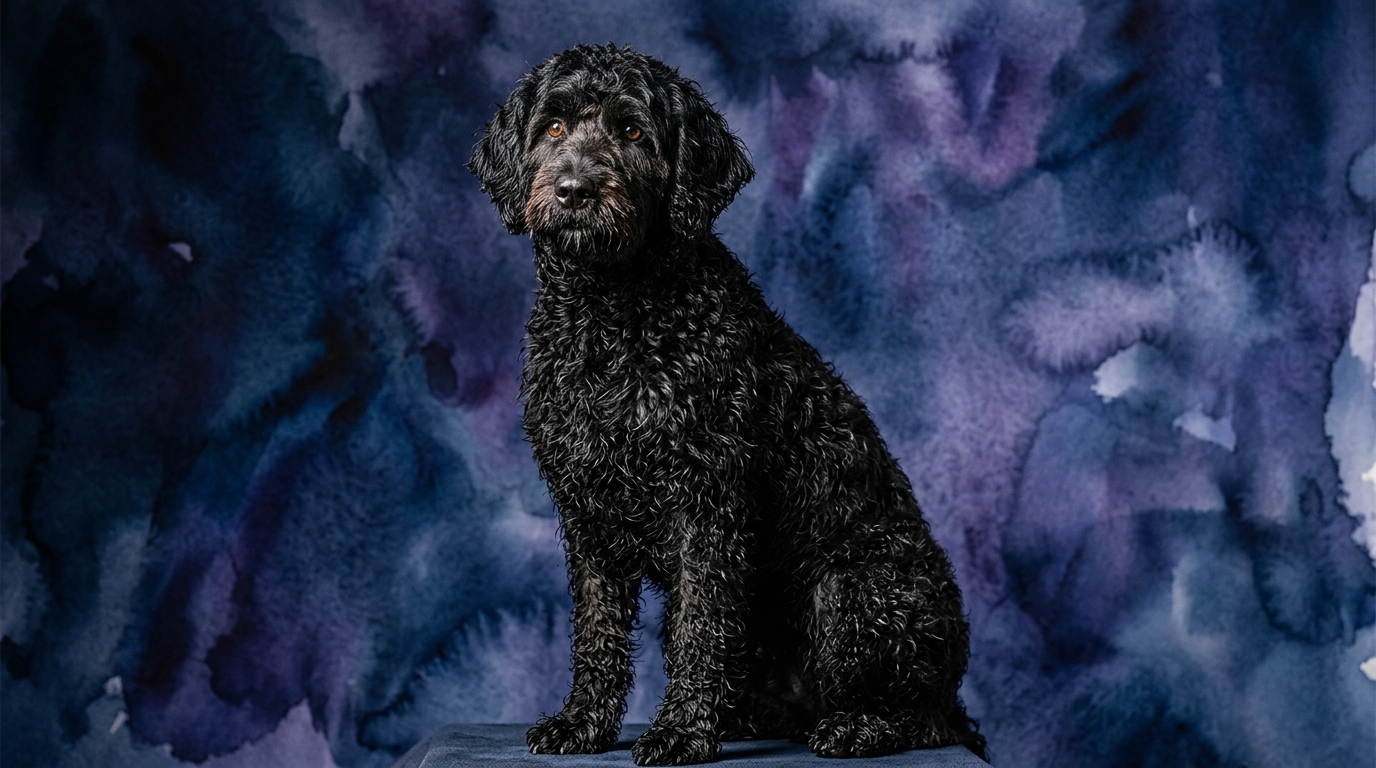

Side-by-Side IQ Profile: Understanding Similar Scores, Different Expressions
At first glance, the Portuguese Water Dog (PWD) and the Neapolitan Mastiff appear to share identical cognitive profiles according to The Cosmic Pet Pet IQ Lab, with both breeds scoring 3/5 across all five dimensions: problem Solving, training Speed, social Intelligence, instinctive Drive, and memory. However, these identical numerical ratings mask a rich tapestry of behavioral nuances unique to each breed’s lineage and purpose. A '3/5' in one breed is not merely a carbon copy in another; it is an assessment of their capacity within their specific breed context and typical expression.
For the **Portuguese Water Dog**, a 3/5 in **problem Solving** indicates a moderate capacity for creative solutions, often applied to dynamic tasks like retrieving objects from complex environments or navigating obstacles with agility. Their historical role as a fisherman's companion, herding fish into nets and retrieving lost gear, required adaptable thinking in varied aquatic settings. Their **training Speed** at 3/5 reflects a moderate pace of learning new commands, often balanced by an eager-to-please nature that makes them responsive to consistent, engaging methods. **Social Intelligence** at 3/5 for a PWD means they are generally adept at reading human cues and engaging interactively, forming strong bonds within their family unit and often seeking collaboration. Their **instinctive Drive** at 3/5 is strongly tied to their working heritage—a robust urge to fetch, swim, and be actively involved in tasks, which can translate into a need for mental and physical engagement. Finally, a 3/5 in **memory** suggests they retain learned behaviors and routines effectively, remembering commands, routes, and interactions over time, which is crucial for a working partner.
The **Neapolitan Mastiff**, also scoring 3/5 across the board, expresses these cognitive traits through a very different lens, shaped by their ancient role as a formidable guard and protector. Their 3/5 in **problem Solving** often manifests in a more independent and discerning manner, such as assessing potential threats, navigating their territory effectively, or figuring out the most comfortable spot for observation. This isn't about retrieving a toy, but about evaluating a situation. Their **training Speed** at 3/5 suggests they learn commands at a moderate pace, but their independent and sometimes stubborn nature means they require patient, firm, and consistent guidance, often needing to understand the 'why' behind a command rather than simply complying for compliance's sake. A 3/5 in **social Intelligence** for a Neapolitan Mastiff points to a deep, protective bond with their immediate family, exhibiting a nuanced understanding of household dynamics and often being reserved or wary with strangers. Their **instinctive Drive** at 3/5 is overwhelmingly focused on guardianship and protection, a profound impulse to survey, defend, and remain vigilant over their home and loved ones. Lastly, their 3/5 in **memory** means they reliably recall who belongs and who doesn't, remembering individuals they've met and the boundaries of their perceived territory, which is vital for their protective duties.
Where the Portuguese Water Dog Wins Cognitively
The Portuguese Water Dog demonstrates a cognitive edge in scenarios demanding active, interactive engagement and dynamic problem-solving within a collaborative framework. While both breeds score 3/5 in problem-solving, the PWD's manifestation leans towards tasks requiring agility, quick decision-making in changing environments, and an inherent desire to work *with* a human partner. Their historical role demanded they think on their feet, whether herding fish or retrieving items from turbulent waters. This translates into a dog that often excels in dog sports like agility or obedience trials, where understanding complex sequences and adapting to new challenges are key. Their social intelligence, while rated the same, is often expressed as a greater eagerness to interpret and respond to a wider range of human commands and subtle cues, making them more pliable in interactive learning settings. A PWD might intuitively understand a human's body language in a game of fetch, adjusting their retrieve based on where the human is looking or pointing, showcasing a more fluid application of their social and problem-solving capacities.
Where the Neapolitan Mastiff Wins Cognitively
Conversely, the Neapolitan Mastiff holds a cognitive advantage in situations requiring profound discernment, independent judgment, and unwavering loyalty rooted in a strong protective instinct. Their 3/5 problem-solving capacity shines in evaluating potential threats or anomalies within their environment, making calculated decisions about when and how to respond without constant human direction. This isn't about performing tricks; it's about assessing the security of their domain. Their social intelligence, also rated 3/5, is expressed as a deep, nuanced understanding of their family's safety and well-being, allowing them to differentiate between a friendly visitor and a perceived intruder with impressive accuracy. They remember faces and behaviors, building a mental catalog of who is 'safe' and who warrants suspicion. This breed's memory and instinctive drive coalesce to create a formidable guardian whose cognitive strengths lie in vigilance, territorial awareness, and a quiet, formidable presence that deters without necessarily needing active command. They win in contexts where a steadfast, discerning protector is paramount.
Which is Easier to Train and Why
When considering ease of training, the Portuguese Water Dog generally presents as more straightforward for the average owner, despite both breeds having a 3/5 training speed. The PWD's historical role fostered a strong desire for collaboration and engagement with their human handlers. They often possess a higher intrinsic motivation to perform tasks and respond to positive reinforcement, seeing training as a fun, interactive activity. Their moderate training speed is complemented by a zest for learning and a natural athleticism that makes them receptive to various commands and activities, from basic obedience to complex tricks or sports. They are typically less prone to independent decision-making during training sessions and are more inclined to follow direction, making early socialization and obedience training a more fluid process.
The Neapolitan Mastiff, while capable of learning at a moderate pace (3/5 training speed), often requires a different approach to training. Their deep-seated independence and protective instincts mean they are less inclined to perform simply for the sake of pleasing or for treats alone. Training a Neapolitan Mastiff demands immense patience, consistency, and a clear, confident leader. They respond best to fair, firm methods that establish trust and respect, rather than purely reward-based systems. Their training speed can be perceived as slower not because of a lack of capacity, but because of their discerning nature; they need to understand the purpose and value of a command before committing. Their guarding drive can also mean they are less focused on 'tricks' and more on observing their environment, requiring trainers to work with, rather than against, their natural inclinations. Early and extensive socialization is critical for this breed to ensure their protective instincts are well-managed and directed appropriately.
Which Suits Active Owners vs. Relaxed Owners
The Portuguese Water Dog is an ideal companion for active owners who relish daily engagement and outdoor adventures. Their instinctive drive, rated 3/5, combined with their moderate problem-solving and social intelligence, means they thrive on consistent mental and physical stimulation. They are built for movement, swimming, and interactive play, requiring significant exercise to prevent boredom and channeling their energetic nature constructively. Owners who enjoy hiking, running, dog sports, or simply long, engaging walks will find a PWD an enthusiastic and capable partner. Their need for involvement means they are not content to be couch potatoes; they want to be part of the action and will actively seek interaction and tasks.
The Neapolitan Mastiff, on the other hand, is better suited for more relaxed owners who appreciate a calm, watchful presence and a less demanding exercise routine, though their sheer size necessitates a certain level of physical management. While they need regular, moderate exercise to maintain health, their instinctive drive (3/5) is primarily expressed through guarding and territorial patrolling, not high-energy pursuits. They are content with a secure yard to survey and shorter, purposeful walks. Their problem-solving and social intelligence are geared towards observation and discernment rather than constant interaction. Owners who value a loyal, protective companion that is generally quiet indoors and requires a firm, consistent, but not overly active, leadership style will find the Neapolitan Mastiff a fitting choice. They are more about presence and devotion than constant activity.
The Verdict
Choose the Portuguese Water Dog if you seek an interactive, adaptable companion for an active lifestyle, thriving on collaborative tasks and dynamic engagement.
Opt for the Neapolitan Mastiff if you desire a devoted, discerning guardian with a calm demeanor, valuing steadfast loyalty and a protective presence over high-energy activities.
🧠 Find Your Pet's IQ Score
Our Pet IQ Lab assessment covers 25+ tests across 5 cognitive dimensions — personalized to your breed.
Take the Full IQ Test →Frequently Asked Questions
Do Portuguese Water Dogs bark a lot?
Portuguese Water Dogs can be prone to barking, especially if not adequately exercised or mentally stimulated. Their alert nature and history as working dogs mean they are quick to announce new arrivals or perceived anomalies, but consistent training can help manage this behavior.
Are Neapolitan Mastiffs good with children?
Neapolitan Mastiffs can be wonderful with children from their own family, often displaying a gentle and protective nature, but supervision is always recommended due to their immense size. They are generally patient and tolerant, viewing family children as part of their 'pack' to be guarded.
Which breed is better for first-time dog owners?
Given their distinct needs, the Portuguese Water Dog is generally more adaptable for a committed first-time owner willing to provide ample training and exercise. The Neapolitan Mastiff's independent nature and strong protective instincts often require an owner with prior experience in managing large, powerful breeds.