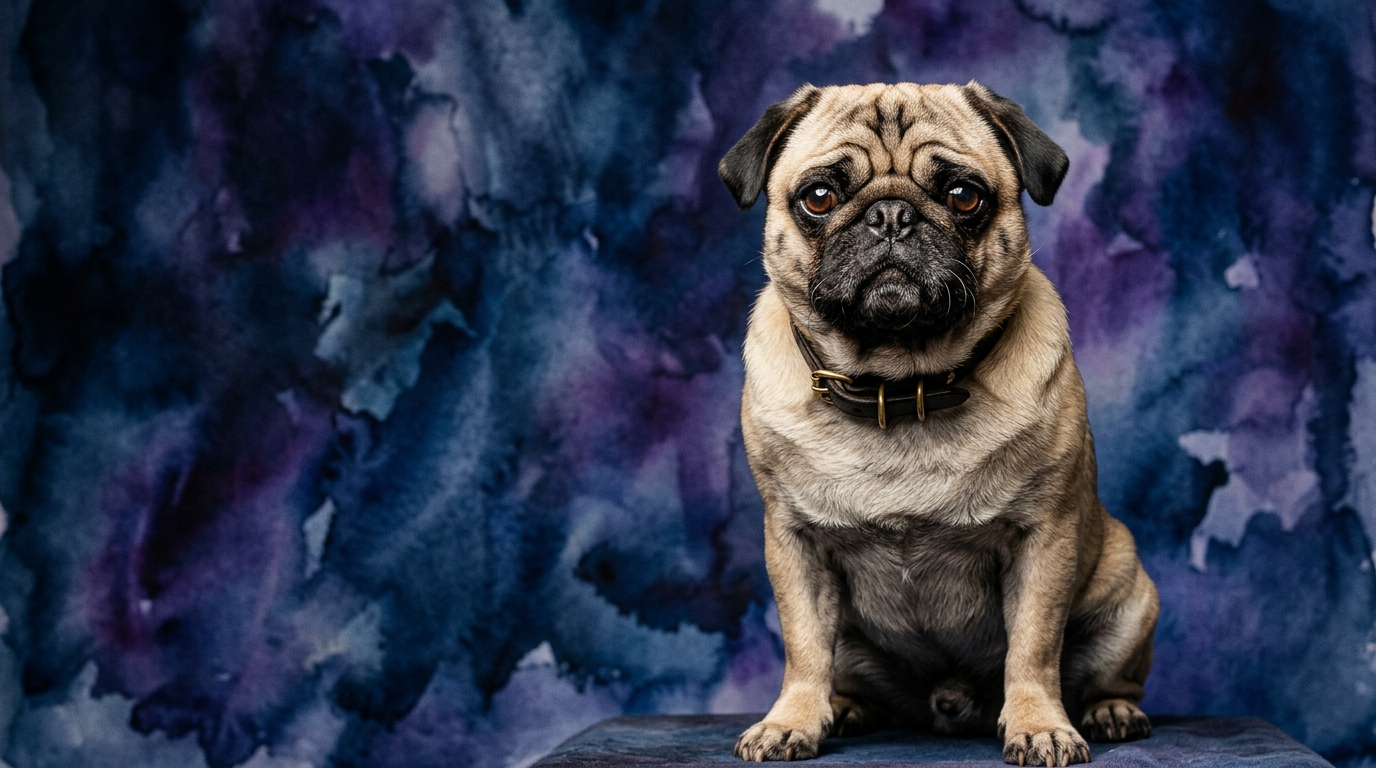

Side-by-Side Cognitive Profiles
At The Cosmic Pet Pet IQ Lab, we evaluate canine cognition across five distinct dimensions: Problem Solving, Training Speed, Social Intelligence, Instinctive Drive, and Memory. These metrics offer a granular view beyond general perceptions, highlighting the unique mental strengths of each breed. The Pug, with a Coren rank of #57, presents a profile emphasizing social connection, while the English Toy Spaniel, though not Coren-ranked, shows a more balanced distribution across cognitive functions.
The Pug's cognitive breakdown reveals a Problem Solving score of 2/5, indicating they may not independently strategize complex solutions, often preferring guidance or relying on established routines. Their Training Speed is also 2/5, suggesting that acquiring new commands requires consistent repetition and patience. However, their Social Intelligence shines at a remarkable 5/5, reflecting an exceptional attunement to human emotions and social cues. Instinctive Drive is moderate at 2/5, meaning they are less inclined towards persistent hunting or herding behaviors, and their Memory stands at a solid 3/5, allowing them to retain learned information and experiences effectively.
In contrast, the English Toy Spaniel exhibits a more even cognitive spread. Their Problem Solving ability is rated 3/5, suggesting a modest capacity for independent thought and overcoming simple obstacles. Training Speed also scores 3/5, indicating a slightly quicker grasp of new commands compared to the Pug, though still requiring dedicated effort. Their Social Intelligence is 3/5, meaning they are amiable and responsive to human interaction but perhaps not as acutely sensitive to subtle emotional shifts as the Pug. Instinctive Drive is 3/5, showing a moderate level of natural curiosity and engagement with their environment, and their Memory matches the Pug's at 3/5, providing a reliable capacity for recall.
Where the Pug Excels Cognitively
The Pug's undisputed cognitive strength lies in its profound Social Intelligence, scoring a perfect 5/5. This isn't merely about friendliness; it signifies an exceptional ability to interpret human body language, vocal tones, and emotional states. A Pug can often sense a shift in an owner's mood or anticipate a desire for comfort, making them extraordinarily empathetic companions. This deep social acumen allows them to form incredibly strong, almost intuitive bonds, often seeming to 'understand' their human counterparts on a visceral level.
This high social intelligence also influences their memory and training in unique ways. While their Training Speed is 2/5 for rote commands, their memory for social interactions and routines is quite robust, linked to their desire for connection. They remember who provides comfort, when affection is given, and the established patterns of their human's day, all reinforcing their role as a devoted companion. Their lower instinctive drive further channels their focus onto human interaction, making them less distractible by environmental stimuli when seeking social engagement.
Where the English Toy Spaniel Shows Cognitive Strengths
The English Toy Spaniel demonstrates a more adaptable cognitive profile, particularly in areas of Problem Solving and Training Speed. With a Problem Solving score of 3/5, they are more inclined to independently figure out mild challenges, such as navigating a simple puzzle toy or finding a hidden treat, compared to the Pug's tendency to wait for assistance. This suggests a slightly greater internal drive for exploration and mild intellectual engagement, making them potentially more responsive to varied forms of mental enrichment.
Their Training Speed, also at 3/5, indicates a quicker learning curve for new commands and tricks. While not rapid learners, they might pick up routines and cues with fewer repetitions than a Pug, allowing for a broader repertoire of learned behaviors. This balanced cognitive approach, combined with a 3/5 Instinctive Drive, means they are often more engaged with their surroundings and potentially more receptive to activities that involve moderate exploration or scent work, providing a different dimension to their companionship.
Training: Pug vs. English Toy Spaniel
When it comes to training, the core difference lies in their respective Training Speed scores. The Pug's 2/5 rating means that consistency, patience, and positive reinforcement are paramount. They may require many repetitions to solidify a command, and owners should be prepared for a slower progression. However, their 5/5 Social Intelligence can be leveraged; Pugs often respond exceptionally well to training that feels like a shared activity, where pleasing their human is the ultimate reward, rather than relying solely on treats or toys. Their strong desire for connection can be a powerful motivator, making them surprisingly cooperative once the 'why' of the training is understood through the social bond.
The English Toy Spaniel, with a Training Speed of 3/5, typically shows a slightly faster uptake of commands. They may still require repetition, but often grasp concepts with fewer sessions. Their balanced Social Intelligence (3/5) means they are responsive to their owner's cues, but their motivation might be more evenly split between pleasing their human and the reward itself. They might also engage more readily with clicker training or short, varied sessions that appeal to their moderate problem-solving abilities, making the training process feel a bit more dynamic for both dog and owner.
Matching Canine Cognition to Lifestyle
The cognitive profiles of the Pug and English Toy Spaniel suggest they thrive in slightly different environments and with distinct types of owners. A Pug, with its exceptional Social Intelligence (5/5) and lower Instinctive Drive (2/5), is often an ideal companion for relaxed owners who prioritize deep emotional connection and a calm home life. They excel in situations where their primary role is to be a devoted, empathetic presence, content with moderate physical activity and extensive cuddle time. Their cognitive strengths are geared towards understanding and responding to human emotional needs, making them intuitive comfort providers.
Conversely, the English Toy Spaniel's more balanced cognitive scores – 3/5 across Problem Solving, Training Speed, Social Intelligence, and Instinctive Drive – suit owners who enjoy a moderate level of interaction and gentle mental engagement. While still a loving companion, they might appreciate owners who are inclined to engage them in mild puzzle play, short training sessions, or exploring new, safe environments. Their slightly higher drive and problem-solving ability mean they can derive satisfaction from activities that require a bit more active participation, making them a good fit for owners who enjoy a slightly more interactive, yet still relaxed, companionship.
The Verdict
Choose a Pug if you seek an unparalleled emotional bond and a deeply empathetic companion who thrives on human connection above all else. They are ideal for owners who appreciate a calm, devoted presence and are prepared for patient, relationship-based training.
Opt for an English Toy Spaniel if you desire a balanced companion with a moderate capacity for learning and gentle engagement in activities. They suit owners who enjoy a slightly more interactive dynamic, including mild training challenges and environmental exploration.
🧠 Find Your Pet's IQ Score
Our Pet IQ Lab assessment covers 25+ tests across 5 cognitive dimensions — personalized to your breed.
Take the Full IQ Test →Frequently Asked Questions
Are Pugs difficult to train?
Pugs have a Training Speed score of 2/5, meaning they require significant patience and consistency. While not 'difficult' in a defiant sense, they learn at a slower pace and benefit greatly from positive reinforcement and leveraging their strong desire to please their owners through social connection.
Do English Toy Spaniels enjoy puzzle toys?
With a Problem Solving score of 3/5 and an Instinctive Drive of 3/5, English Toy Spaniels generally show a moderate interest in puzzle toys. They can find enjoyment in figuring out simple challenges to retrieve treats, making them suitable for owners who wish to provide gentle mental stimulation.
Which breed is more independent?
Neither breed is highly independent, as both are companion dogs. However, the English Toy Spaniel, with slightly higher Problem Solving and Instinctive Drive scores, might exhibit a touch more independent curiosity and engagement with its surroundings compared to the Pug, who heavily prioritizes human interaction.