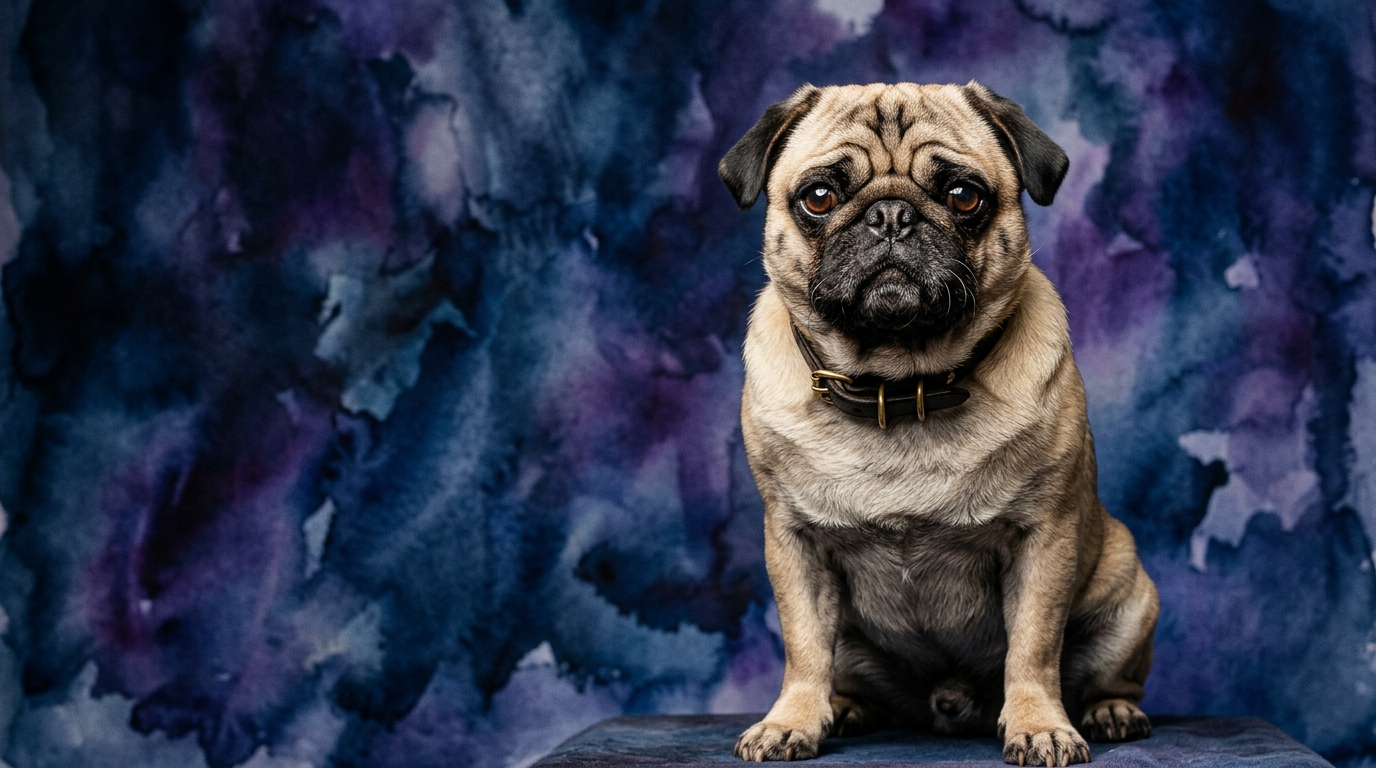
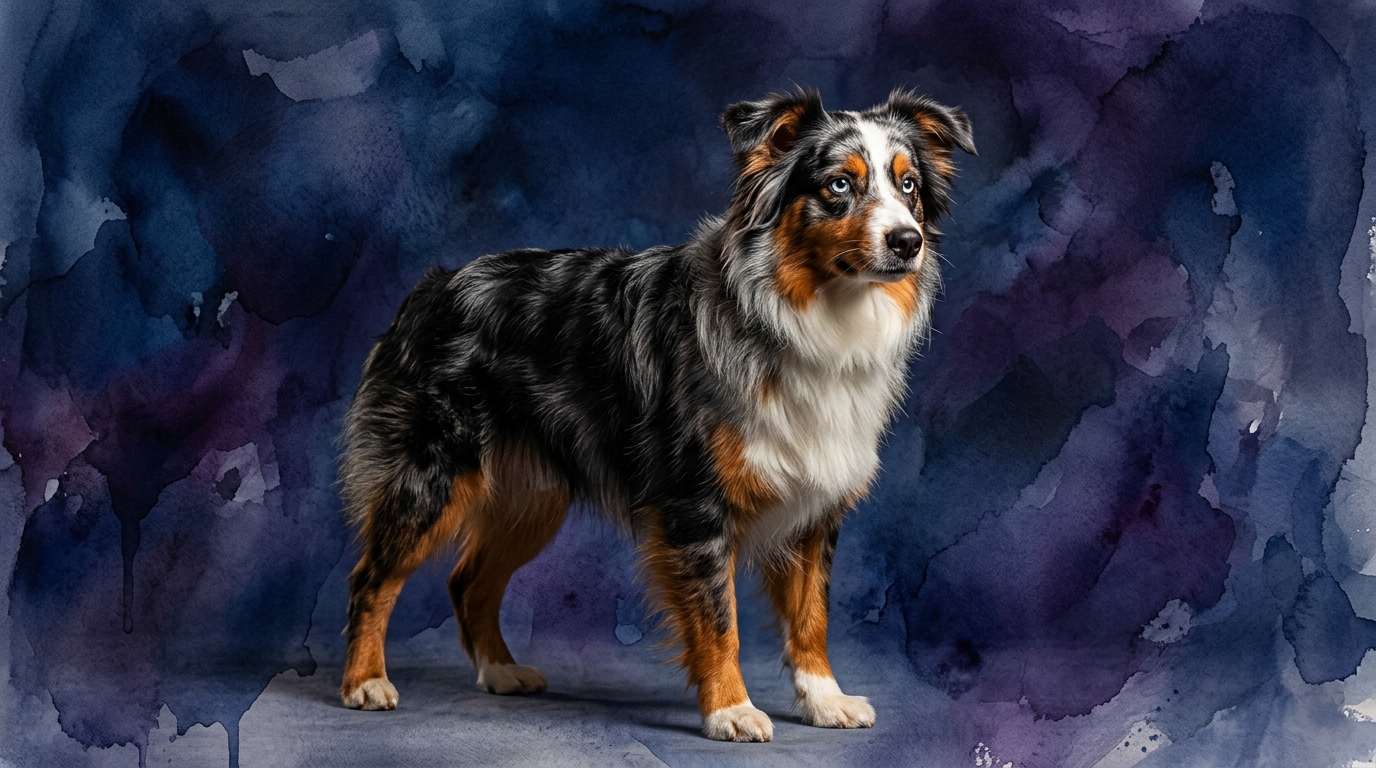
Side-by-Side Cognitive Profiles: Pug vs. Miniature American Shepherd
The Cosmic Pet Pet IQ Lab employs a five-dimensional framework to assess canine intelligence, moving beyond simplistic notions of 'smartness' to understand specific cognitive strengths. This approach allows us to appreciate the unique mental architectures of breeds like the Pug and the Miniature American Shepherd, even though only the Pug has a Coren ranking (#57), reflecting its primary role as a companion.
Pug Cognitive Profile:
Problem Solving (2/5): Pugs typically approach novel challenges with less independent strategizing. They may struggle with complex puzzles or multi-step tasks, often relying on their human companions for guidance rather than persistent solo effort. Their preference leans towards established routines, where predictability outweighs the need for constant mental gymnastics.
Training Speed (2/5): While capable of learning, Pugs are not typically quick to grasp new commands or intricate sequences. They can exhibit a charming stubbornness, requiring patience, consistent positive reinforcement, and a lighthearted approach. Repetition and clear, concise cues are key to their learning success.
Social Intelligence (5/5): This is where Pugs truly shine. They possess an exceptional ability to read human emotions, subtle body language, and vocal inflections. Their cognitive strength lies in forming deep, empathetic bonds, understanding social dynamics within a household, and responding intuitively to their owners' moods and needs. They are masters of companionship.
Instinctive Drive (2/5): Pugs exhibit minimal inherent drives for tasks like hunting, herding, or guarding. Their historical role as lap companions means their instincts are primarily geared towards comfort, affection, and proximity to their human family. They generally lack the intense focus or sustained physical drive seen in working breeds.
Memory (3/5): Pugs demonstrate an average capacity for memory, effectively recalling familiar commands, routines, and the locations of favored people or objects. While they can remember basic training, they might not retain long, complex chains of commands with the same precision as breeds with higher working memory demands.
Miniature American Shepherd Cognitive Profile:
Problem Solving (3/5): Miniature American Shepherds (Mini Aussies) show a moderate capacity for problem-solving. They can navigate various environmental challenges, figure out how to access desired objects, and learn from trial and error. This breed enjoys engaging with puzzle toys and finding solutions to moderate mental tasks, demonstrating adaptability.
Training Speed (3/5): Mini Aussies generally pick up new commands and concepts at an average pace. They are typically eager to please their handlers and respond well to consistent, reward-based training. Their willingness to engage and moderate focus make them receptive students, capable of learning a broad range of commands and even complex tricks.
Social Intelligence (3/5): Mini Aussies form strong, loyal bonds with their immediate family, often displaying a deep understanding of their owners' intentions and moods. However, they can be more reserved or watchful around strangers, contrasting with the Pug's universal friendliness. Their social cognition is primarily directed towards their inner circle, fostering a strong 'pack' dynamic.
Instinctive Drive (3/5): As a scaled-down herding breed, Mini Aussies possess a moderate, inherent drive to work and be useful. This can manifest as an interest in herding games, dog sports, or a desire for a 'job' around the house. They have a purposeful energy that benefits from structured activity and mental engagement, reflecting their historical working lineage.
Memory (3/5): Mini Aussies possess an average memory capacity, allowing them to retain a fair number of commands, remember complex sequences in training (like agility courses), and recall routines. They can learn and execute tasks that require a sequence of actions, indicating a functional working memory for practical applications.
Where the Pug Wins Cognitively
The Pug's primary cognitive advantage lies in its unparalleled social intelligence. At a remarkable 5/5, they are canine empathizers, exceptionally attuned to the subtle nuances of human emotion and social cues. This isn't merely about affection; it's a sophisticated ability to 'read the room,' understanding when their owner needs comfort, a distraction, or simply quiet companionship. While other breeds might offer loyalty, the Pug offers a profound, intuitive connection, often anticipating needs without explicit commands. Their problem-solving might be lower in mechanical tasks, but their social problem-solving—navigating complex human relationships and emotional landscapes—is truly their forte. This manifests in their uncanny ability to integrate seamlessly into family life, adapting their behavior to match the prevailing mood and fostering deep, reciprocal bonds.
Where the Miniature American Shepherd Wins Cognitively
The Miniature American Shepherd's cognitive strengths distinctly outpace the Pug in areas requiring independent thought and task orientation. With a problem-solving score of 3/5, they demonstrate a greater capacity for self-directed reasoning, capable of figuring out moderate environmental puzzles or adapting to new training scenarios with less direct instruction. Their moderate instinctive drive (3/5) gives them a purposeful energy, translating into a desire to engage in activities that require focus and effort, whether it's learning a new trick sequence or participating in dog sports. Unlike the Pug, whose drives are primarily social, the Mini Aussie possesses an inherent motivation to work alongside their human, making them more adept at understanding and executing complex, multi-step commands that require sustained attention and a degree of independent decision-making. Their cognitive profile is geared towards active collaboration and mental engagement in structured tasks.
Which is Easier to Train and Why
When considering ease of training, the Miniature American Shepherd generally holds an advantage over the Pug, though the 'why' is nuanced. The Mini Aussie's training speed is rated at 3/5, indicating a moderate receptiveness to learning new commands and a willingness to engage in structured training sessions. Their moderate instinctive drive means they often find purpose and enjoyment in having a 'job,' making them more intrinsically motivated to participate in training. They typically respond well to consistent, reward-based methods and can progress through a variety of obedience and trick training with good focus.
Conversely, the Pug's training speed is 2/5. While not untrainable, Pugs can exhibit a charming reluctance or a preference for comfort over rigorous mental exertion. Their high social intelligence means they might occasionally use their cuteness to subtly manipulate situations, requiring an owner to be firm yet gentle. Training a Pug often requires more patience, shorter sessions, and a very high value reward system. They thrive on positive reinforcement and will learn, but their pace is slower, and their motivation is often more about pleasing their beloved human than a deep desire to master a task. Therefore, for an owner seeking a dog that picks up commands more readily and enjoys the process of learning complex sequences, the Miniature American Shepherd will likely prove an easier and more satisfying training partner.
Which Suits Active Owners vs. Relaxed Owners
The cognitive and instinctive profiles of these two breeds clearly delineate their suitability for different lifestyles. The Miniature American Shepherd, with its 3/5 instinctive drive and moderate problem-solving, is an ideal match for active owners. This breed thrives on mental and physical engagement, requiring daily opportunities for structured exercise, puzzle-solving, and ongoing training. Owners who enjoy hiking, dog sports like agility or obedience, or even just long, engaging walks will find a Mini Aussie to be a fulfilling companion. Their cognitive need for purpose and activity means that without sufficient stimulation, they can become bored or develop unwanted behaviors.
In stark contrast, the Pug, with its 2/5 instinctive drive and 5/5 social intelligence, is perfectly suited for more relaxed owners. Pugs are content with shorter, leisurely strolls and plenty of cuddle time on the sofa. Their primary cognitive need is social interaction and companionship, not intense physical or mental tasks. They are masters of relaxation and emotional connection, perfectly happy to be a warm, comforting presence. Owners who prefer a less demanding exercise routine and prioritize a deep, empathetic bond will find the Pug to be an ideal, low-maintenance companion from an activity standpoint.
The Verdict
Choose a Pug if your lifestyle prioritizes deep emotional connection, intuitive companionship, and a relatively relaxed daily routine, appreciating a dog whose greatest cognitive strength is understanding you.
Choose a Miniature American Shepherd if you seek an engaged, task-oriented canine partner for an active lifestyle, valuing a dog that enjoys learning, problem-solving, and participating in structured activities.
🧠 Find Your Pet's IQ Score
Our Pet IQ Lab assessment covers 25+ tests across 5 cognitive dimensions — personalized to your breed.
Take the Full IQ Test →Frequently Asked Questions
Are Pugs difficult to train because of their problem-solving score?
Pugs aren't inherently difficult, but their training speed is slower, and they respond best to patience, positive reinforcement, and making sessions fun. Their lower problem-solving means complex tasks might be frustrating, so focus on basic obedience and social skills.
Does the Miniature American Shepherd's moderate social intelligence mean they aren't affectionate?
Not at all; Miniature American Shepherds form very strong, loyal bonds with their family. Their social intelligence is directed more towards their inner circle, meaning they might be reserved with strangers but are deeply affectionate and connected to their trusted humans.
How can I provide mental stimulation for a Pug, given their lower problem-solving score?
Mental stimulation for a Pug should focus on interaction and simple enrichment. Use basic puzzle toys, engage in short training sessions for simple commands, and provide plenty of social interaction and new environments to explore at a relaxed pace.