
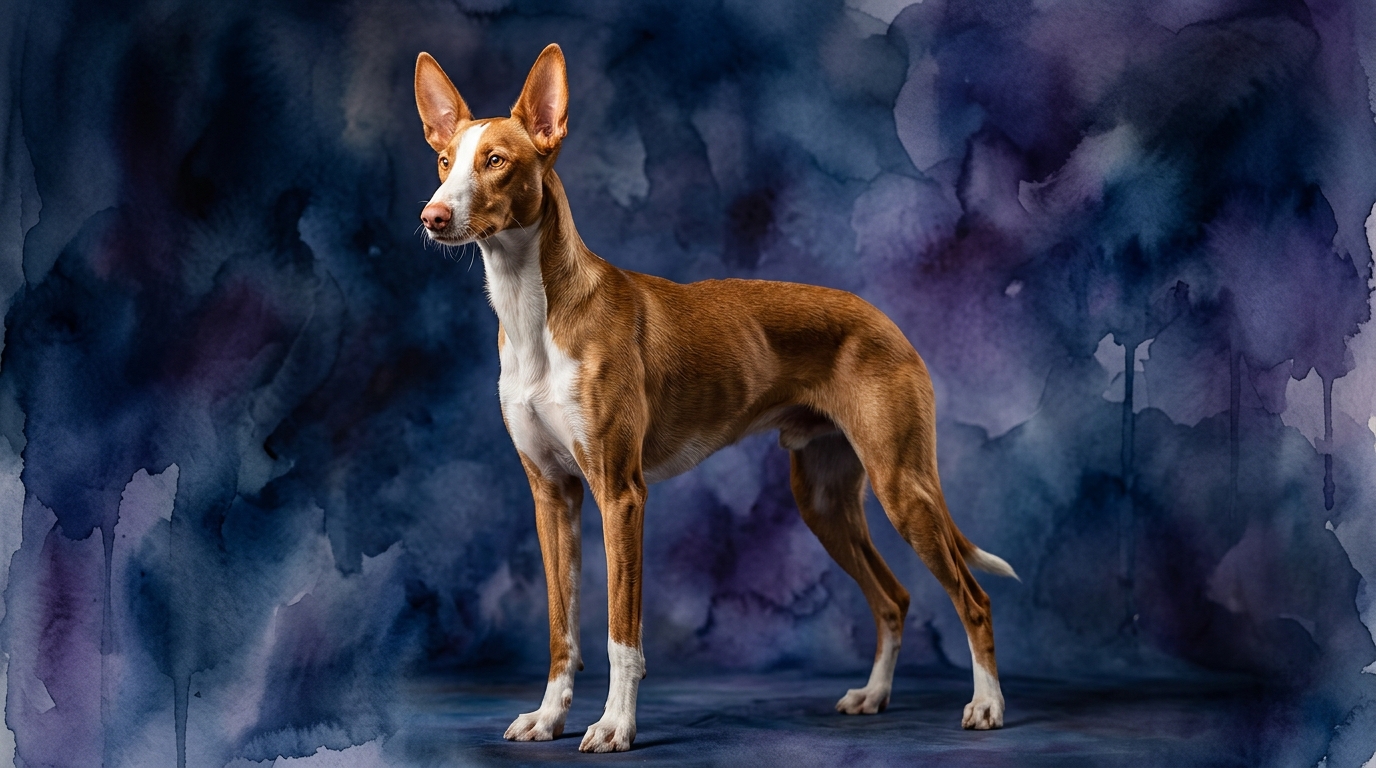
Side-by-Side IQ Profile
Despite both the Rat Terrier and the Ibizan Hound scoring identically across all five cognitive dimensions in The Cosmic Pet Pet IQ Lab, their historical roles and breed-specific traits mean these scores manifest in distinct ways. Understanding these nuances is key to appreciating their unique mental makeups.
For the **Rat Terrier**, their Problem Solving (3/5) suggests a moderate ability to navigate novel situations and figure out solutions, often translating to cunning strategies for locating and dealing with small vermin or cleverly manipulating puzzle toys. Their terrier tenacity means they’re persistent in finding a way, even if the initial approach isn't obvious, excelling at figuring out how to get *into* or *under* things. Their Training Speed (3/5) indicates they pick up new commands at a respectable pace, responding well to consistent, positive reinforcement, though their independent spirit might lead them to test boundaries. Social Intelligence (3/5) means they demonstrate a solid capacity to read and respond to human emotions, forming strong bonds and often adapting well to household dynamics, though some can be reserved with strangers. Their Instinctive Drive (3/5) is primarily focused on prey, exhibiting strong urges to chase, dig, and investigate small movements, a persistent drive needing appropriate outlets. Finally, their Memory (3/5) suggests these dogs recall learned commands, routines, and experiences effectively, aiding in training consistency and adherence to household rules.
The **Ibizan Hound**, while sharing a Problem Solving (3/5) score, applies this cognitive ability differently. For them, it often manifests in sophisticated hunting strategies, such as surveying vast landscapes to identify efficient routes to intercept prey or navigating complex terrain with precision. Their solutions are frequently spatial and predictive rather than manipulative, excelling at finding the path of least resistance or the most advantageous angle during a chase. Their Training Speed (3/5) means they can grasp concepts quickly, but their independent sighthound nature necessitates patient, engaging, and high-value reward-based training; they are not always motivated by pleasing their handler. Social Intelligence (3/5) in an Ibizan Hound often involves sensitivity and attunement to their owner's mood, offering quiet companionship, but they tend to be reserved and observant with strangers. Their Instinctive Drive (3/5) is almost entirely dedicated to their sighthound heritage, predominantly visual, focused on spotting, chasing, and catching fast-moving objects. This powerful instinct can override other stimuli, making recall challenging. Their Memory (3/5) is strong for places, routines, and experiences, serving them well in remembering hunting grounds, home layouts, and learning from past chase outcomes.
Where Rat Terrier Wins Cognitively
Despite identical numerical IQ scores, the Rat Terrier's cognitive strengths shine in scenarios demanding focused manipulation and quick, reactive decision-making in confined or complex environments. Their problem-solving (3/5) is often geared towards intricate tasks, such as figuring out how to bypass obstacles to reach a hidden toy or escaping a crate, utilizing their physical dexterity alongside mental agility. Their social intelligence (3/5) often translates into a deeper engagement with human-initiated games and a more direct responsiveness to handler cues during interactive play or agility, making them seem more 'tuned in' to human instruction in dynamic settings. The Rat Terrier's instinctive drive (3/5) for vermin hunting also means they excel in tasks requiring sustained focus on a small, specific target, often showing impressive determination.
Where Ibizan Hound Wins Cognitively
The Ibizan Hound's cognitive advantages become apparent in situations that demand expansive spatial reasoning, independent judgment, and rapid processing of visual information over large distances. Their problem-solving (3/5) excels in navigating complex outdoor environments, strategically planning pursuit routes during a high-speed chase, or anticipating the movements of distant prey with remarkable accuracy. This reflects a different type of cognitive processing, prioritizing speed and spatial awareness over intricate manipulation. Their memory (3/5) is particularly strong for recalling terrain, landmarks, and the outcomes of past hunts, allowing them to learn and adapt their strategies across vast landscapes. Furthermore, their instinctive drive (3/5) for visual pursuit is a finely honed cognitive tool, enabling them to process visual stimuli at incredible speeds and maintain focus on a moving target against a busy backdrop.
Which Is Easier to Train and Why
While both breeds share a 3/5 training speed, the Rat Terrier is generally perceived as easier to train for obedience and cooperative tasks due to their inherent desire to interact and work with their human companions. Their social intelligence (3/5) often manifests as a greater eagerness to please and a more direct responsiveness to handler feedback. Rat Terriers thrive on engaging activities, and their problem-solving (3/5) often applies to understanding what's required of them in a structured training session. They can be opinionated, but consistent, positive reinforcement methods typically yield good results.
The Ibizan Hound, conversely, often presents more of a training challenge, not because of a lack of cognitive ability, but due to their independent nature and strong instinctive drive (3/5) for chasing. Their problem-solving (3/5) is often directed towards their own goals rather than fulfilling a handler's request, especially if a visual stimulus (like a squirrel) overrides the training context. Sighthounds were bred to hunt independently, making them less inclined to seek constant human direction. Training an Ibizan Hound requires immense patience, creativity, and high-value rewards, often focusing on activities that harness their natural drives, such as lure coursing, rather than strict obedience in distracting environments.
Which Suits Active Owners vs. Relaxed Owners
The Rat Terrier, while possessing a notable instinctive drive (3/5) and requiring regular exercise and mental stimulation, can adapt to a wider range of active lifestyles. They are versatile companions for owners who enjoy daily walks, jogs, dog sports like agility, or even urban exploration. Their moderate energy levels and adaptable nature mean they can settle down indoors after sufficient activity, making them suitable for active individuals or families who also appreciate downtime. They are not necessarily for 'relaxed' owners in the sedentary sense, but they can be content with a varied routine that includes both vigorous play and quiet companionship.
The Ibizan Hound, however, is unequivocally suited for highly active owners who can provide consistent, intense physical outlets, particularly opportunities for off-leash running in secure areas. Their powerful instinctive drive (3/5) for chasing and their remarkable physical prowess demand daily sprints and extensive exercise to maintain their physical and mental well-being. A relaxed owner who cannot provide these outlets will likely find an Ibizan Hound to be a challenging companion, as their unmet energy requirements can lead to boredom and destructive behaviors. They thrive with owners who understand and embrace their sighthound nature, potentially participating in activities like lure coursing, which directly taps into their core instincts.
The Verdict
Opt for the Rat Terrier if you seek a mentally agile, interactive companion who excels in varied activities, enjoys problem-solving human-centric puzzles, and thrives on a moderate yet consistent routine of engagement and physical activity.
Select the Ibizan Hound if you are a highly active individual or family capable of providing extensive opportunities for running, appreciate independent thinking, and are prepared for a dog whose cognitive strengths lie in spatial awareness and the thrill of the chase.
🧠 Find Your Pet's IQ Score
Our Pet IQ Lab assessment covers 25+ tests across 5 cognitive dimensions — personalized to your breed.
Take the Full IQ Test →Frequently Asked Questions
Do identical IQ scores mean these breeds are equally easy to live with?
Not at all. Identical IQ scores (3/5 across the board) indicate similar *potential* in cognitive dimensions, but their breed-specific drives and historical roles dictate *how* that intelligence is expressed and what kind of living environment they thrive in. A Rat Terrier uses its problem-solving to outwit vermin, while an Ibizan Hound uses its to strategize a chase across open fields, leading to very different behavioral outputs.
Can an Ibizan Hound be a good apartment dog if exercised enough?
While an Ibizan Hound can be calm indoors, their absolute need for vast, safe spaces to run at high speeds makes them challenging apartment dwellers. 'Exercised enough' for an Ibizan Hound means daily opportunities for intense, unrestrained sprints, which is difficult to provide adequately without a large, securely fenced yard or regular access to dedicated dog parks/fields.
Are Rat Terriers good with children due to their social intelligence?
Rat Terriers, with their 3/5 social intelligence, can be excellent family dogs, often forming strong bonds with children. However, their terrier nature means they appreciate respect and can be sensitive to rough handling, so supervision with very young children is always advisable to ensure positive interactions for both dog and child.