
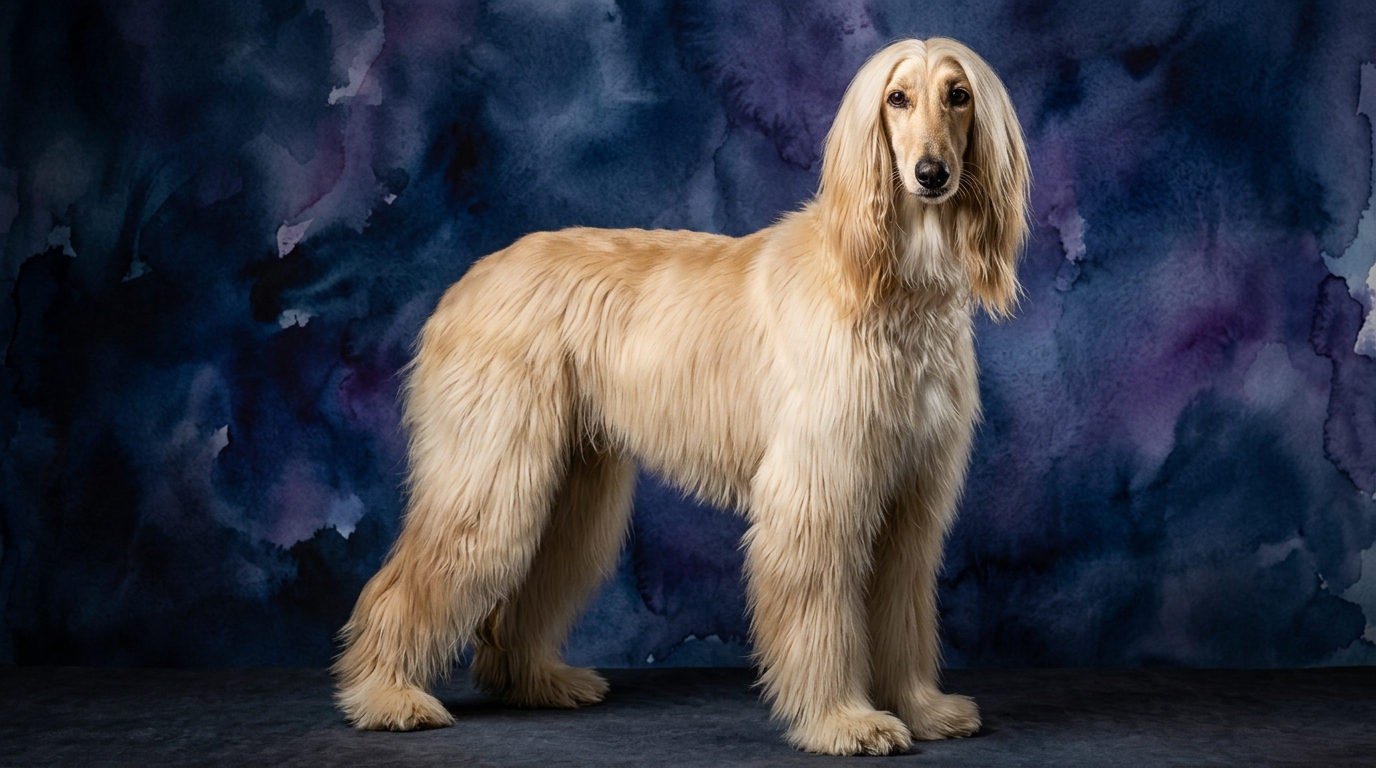
Side-by-Side IQ Profile: Rottweiler vs. Afghan Hound
The Cosmic Pet Pet IQ Lab employs a five-dimensional framework to assess canine cognition: problem-solving, training speed, social intelligence, instinctive drive, and memory. These scores, alongside Coren's ranking which primarily reflects working obedience, offer a nuanced perspective on a breed's mental capacities, moving beyond simple notions of 'smartness' to explore specific cognitive strengths.
The Rottweiler, a Working breed, stands at Coren rank #9, demonstrating a robust cognitive profile. Their Pet IQ Lab scores are: Problem Solving 5/5, Training Speed 4/5, Social Intelligence 4/5, Instinctive Drive 5/5, and Memory 5/5. This profile suggests a canine adept at understanding and executing complex tasks, retaining information, and engaging effectively with their human counterparts.
In contrast, the Afghan Hound, a Hound breed, holds Coren rank #79. Their Pet IQ Lab scores paint a different picture: Problem Solving 4/5, Training Speed 1/5, Social Intelligence 2/5, Instinctive Drive 5/5, and Memory 3/5. This indicates a breed with strong independent problem-solving skills, particularly in their instinctive pursuits, but a distinct approach to learning and social interaction compared to the Rottweiler.
Where the Rottweiler Excels Cognitively
The Rottweiler's cognitive strengths are evident in their top scores for Problem Solving (5/5) and Memory (5/5). This breed demonstrates a profound ability to analyze novel situations and devise effective solutions, whether it's navigating an intricate obstacle course or figuring out how to access a desired object. Their exceptional memory allows them to recall multi-step commands and routines with impressive accuracy, even after long periods.
Furthermore, their Social Intelligence (4/5) means Rottweilers are highly attuned to human communication, including subtle cues and emotional states. This sensitivity allows them to form strong, cooperative working partnerships, making them receptive to guidance and eager to engage in collaborative tasks. This combination of mental prowess and social awareness underpins their historical roles in herding, guarding, and protection.
Where the Afghan Hound Demonstrates Unique Cognitive Strengths
While their overall profile differs, the Afghan Hound possesses distinct cognitive strengths, particularly in Instinctive Drive (5/5) and a commendable Problem Solving score of 4/5. Their problem-solving capacity is often expressed through an independent, self-reliant lens, honed by centuries of sighthound hunting where quick, autonomous decisions were crucial for success. An Afghan Hound excels at calculating the most efficient pursuit path or navigating complex terrain during a chase, without needing human direction.
Their powerful Instinctive Drive isn't just about chasing; it shapes their perception of the world. This drive fuels their independent thought and action, enabling them to make split-second decisions based on visual stimuli and inherent predatory instincts. This cognitive wiring means they are exceptionally good at what they were bred for: swift, unassisted pursuit over vast distances.
Training Dynamics: A Tale of Two Approaches
The contrast in Training Speed (Rottweiler 4/5 vs. Afghan Hound 1/5) and Social Intelligence (Rottweiler 4/5 vs. Afghan Hound 2/5) creates vastly different training experiences. Rottweilers, with their higher social intelligence and eagerness to engage, absorb new commands and routines swiftly. They thrive on structured learning and positive reinforcement, often showing a keen desire to please their handlers and form a cohesive working unit.
The Afghan Hound, however, approaches training with a distinct independence. Their lower training speed doesn't imply a lack of learning capacity, but rather a strong self-direction and a lower perceived need to perform for human approval. Training an Afghan Hound requires immense patience, creativity, and finding motivations beyond simple praise. They learn best when tasks align with their natural instincts or when rewards are highly enticing, often appearing to 'consider' a command before deciding whether to comply on their own terms.
Matching Mentalities: Active vs. Relaxed Lifestyles
For owners, understanding these cognitive differences is key to a harmonious relationship. The Rottweiler, with its high problem-solving, memory, and instinctive drive, requires consistent mental engagement and a sense of purpose. They thrive in environments where they are given jobs, whether it's obedience, protection work, or dog sports. Owners who enjoy structured training, active participation, and providing clear leadership will find a deeply rewarding partnership with a Rottweiler.
The Afghan Hound, while possessing an equally powerful instinctive drive, directs it differently. They require significant physical exercise, particularly opportunities for sustained, secure off-leash running to satisfy their sighthound instincts. Their independent nature means they may not constantly seek out mental tasks or collaborative games like a Rottweiler. Owners who appreciate a companion with a regal, sometimes aloof, demeanor and can provide ample space for their physical expression, without demanding constant mental 'work,' will find the Afghan Hound a fitting match.
The Verdict
Choose a Rottweiler if you seek a highly engaged, trainable companion eager to partner in tasks, protection, or dog sports, and can provide consistent mental stimulation and structured training.
Choose an Afghan Hound if you admire an independent, visually driven companion, appreciate a less 'people-pleasing' temperament, and can provide ample secure space for instinctual running, understanding that training requires significant patience and unconventional methods.
🧠 Find Your Pet's IQ Score
Our Pet IQ Lab assessment covers 25+ tests across 5 cognitive dimensions — personalized to your breed.
Take the Full IQ Test →Frequently Asked Questions
Does a lower Coren rank mean an Afghan Hound is less capable?
Not entirely. Coren's ranking primarily assesses 'working and obedience intelligence,' which favors breeds eager to follow human commands. An Afghan Hound's lower rank reflects its independent nature and selective obedience, not an overall lack of cognitive ability, especially in its specialized areas like sighthound work.
Can an Afghan Hound be trained for complex tasks?
While an Afghan Hound's training speed is low, they are capable of learning complex tasks if the motivation is strong and the training methods are highly engaging and reward-based. It requires far more patience, creativity, and understanding of their independent drive compared to a Rottweiler.
How does instinctive drive differ between the two breeds?
Both breeds have a 5/5 instinctive drive, but its manifestation differs. For the Rottweiler, it's often directed towards protection, guarding, and working tasks alongside humans. For the Afghan Hound, it's primarily expressed as an intense prey drive and a need to chase, rooted in their sighthound hunting heritage.