
Side-by-Side IQ Profile: Rottweiler vs. Komondor
The Cosmic Pet Pet IQ Lab assesses canine intelligence across five key dimensions, providing a granular view of each breed's cognitive strengths.
For the Rottweiler, we observe a robust profile: Problem Solving 5/5, Training Speed 4/5, Social Intelligence 4/5, Instinctive Drive 5/5, and Memory 5/5. Rottweilers exhibit a strong capacity for analytical thought, quickly assessing novel situations and devising effective solutions, which manifests in their ability to learn complex sequences and adapt strategies. Their strong focus and desire to engage with handlers contribute to rapid acquisition of new commands, while their keen awareness of social cues allows them to interpret human emotions and respond appropriately. The breed's inherent drives for guarding and protection are exceptionally strong, translating to a powerful inclination to fulfill purposeful tasks, and they demonstrate excellent recall for learned behaviors and specific people.
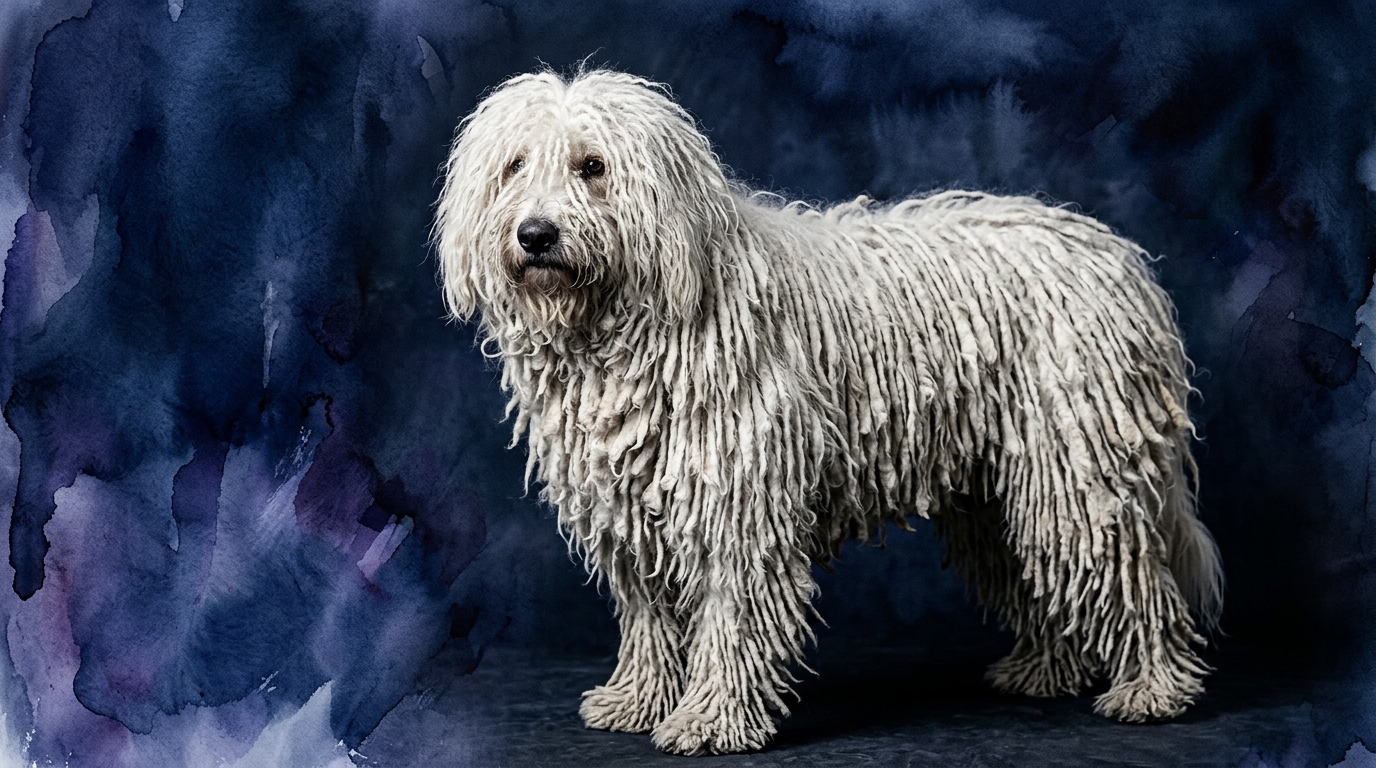
The Komondor presents a distinct profile: Problem Solving 3/5, Training Speed 3/5, Social Intelligence 3/5, Instinctive Drive 3/5, and Memory 3/5. Komondors approach challenges with a more independent, instinct-driven methodology, where solutions often stem from their innate guardian behaviors rather than complex analytical processing. While capable of learning, they typically require more repetition and patience in training due to their independent nature, often preferring to act on their own initiative. Their social understanding is primarily geared towards their flock or family unit, exhibiting loyalty but appearing more aloof outside their core group. The Komondor's instinctive drive is singularly focused on autonomous livestock guardianship, observing, patrolling, and deterring threats with unwavering dedication, and they retain information pertinent to their roles and routines, such as patrol routes or recognizing their charges.
Where the Rottweiler Wins Cognitively
The Rottweiler clearly outpaces the Komondor in areas requiring flexible cognitive application and rapid adaptation. Their superior problem-solving (5/5) means they excel at tasks demanding novel solutions, such as advanced obedience trials, intricate scent work, or navigating complex agility courses. This breed demonstrates a capacity to understand cause-and-effect relationships quickly, adjusting their approach based on outcomes rather than rigid adherence to instinct. Furthermore, their higher social intelligence (4/5) allows them to interpret human intent and emotional states with greater nuance, fostering a more responsive partnership in training and daily life. A Rottweiler is more likely to anticipate a handler's next move or understand a frustrated tone, adjusting their behavior accordingly. Their exceptional memory (5/5) ensures that once a concept is learned or a boundary established, it is retained with remarkable consistency, reducing the need for constant re-teaching compared to the Komondor.
Where the Komondor Wins Cognitively
While the Komondor's overall IQ profile appears lower in a general context, it's crucial to understand their specialized cognitive strengths, particularly within their intended role. Their instinctive drive (3/5), though rated lower in broad applicability, is perfectly honed for autonomous livestock guardianship. This breed possesses an unmatched ability to observe, assess, and protect without direct human command, relying on centuries of selective breeding for independent decision-making in the field. This isn't a deficit in intelligence but a different kind of cognitive processing—one focused on self-reliance and environmental awareness rather than human-directed tasks. Their problem-solving (3/5) in a guardian context is about recognizing threats and implementing protective strategies independently, which they do with unwavering dedication. A Komondor's cognitive strength lies in its steadfast, unwavering focus on its charges, often making complex decisions to deter predators with minimal human intervention, a task few other breeds can perform with such inherent proficiency.
Which is Easier to Train and Why
Between these two, the Rottweiler is demonstrably easier to train due to several key cognitive differences. Their higher training speed (4/5) means they pick up new commands and behaviors more rapidly, requiring fewer repetitions to achieve proficiency. This stems from their inherent eagerness to work with their handler and a strong desire to please, coupled with excellent memory (5/5) that solidifies learned behaviors. Rottweilers are generally more engaged and attentive during training sessions, viewing it as a collaborative effort. They respond well to positive reinforcement and thrive on structured learning.
In contrast, the Komondor's training speed (3/5) is slower, largely because their strong independence and self-directed instincts mean they often question the necessity of a command or prefer to follow their own judgment. They were bred to operate autonomously with their flock, not to take constant direction from humans. This means a Komondor might understand a command but choose not to execute it if it doesn't align with their perceived immediate priorities, making training a lesson in patience and finding ways to motivate their self-sufficient nature. Their problem-solving is geared towards independent action, not necessarily compliance with human directives.
Which Suits Active Owners vs. Relaxed Owners
For active owners seeking a dynamic partner in various pursuits, the Rottweiler is the clear choice. Their high instinctive drive (5/5) for purposeful tasks, combined with superior problem-solving and training speed, makes them ideal for dog sports like obedience, agility, protection work, or even search and rescue. They thrive on mental and physical challenges and require consistent engagement to prevent boredom. A Rottweiler owner needs to be prepared for regular, structured activities that tap into their cognitive and physical vigor, ensuring their significant mental capacity is adequately utilized.
Conversely, the Komondor is better suited for owners who appreciate a more relaxed, observational companion, particularly those with a specific need for property or livestock protection. While they require space and consistent, low-key monitoring of their territory, their needs are less about high-intensity structured activities and more about a steady, predictable routine. Their independence means they don't constantly demand interaction but are vigilant guardians, making them suitable for owners who value a watchful, self-sufficient presence over an always-on playmate. Their cognitive focus is on awareness and protection, not on performing complex routines for human entertainment.
The Verdict
Choose a Rottweiler if you seek a highly trainable, versatile companion eager for diverse activities, from competitive sports to dedicated family guardianship, who thrives on collaborative engagement and mental challenges.
Opt for a Komondor if your lifestyle accommodates a self-sufficient, independent guardian primarily focused on protecting property or livestock, valuing their steadfast vigilance over rapid obedience or constant interaction.
🧠 Find Your Pet's IQ Score
Our Pet IQ Lab assessment covers 25+ tests across 5 cognitive dimensions — personalized to your breed.
Take the Full IQ Test →Frequently Asked Questions
Does a Komondor's lower IQ rating mean it's not a good pet?
Absolutely not. The IQ ratings reflect specific cognitive dimensions relevant to working roles and training, not overall value as a companion. A Komondor’s independence and protective instincts make it an exceptional guardian for the right owner and environment, despite its lower scores in areas like training speed.
Are Rottweilers difficult to manage due to their strong instinctive drives?
Rottweilers possess powerful instinctive drives, which require consistent, early socialization and firm, positive training to channel appropriately. With proper guidance and engagement, these drives make them highly capable and dedicated partners, but without it, they can indeed be challenging.
Can a Komondor be trained for general obedience like a Rottweiler?
A Komondor can certainly learn general obedience, but it will typically require more patience, consistency, and understanding of their independent nature than training a Rottweiler. They respond best when they perceive the command as relevant and from a trusted leader, rather than simply for the sake of compliance.