
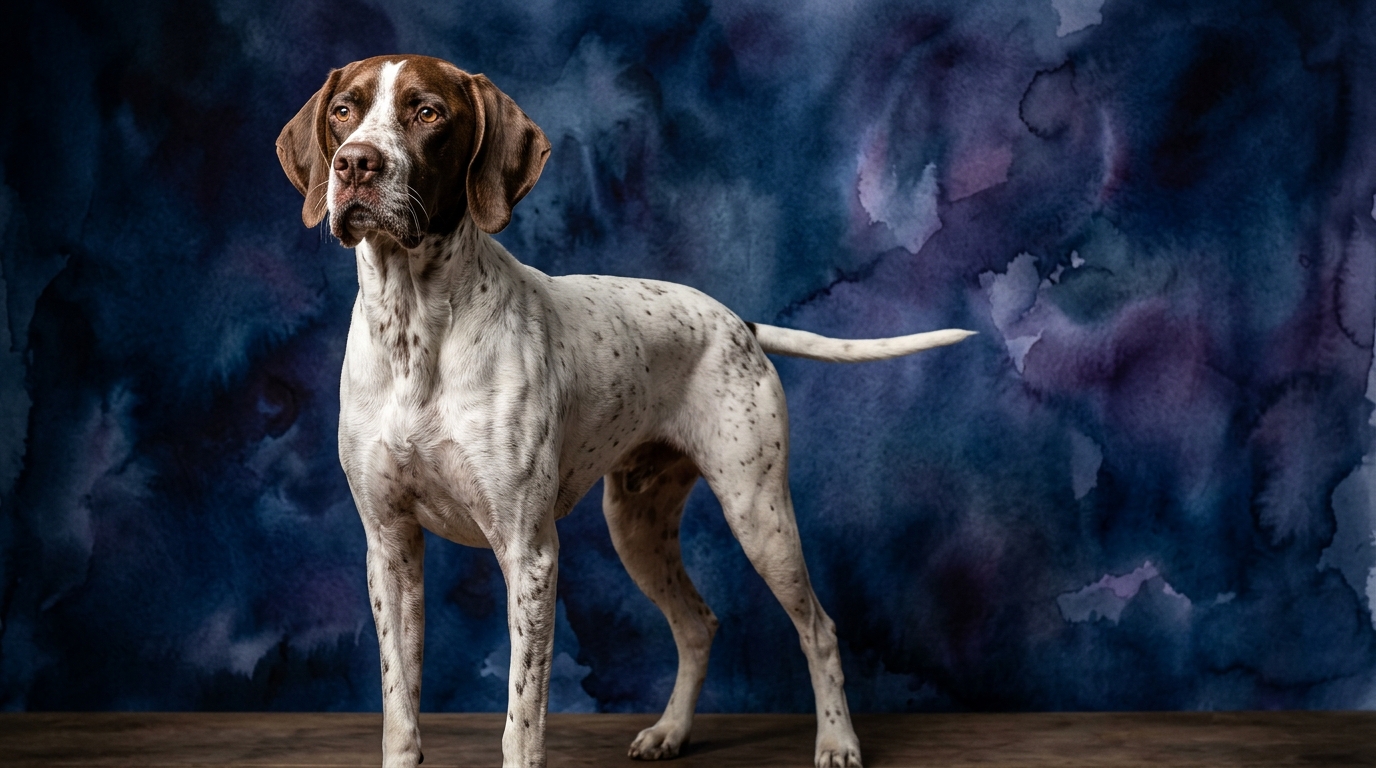
Side-by-Side Cognitive Profiles: Rottweiler vs. Pointer
The Cosmic Pet Pet IQ Lab employs five key dimensions to evaluate canine intelligence, offering a granular view beyond generic labels. For the Rottweiler, a Working breed ranked #9 by Coren for obedience and working intelligence, their cognitive scores paint a picture of profound capability. Their Problem Solving is rated 5/5, indicating an exceptional capacity to analyze situations and devise solutions, often demonstrating strategic thought. Training Speed stands at 4/5, suggesting a quick grasp of new commands and routines, though their inherent assertiveness requires precise guidance. Social Intelligence is 4/5, highlighting their adeptness at interpreting human cues and understanding complex social dynamics within a family unit. Instinctive Drive is a powerful 5/5, reflecting deeply embedded impulses for protection, guarding, and task completion. Finally, their Memory is an impressive 5/5, allowing for remarkable retention of learned behaviors and experiences over time.
In contrast, the Pointer, a Sporting breed without a specific Coren rank, presents a different cognitive blueprint, tailored for its specialized role. Its Problem Solving capability is rated 3/5, indicating competence in practical, task-specific challenges, particularly those related to its hunting purpose, but less inclination towards abstract or multi-layered puzzles. Training Speed is 3/5, meaning they learn at a moderate pace, thriving on consistent, positive reinforcement methods. Social Intelligence scores 3/5, suggesting they are generally affable and responsive to human interaction, though their attention can sometimes be more fixated on environmental stimuli than subtle emotional signals. Instinctive Drive is 3/5, reflecting a strong, specialized impulse for scenting and pointing game, rather than a broad spectrum of working drives. Their Memory is also 3/5, sufficient for retaining field commands and recognizing specific scent patterns, though perhaps not with the extensive depth seen in breeds with more diverse cognitive demands.
Where the Rottweiler Excels Cognitively
The Rottweiler's cognitive profile showcases several areas of clear strength when compared to the Pointer. Its 5/5 rating in Problem Solving is particularly noteworthy; these dogs don't just follow commands, they often assess situations and make independent, effective decisions. This capacity allows them to excel in complex roles like protection work, search and rescue, or advanced obedience, where they must interpret evolving scenarios and apply learned principles. For instance, a Rottweiler might quickly understand how to manipulate a latch to access a desired item, or how to navigate an obstacle course with minimal instruction after initial exposure.
Furthermore, the Rottweiler's superior Memory (5/5) and Instinctive Drive (5/5) contribute significantly to its efficacy in working capacities. Their ability to retain vast amounts of information means they can master an extensive repertoire of commands and behaviors, making their training durable and reliable. Coupled with their inherent drive, which is broad and powerful, they are motivated to apply their knowledge and skills consistently. This combination allows them to maintain focus on tasks, even challenging ones, and remember intricate sequences or rules over prolonged periods, setting them apart in tasks demanding sustained cognitive application and recall.
Where the Pointer Shines Cognitively
While the Pointer's individual IQ scores might be numerically lower than the Rottweiler's, it's crucial to understand that its cognitive strengths are exquisitely honed for its specific purpose, demonstrating a specialized form of intellect. The Pointer's 3/5 Instinctive Drive, while not as broad as the Rottweiler's, is intensely focused on scenting and 'pointing' game. This requires a unique blend of environmental awareness, sustained olfactory discrimination, and the ability to freeze and hold position, which is a highly specialized cognitive task. Their minds are wired to process scent information with extreme precision and to act on it with unwavering dedication, a focused intelligence that is unparalleled in its domain.
The Pointer's Social Intelligence (3/5) and Training Speed (3/5), while moderate, are perfectly suited for cooperative work with a handler in the field. They are responsive to direction and eager to please in the context of their hunting activities, forming a highly effective partnership. Their Problem Solving (3/5) is practical and relevant to their work, such as figuring out the best path through dense cover or locating a scent source. This specific cognitive architecture allows them to perform their sporting duties with graceful efficiency and unwavering commitment, showcasing a distinct form of working intelligence that prioritizes sensory input and physical execution over complex abstract reasoning.
Training Dynamics: Which is Easier to Guide?
Determining which breed is 'easier' to train is less about raw intelligence and more about the specific challenges and rewards each presents. The Rottweiler, with its 4/5 Training Speed and 5/5 Memory, can acquire new commands swiftly and retain them robustly. However, their 5/5 Problem Solving and 5/5 Instinctive Drive mean they are not passive learners; they will challenge boundaries, test consistency, and require a firm, confident, and knowledgeable handler. Their intelligence allows them to understand complex instructions, but also to make independent decisions, which, if not properly guided, can lead to undesirable behaviors. Training a Rottweiler is about channeling their immense cognitive capacity and strong will into productive avenues.
The Pointer, with its 3/5 Training Speed and 3/5 Memory, typically requires more repetition and patience. They are generally eager to please, especially when training taps into their natural hunting drives, but their focus can be easily diverted by environmental scents or movements. Their 3/5 Instinctive Drive, while specialized, means that a strong prey drive can make off-leash training challenging in distracting environments. They are less likely to 'outsmart' their handler than a Rottweiler, but their learning curve is more gradual, and their motivation is often tied directly to their innate desire to hunt or to receive immediate positive reinforcement. Consistency and clarity are paramount for both, but the Rottweiler demands intellectual engagement alongside instruction, while the Pointer often benefits most from tapping into its physical and sensory drives.
Lifestyle Match: Active vs. Relaxed Owners
When considering an owner's lifestyle, neither the Rottweiler nor the Pointer is suited for a truly 'relaxed' or sedentary home. Both breeds possess significant energy and cognitive needs that demand active engagement. The Rottweiler, with its high Problem Solving (5/5) and Instinctive Drive (5/5), requires more than just physical exercise; it needs extensive mental stimulation. Owners must provide consistent training, puzzle toys, advanced obedience, or even dog sports like protection work or agility to keep their minds engaged. A bored Rottweiler, lacking mental outlets, can become destructive or develop behavioral issues, as their intellect demands a 'job' to do.
The Pointer, conversely, is an athlete whose needs are primarily physical and sensory. Its 3/5 Instinctive Drive for hunting means it thrives on vast open spaces where it can run, scent, and explore. Daily, vigorous exercise, ideally off-leash in safe areas, is non-negotiable. While they benefit from training and some mental engagement, their primary fulfillment comes from satisfying their urge to range and utilize their keen senses. An owner who cannot provide hours of running and outdoor exploration will find a Pointer restless, anxious, and prone to destructive behaviors born of pent-up physical energy. Therefore, both demand active owners, but the nature of that activity differs significantly: one for mental challenge, the other for physical exertion and sensory input.
The Verdict: When to Choose Each Companion
The Verdict
Choose a Rottweiler when you seek a deeply intelligent, protective companion capable of complex learning and strong social bonds, and are prepared to provide unwavering leadership and extensive mental challenges.
Opt for a Pointer when your lifestyle embraces extensive outdoor activity, particularly in open spaces, and you desire an energetic companion whose joy comes from exploring and utilizing their keen senses in a natural environment.
🧠 Find Your Pet's IQ Score
Our Pet IQ Lab assessment covers 25+ tests across 5 cognitive dimensions — personalized to your breed.
Take the Full IQ Test →Frequently Asked Questions
Is a Rottweiler harder to manage than a Pointer?
Rottweilers often present a greater management challenge due to their formidable physical presence, high problem-solving abilities, and strong protective instincts, requiring consistent training and socialization from an early age. Pointers, while energetic, are generally more straightforward in their motivations, primarily driven by their sporting instincts rather than complex decision-making, making their management more focused on physical outlets.
Which breed is better for a first-time dog owner?
Neither breed is typically recommended for a truly novice owner due to their specific needs and strong drives. However, if an aspiring first-time owner is dedicated to extensive training and understanding breed-specific traits, a Pointer might be slightly less demanding in terms of complex cognitive management compared to the Rottweiler's profound intellect and protective nature.
Do Pointers require less mental stimulation than Rottweilers?
Pointers require significant physical stimulation to satisfy their hunting drives, focusing on scent work and running. While they benefit from training, their need for complex problem-solving and intricate mental puzzles is generally lower than that of a Rottweiler, who thrives on consistent intellectual challenges and purpose-driven tasks.