
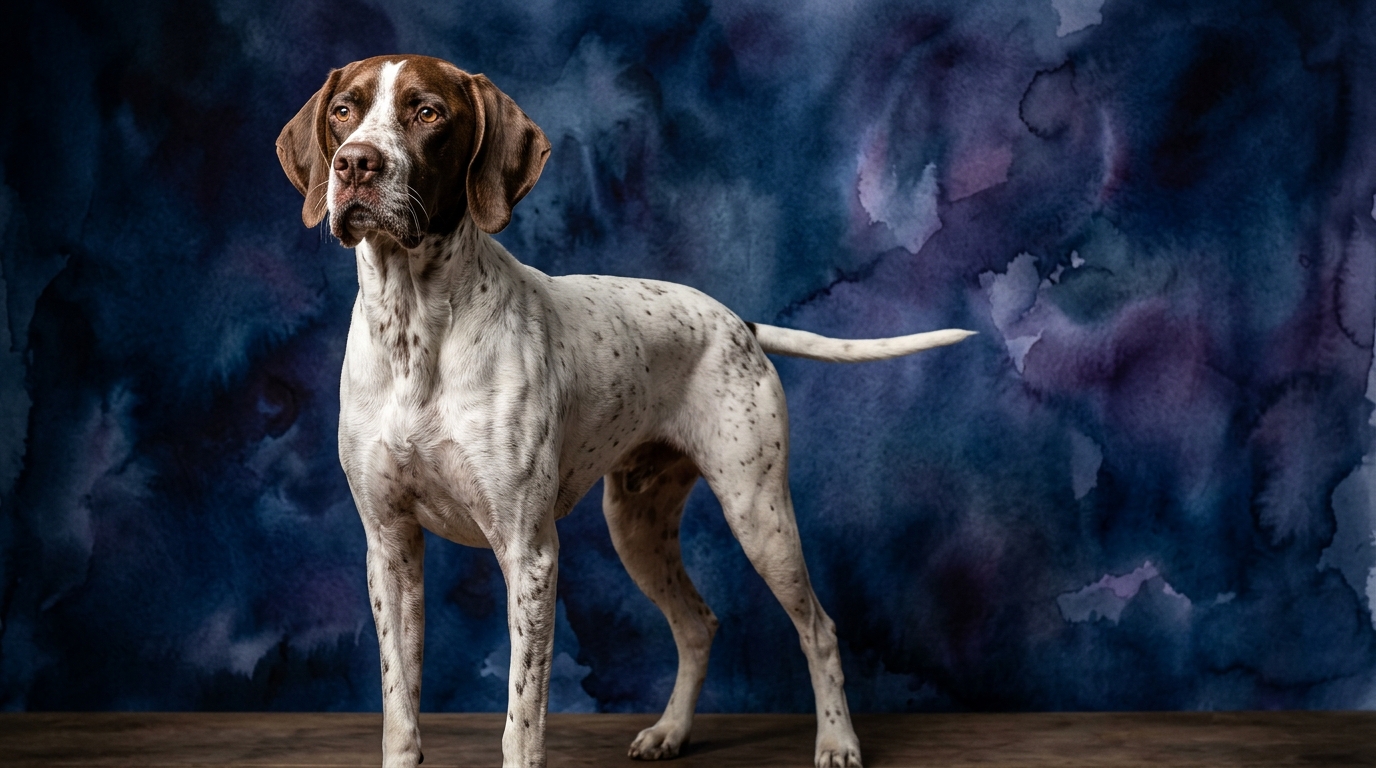
Side-by-Side IQ Profile: Poodle (Standard) vs. Pointer
The Cosmic Pet Pet IQ Lab employs a five-dimensional framework to assess canine cognition, offering a nuanced understanding of each breed's mental architecture. For the Standard Poodle, a breed recognized in the Non-Sporting Group and holding a Coren rank of #2, its profile reflects a remarkable balance of intellectual capacities. Its Problem Solving is rated 5/5, indicating an exceptional capacity for abstract reasoning and strategic thinking when faced with novel challenges. Training Speed also scores 5/5, signifying a rapid acquisition of new commands and complex behavioral sequences. Social Intelligence stands at 5/5, demonstrating a profound ability to interpret human cues, emotions, and subtle social dynamics. The breed's Instinctive Drive is a balanced 4/5, suggesting a moderate, adaptable internal motivation that can be channeled effectively into various activities. Finally, Memory is rated 5/5, underscoring an impressive capacity for long-term retention of learned information and experiences.
In contrast, the Pointer, a distinguished member of the Sporting Group, presents a cognitive profile finely tuned for its specialized historical role. Its IQ Lab scores provide valuable insights into its operational intelligence. The Pointer's Problem Solving is rated 3/5, indicating a practical, direct approach to challenges, often relying on learned patterns rather than abstract strategizing. Training Speed is 3/5, suggesting a steady, consistent learning pace that benefits from clear, repetitive instruction. Social Intelligence also registers 3/5, reflecting a responsive but perhaps less nuanced understanding of complex human social signals compared to breeds with higher scores. Its Instinctive Drive is 3/5, denoting a focused, purpose-driven motivation primarily oriented towards its hunting and pointing tasks, rather than a broad, generalized work ethic. Memory is rated 3/5, indicating reliable retention for task-specific information and established routines, though perhaps less capacity for intricate, multi-layered recall.
Where Poodle (Standard) Wins Cognitively
The Standard Poodle's cognitive strengths are evident across multiple domains, particularly in areas demanding adaptability and abstract thought. Its 5/5 rating in Problem Solving means this breed excels at navigating novel situations, such as figuring out how to open a complex puzzle toy or devising a new route through an obstacle course when the usual path is blocked. This isn't about brute force, but rather mental flexibility. The Poodle's 5/5 Training Speed means it can grasp multi-step commands and intricate routines with remarkable quickness, making it a star in obedience, agility, and even theatrical performance. Furthermore, its 5/5 Social Intelligence allows it to pick up on subtle changes in human tone, body language, and mood, often anticipating intentions or responding empathetically to emotional states. This comprehensive cognitive toolkit makes the Standard Poodle exceptionally versatile and capable of excelling in a wide array of mental challenges beyond its traditional roles.
Where Pointer Wins Cognitively
While the Pointer's scores might appear lower in comparison, its cognitive profile is optimally designed for its specific purpose, demonstrating distinct strengths that are paramount in its field. The Pointer's 3/5 Instinctive Drive, while not the highest, is highly specialized and focused on scenting, locating, and pointing game, allowing for sustained concentration and perseverance in the field without excessive distraction. This isn't a general drive for activity, but a deep, innate motivation for a particular task. Its 3/5 Problem Solving manifests as practical ingenuity in its working environment, such as efficiently quartering a field to cover ground systematically or adjusting its search pattern based on wind direction, rather than solving abstract logic puzzles. The Pointer's 3/5 Memory is reliable for retaining crucial field commands and routines, ensuring consistent performance in high-stakes situations. These strengths combine to create a dog that is not merely good at its job, but profoundly purpose-built, exhibiting an unwavering dedication and efficiency within its domain.
Which is Easier to Train and Why
Based on their respective IQ profiles, the Standard Poodle is generally easier to train for a broad range of tasks compared to the Pointer. The Poodle's 5/5 Training Speed means it absorbs new information and behaviors with minimal repetition, often understanding a new command after just a few exposures. Its 5/5 Problem Solving allows it to generalize learned behaviors to new contexts quickly, and its 5/5 Social Intelligence makes it highly attuned to trainer cues, often eager to please and responsive to subtle feedback. This translates into a dog that can master complex tricks, advanced obedience, and even service dog tasks with relative ease and speed, potentially learning a multi-step fetch routine in a fraction of the time a Pointer would require.
The Pointer, with its 3/5 Training Speed, requires a more patient, consistent, and methodical approach. While capable of learning, it benefits from clear, repetitive instruction and positive reinforcement that leverages its natural prey drive. Its 3/5 Problem Solving means it might not spontaneously offer novel solutions to training challenges, preferring to stick to established patterns. Training a Pointer often involves channeling its focused 3/5 Instinctive Drive into desired behaviors, such as a rock-solid 'stay' during a scenting exercise, which requires consistent reinforcement over time. While Pointers achieve high proficiency in their specialized field, general obedience or complex non-sporting tasks may demand more sustained effort and creative motivation from the trainer.
Which Suits Active Owners vs. Relaxed Owners
The cognitive and temperamental differences between these two breeds lead to distinct lifestyle compatibility. The Standard Poodle, with its high scores across Problem Solving, Training Speed, and Social Intelligence, thrives with owners who enjoy providing consistent mental enrichment and engaging in interactive activities. These dogs relish learning new things, participating in dog sports like agility or rally obedience, or even advanced trick training. While they are adaptable, a Poodle requires daily mental stimulation to prevent boredom, which can manifest as undesirable behaviors. They are well-suited for active owners who prioritize intellectual engagement and enjoy a responsive, communicative companion. Their physical exercise needs are moderate compared to a true working dog, making them adaptable to various active lifestyles.
The Pointer, on the other hand, is built for endurance and purpose-driven activity, making it an ideal match for highly active owners. Its 3/5 Instinctive Drive, though not the highest, is profoundly focused on its hunting heritage, meaning it requires regular, vigorous exercise that ideally taps into its natural inclinations, such as long runs, hikes, or field work. A Pointer is less concerned with abstract mental puzzles and more fulfilled by opportunities to use its nose and cover ground. While they can be calm companions indoors after sufficient exercise, they are not suited for relaxed owners who cannot commit to providing extensive physical outlets for their energy and innate drive. They are best for individuals who appreciate a dedicated, enduring partner for outdoor adventures and field sports.
The Verdict: When to Choose Each
The Verdict
Choose a Standard Poodle if you seek a highly adaptable, intellectually curious companion eager to learn complex tasks and engage deeply in social interaction, thriving on mental enrichment.
Opt for a Pointer if you are an active individual or family able to provide consistent, vigorous physical exercise that satisfies its focused sporting instincts, valuing a dedicated, enduring outdoor partner.
🧠 Find Your Pet's IQ Score
Our Pet IQ Lab assessment covers 25+ tests across 5 cognitive dimensions — personalized to your breed.
Take the Full IQ Test →Frequently Asked Questions
Does a Pointer's 3/5 Instinctive Drive mean it's not a driven dog?
No, a 3/5 Instinctive Drive for a Pointer indicates a focused, purpose-driven motivation primarily oriented towards its hunting and pointing tasks, rather than a broad, generalized work ethic. This means its drive is highly specialized and effective within its domain, not lacking.
Can a Pointer excel in dog sports like agility, despite lower IQ scores in some areas?
Yes, a Pointer can certainly excel in dog sports, especially those that leverage its athleticism, endurance, and focused drive, such as field trials, tracking, or even agility with consistent training. While its training speed may require more repetition, its dedication and physical capabilities are significant assets.
How does the Standard Poodle's 5/5 Social Intelligence manifest in daily life?
A Standard Poodle's 5/5 Social Intelligence allows it to interpret subtle human cues, emotions, and intentions, often anticipating needs or responding empathetically. This means they can be highly communicative companions, picking up on nuances in tone or body language and adapting their behavior accordingly.