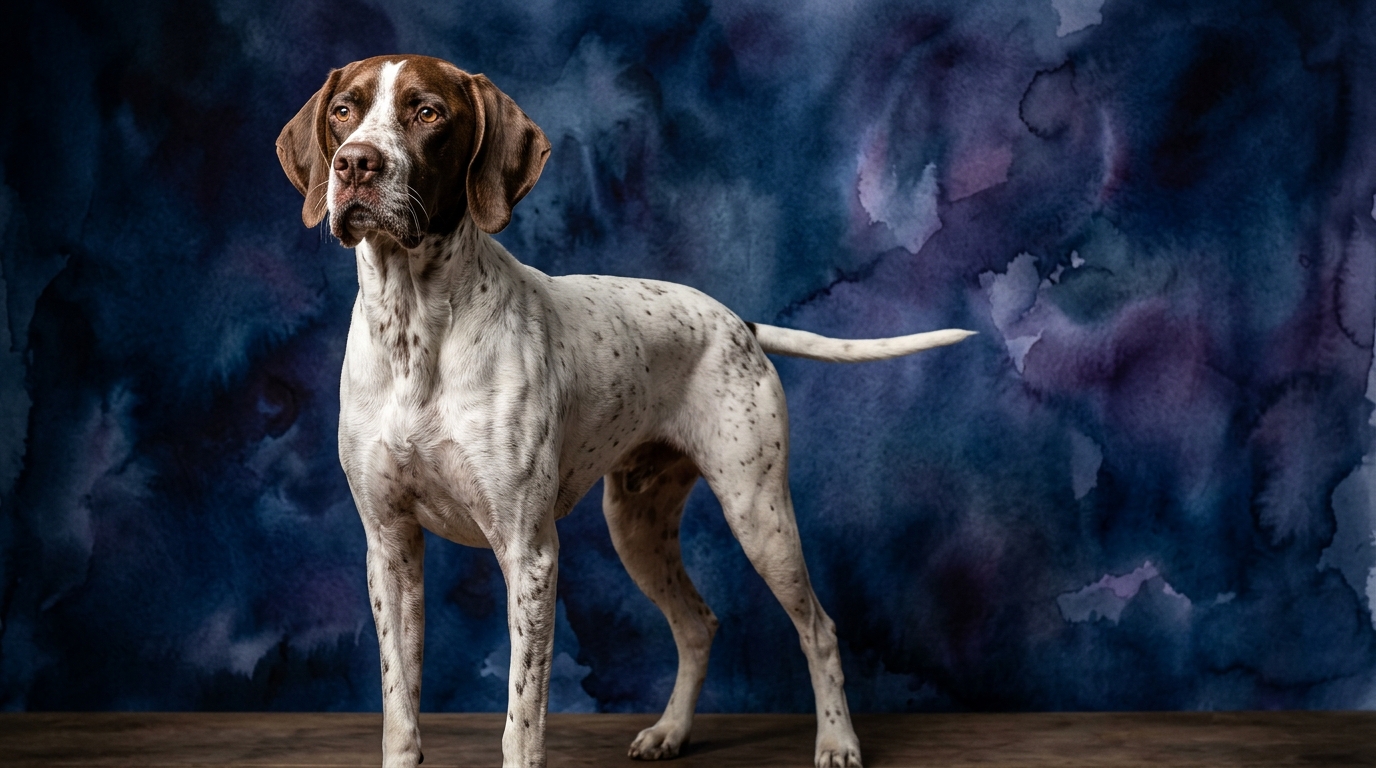
Pointer at a glance
| IQ Rank / Score | 17/25 |
|---|---|
| Trainability | ★★★★☆ (4/5) |
| Social Intelligence | ★★★☆☆ (3/5) |
| Lifespan | 10-12 years |
| Shedding | Moderate to high |
| Exercise Needs | High (60+ min/day + training) |
| Origin | England |
Understanding the Pointer's Canine Mind
Originating from England in the 17th century, the Pointer was meticulously bred not just to find game, but to indicate its presence with a precise, unwavering stance – the iconic 'point.' This specialized role fundamentally shaped their cognitive architecture, demanding a unique blend of sensory acuity, disciplined focus, and collaborative intelligence. Unlike breeds that flush game or retrieve it immediately, the Pointer's primary task was to freeze, effectively acting as a living compass, silently guiding the hunter to the quarry. This required an extraordinary capacity for environmental processing, understanding terrain, wind direction, and the nuanced behavior of game birds, all while maintaining perfect stillness. Their intelligence, therefore, evolved to prioritize keen observation, precise communication, and an immense capacity for self-control, making them highly attuned to both their environment and their human partner. Their history is not just about instinct, but about the development of a highly refined, cooperative intellect designed for a very specific, demanding purpose in the field. This foundation of biddability and focus extends far beyond hunting, influencing their trainability and adaptability in various aspects of modern life.
The Pointer's journey from a working dog to a beloved companion has further highlighted their versatile intellect. While their strong hunting heritage remains, Pointers thrive on mental engagement and purposeful activity, demonstrating that their intelligence isn't limited to the field. Their development as a breed has instilled in them a keen observational capacity, an ability to read subtle cues from their environment and handler, and an inherent drive to cooperate. This makes them not only efficient hunting partners but also surprisingly adaptable learners who excel when given clear direction and a 'job' to do, whether it's navigating an agility course or simply being a responsive family member. Their cognitive evolution is a testament to how human selection can shape specific intellectual strengths in a species, tailoring their minds for particular tasks and enhancing their capacity for complex learning and partnership.
The Primary Angle: Focused Observational Intelligence & Collaborative Scent Work
The Pointer's cognitive prowess is fundamentally shaped by its historical role as a silent, unwavering partner to the hunter, making its primary intelligence angle 'Focused Observational Intelligence & Collaborative Scent Work.' Their intelligence isn't merely about following commands, but about a sophisticated synthesis of sensory input, spatial reasoning, and cooperative communication. Pointers excel at processing an immense amount of complex olfactory information, meticulously differentiating target scents from a cacophony of environmental smells. This requires intense, sustained focus—a form of selective attention that allows them to pinpoint game even in challenging conditions. Unlike a Retriever, who finds and brings back, or a Flusher, who drives game into the open, the Pointer’s task is to *identify* and *indicate*, a cognitively distinct approach.
However, their uniqueness lies in what happens *after* detection: the 'point.' This act is a masterclass in impulse control, where the dog must override the primal urge to chase or retrieve, instead freezing in a statuesque pose to communicate the game's location to their human handler. This collaborative scent work demands not only acute sensory perception but also a profound understanding of their role in a team, exhibiting a distinct type of intelligence that balances independent problem-solving in the field with unwavering cooperation and precise communication. They are, in essence, living indicators, requiring spatial awareness to orient their body correctly, environmental understanding to assess wind and cover, and an innate desire to work harmoniously with their human partner. This focused observational intelligence, coupled with their collaborative scent work, means they are constantly analyzing, interpreting, and communicating their findings, often without a sound, showcasing a truly specialized and impressive canine mind.
Surprising Cognitive Insight: The Paradox of Impulse Control
One of the most surprising scientific insights into the Pointer's cognition lies in the paradox of their signature behavior: the point itself. Pointers were developed to 'point' game by freezing and indicating its location, a distinctive behavior that evolved from earlier setting spaniels, rather than flushing or retrieving the game immediately. This specialized role demands an incredible level of **impulse control and precise, non-verbal communication** – a cognitive feat often underestimated. Unlike many other hunting breeds that flush game or retrieve it, the Pointer's entire purpose revolves around identifying the game, holding rock-still, and using their body language to direct their handler, essentially acting as a living compass. This isn't just an automatic reflex; it's a sophisticated behavioral inhibition where the dog consciously overrides its powerful innate predatory drive to chase and capture, in favor of a static, communicative posture. This requires profound self-discipline and an advanced understanding of its cooperative role with the hunter.
This unique specialization required centuries of selective breeding to enhance not just their sense of smell, but their capacity for sustained focus, patience, and a deep, ingrained understanding of their cooperative role. It's a testament to their cognitive flexibility that they can suppress their natural instincts (to chase) in favor of a silent, almost meditative display of location, all for the benefit of their human partner. The Pointer's ability to exert such profound impulse control, sometimes for extended periods in highly stimulating environments, highlights a complex neural circuitry dedicated to inhibition, attention, and interspecies communication. It reveals a capacity for advanced executive function that goes far beyond simple instinct, making them a fascinating subject for studies on canine self-control and working partnership.
Debunking the Myths: More Than Just Instinct
**Claim:** "Pointers are just instinct-driven hunting machines with limited trainable intelligence beyond their field work."
**Why It Exists:** This common myth often arises because the Pointer's powerful, specialized hunting drive and iconic pointing stance are so dominant and visually striking that they tend to overshadow other cognitive abilities. People might mistakenly perceive their unwavering focus on scent and game as a singular, less adaptable form of intelligence, assuming their brains are solely wired for their original purpose. Their intense dedication to their work can sometimes be misconstrued as a lack of versatility or a one-track mind, leading owners to underestimate their broader cognitive potential.
**Truth:** While their instinctive drive for hunting is undeniably potent and central to their identity, Pointers are highly intelligent, eager-to-please dogs with excellent problem-solving skills, impressive memory for training, and remarkable adaptability in various learning contexts. They excel particularly in tasks requiring focus, patience, and cooperation, demonstrating a strong capacity for learning complex commands, participating in dog sports beyond field trials, and thriving as adaptable, engaged family companions. Their intelligence extends far beyond the field; Pointers are adept at learning intricate obedience routines, excelling in agility, and even participating in scent work competitions that require different applications of their olfactory skills. Their biddable nature and deep desire to please their human partners make them highly responsive to training, proving that their intellect is anything but limited. They are not merely automatons of instinct, but intelligent, thoughtful, and highly capable dogs who flourish with mental stimulation and engagement, demonstrating a rich inner world that belies the 'just a hunter' stereotype.
The Cosmic Pet's Pointer IQ Profile
The Pointer’s IQ profile reflects a breed whose cognitive strengths are profoundly shaped by centuries of selective breeding for a highly specialized, collaborative role. Their **problemSolving** ability, rated at 3, indicates practical and efficient reasoning, particularly when it relates to navigating their environment, deciphering complex scent trails, or overcoming obstacles to reach a target. While not typically known for abstract puzzle-solving on par with some herding breeds, Pointers are adept at finding solutions directly related to their work in the field or in novel environments. This translates into resourceful thinking when faced with a new challenge, showcasing a practical, rather than purely analytical, intelligence.
Their **trainingSpeed** scores a robust 4; these dogs are remarkably quick learners, eager to please, and highly responsive to consistent, positive reinforcement. Their biddable nature and strong desire to cooperate make them excellent students, capable of mastering complex commands, intricate hand signals, and nuanced routines with relative ease. This high trainability was essential for their historical role and makes them a joy to work with in modern obedience, agility, or advanced field training. **SocialIntelligence**, at 3, highlights their good-natured temperament and ability to form strong bonds with their human companions. While not primarily recognized for sophisticated social manipulation or inter-canine diplomacy, they are cooperative, attentive to their handlers, and can read human intentions well, which is crucial for their teamwork-oriented tasks. They thrive on positive interaction and are generally well-adjusted in family settings, showing a healthy social awareness.
The **instinctiveDrive** rating of 5 is undoubtedly their hallmark. Pointers possess an exceptionally powerful prey drive, an unparalleled olfactory sensitivity, and the innate, almost genetic compulsion to "point." This drive is the engine of their being, defining their focus, motivation, and the very essence of their intelligence. It’s what makes them relentless in their search and unwavering in their indication. Finally, their **memory** earns a 4, reflecting their capacity to recall training commands, remember specific scent locations, and learn complex routines. This sharp memory is vital for reinforcing learned behaviors, accumulating a vast "map" of sensory information gathered during their extensive field work, and consistently performing reliably over time, whether it's remembering a past game location or a series of obedience cues. This unique combination of traits paints a picture of a focused, cooperative, and highly driven canine intellect, perfectly adapted to its historical purpose and excelling when given purpose in modern life.
Tailored IQ Tests for the Pointer
At The Cosmic Pet's IQ Lab, we design tests that specifically highlight the unique cognitive strengths of each breed. For the Pointer, these assessments delve into their extraordinary sensory perception, impulse control, and problem-solving abilities within their natural working context. These tests not only provide insights into their intelligence but also offer engaging mental stimulation for this focused breed.
Pointer vs. Similar Breeds: A Cognitive Comparison
When comparing the Pointer to other sporting breeds, such as the **Labrador Retriever**, distinct cognitive profiles emerge. While both are highly trainable, eager-to-please, and possess strong prey drives, their specialized roles have led to different intellectual emphases. The Labrador Retriever's intelligence often centers on memory for retrieving multiple falls, a 'soft mouth,' and an enthusiastic, immediate action-oriented response to game. Their problem-solving is often geared towards efficient retrieval paths. The Pointer, however, exhibits a primary cognitive distinction in its specialized "pointing" behavior, which demands superior impulse control and silent communication over active retrieving, making their observational and collaborative scent work unique. The Pointer must override the immediate impulse to chase, instead freezing and holding a steady point, requiring a sustained cognitive effort to inhibit action and communicate location, a nuanced mental process different from the Lab's drive to physically recover. This difference highlights the Pointer's specialized capacity for disciplined observation and non-verbal cooperation.
FAQ: Pointer Intelligence Unveiled
[object Object]
3 At-Home Tests to Measure Your Pointer's IQ
These tests are adapted from peer-reviewed ethology research. No equipment is needed beyond items you have at home. Run each test 5–10 times for reliable results.
The Myth: "Pointers are just instinct-driven hunting machines with limited trainable intelligence beyond their field work."
✅ While their instinctive drive for hunting is undeniably potent, Pointers are highly intelligent, eager-to-please dogs with excellent problem-solving skills, impressive memory for training, and remarkable adaptability in various learning contexts. They excel particularly in tasks requiring focus, patience, and cooperation, demonstrating a strong capacity for learning complex commands and thriving as adaptable companions.
Pointer vs. Similar Breeds
🧠 What's Your Dog's IQ Score?
Our full Pet IQ Lab assessment includes 12+ tests across 5 cognitive dimensions, calibrated for Pointers specifically.
Take the Full IQ Test →Frequently Asked Questions
How smart is a Pointer?
Our Pet IQ Lab framework scores cognition across five dimensions (max 25). The Pointer totals 17/25 — high for a domestic dog. The full article breaks down each dimension with at-home tests.
Are Pointers easy to train?
Pointers are generally easy to train when you use consistent, reward-based sessions. They score 4/5 on Training Speed in our breed profile.
Are Pointers good with children and other pets?
Pointers can live well with families when socialized early. Their Social Intelligence scores 3/5, so supervise interactions with small children and introduce new pets gradually.
Do Pointers need a lot of mental stimulation?
Absolutely. With Problem Solving 3/5 and Instinctive Drive 4/5, Pointers need daily mental work — puzzle feeders, scent games, training sessions, or nose-work — to avoid boredom.
How much exercise does a Pointer need?
Pointers need active engagement. Plan for 45-60 minutes of exercise and training per day, plus mental stimulation.
How good is a Pointer's memory?
Pointers score 3/5 on memory. They remember high-value associations well; less-used cues fade without refresher sessions.
What is the typical lifespan of a Pointer?
Typical lifespan is 10-12 years for a large dog like the Pointer.
The Pointer is a breed whose intelligence is a captivating blend of acute sensory processing, profound impulse control, and an unwavering drive for collaborative work. Their unique cognitive profile, centered around observational intelligence and specialized scent work, makes them exceptional partners and a fascinating subject for any devoted dog enthusiast.