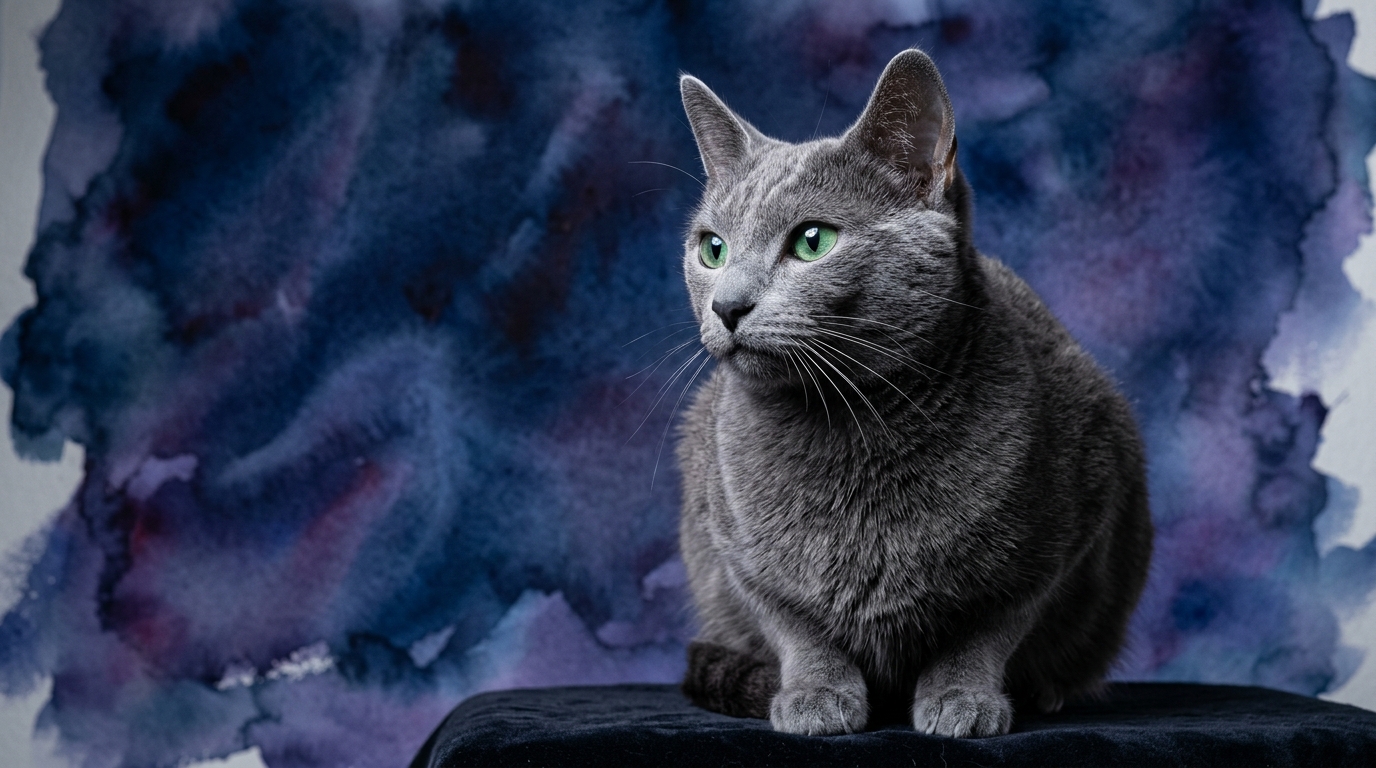
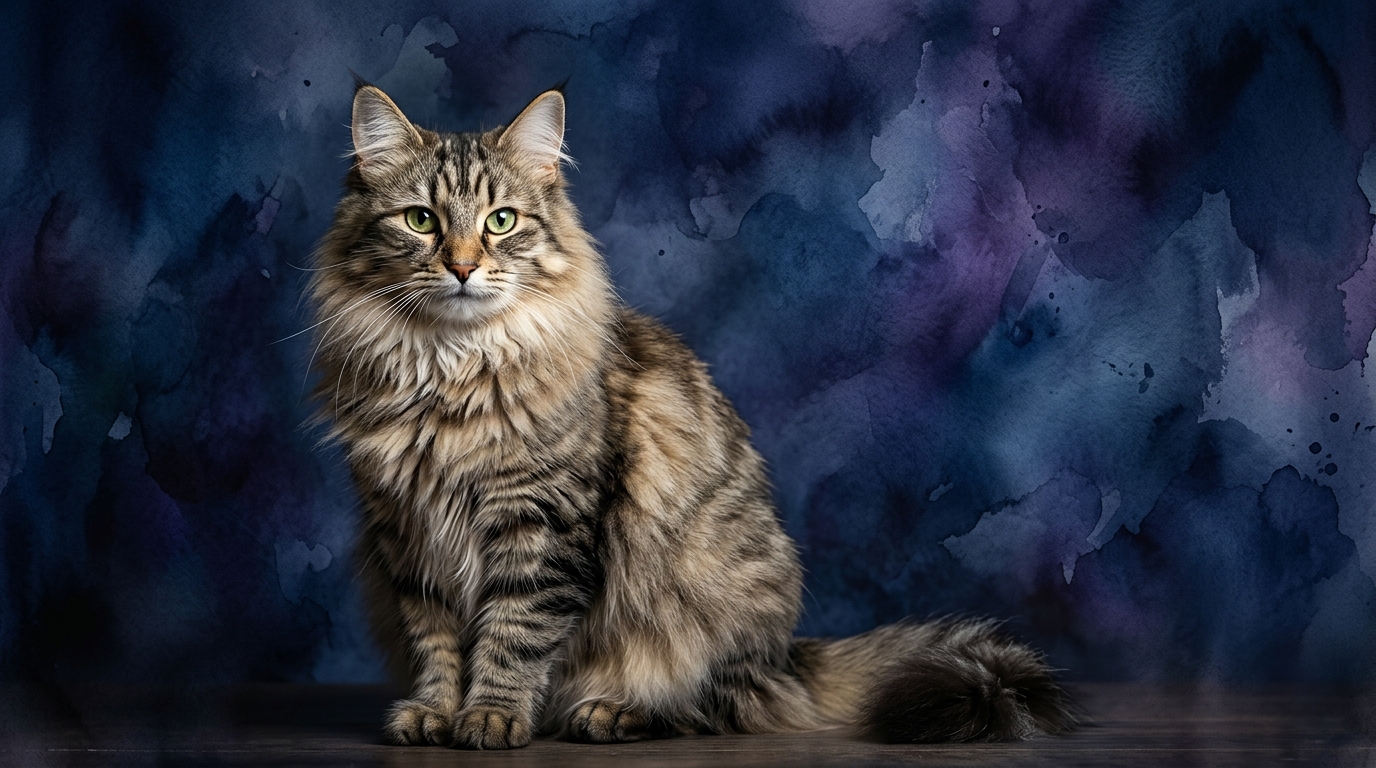
Side-by-Side IQ Profile: Russian Blue vs. Norwegian Forest Cat
The Cosmic Pet Pet IQ Lab evaluates feline intelligence across five crucial dimensions, offering a nuanced perspective beyond simple notions of 'smartness.' For both the Russian Blue and the Norwegian Forest Cat, these scores reveal distinct cognitive blueprints.
**Problem Solving (Russian Blue: 4/5, Norwegian Forest Cat: 4/5):** Both breeds demonstrate a strong capacity for navigating novel situations and figuring out how to achieve goals, such as manipulating puzzle toys or accessing desired areas. This indicates a similar aptitude for logical thought, trial-and-error learning, and adapting to environmental challenges. They can both assess a situation and devise a method to overcome an obstacle.
**Training Speed (Russian Blue: 3/5, Norwegian Forest Cat: 3/5):** Neither breed is a quick study in the realm of formal obedience or complex trick training. Their learning curve is moderate, suggesting that while they are capable of learning commands and behaviors, it requires consistent reinforcement, patience, and engaging methods from their human companions. Rapid acquisition of new commands is not their primary cognitive strength.
**Social Intelligence (Russian Blue: 4/5, Norwegian Forest Cat: 3/5):** The Russian Blue exhibits a higher capacity for understanding human cues, adapting to social dynamics, and forming deeply responsive bonds. They often seem to anticipate owner intentions and react sensitively to emotional shifts, fostering a highly communicative relationship. The Norwegian Forest Cat, while affectionate, operates with a slightly more independent social compass, less acutely attuned to subtle human emotional nuances and more focused on their immediate environment.
**Instinctive Drive (Russian Blue: 3/5, Norwegian Forest Cat: 5/5):** The Norwegian Forest Cat possesses a significantly more pronounced set of innate hunting and exploration behaviors, driven by a strong ancestral urge to stalk, climb, and forage. This manifests as a compelling need for environmental enrichment and active play that simulates natural predatory activities. The Russian Blue has a moderate instinctive drive, often content with less intense predatory play and more inclined towards quiet observation.
**Memory (Russian Blue: 5/5, Norwegian Forest Cat: 4/5):** The Russian Blue demonstrates an exceptional capacity for recalling past events, routines, and specific interactions, potentially remembering complex sequences or long-term associations with remarkable clarity. This contributes to their predictable habits and understanding of household rules. The Norwegian Forest Cat also exhibits good memory, effectively remembering routines and familiar faces, but perhaps with slightly less acute recall for intricate details or very long-past, non-routine events compared to the Russian Blue.
Where the Russian Blue Excels Cognitively
The Russian Blue's cognitive strengths truly shine in areas of long-term recall and social responsiveness. With a Memory score of 5/5, they possess an extraordinary ability to remember routines, past interactions, and the specific habits of their human companions. This means a Russian Blue is highly likely to remember where their favorite toy was left weeks ago, or to anticipate your return home based on a consistent schedule, leading to a sense of predictability and understanding in the household. This superior memory also aids in their grasp of house rules, as they recall which behaviors yield positive or negative responses over extended periods.
Furthermore, their Social Intelligence score of 4/5 indicates a profound capacity for emotional attunement. A Russian Blue often seems to 'read' the room, understanding human moods and responding with appropriate sensitivity. They are adept at picking up on subtle vocal inflections and body language, allowing for a highly communicative bond. This combination of strong memory and social acumen fosters a feline companion that is not only predictable but also deeply connected and responsive to its human family, often forming strong, lasting relationships built on mutual understanding.
Where the Norwegian Forest Cat Excels Cognitively
The Norwegian Forest Cat's cognitive profile highlights a different set of strengths, primarily rooted in their robust Instinctive Drive (5/5). This strong drive translates into exceptional environmental awareness and a compelling need to interact with their surroundings in a physically and mentally stimulating way. They are natural explorers and problem-solvers when it comes to navigating complex physical spaces, demonstrating agility and ingenuity in reaching high places or investigating new territories. This drive fuels their capacity for innovative problem-solving in a practical, physical sense, often related to securing resources or satisfying their innate hunting urges.
While their Problem Solving score is also 4/5, similar to the Russian Blue, for the Norwegian Forest Cat, this often manifests in a more physically dynamic and resourceful manner. They excel at figuring out how to get to that bird outside the window or how to 'hunt' a laser pointer with intense focus and strategy. Their strong natural instincts provide a powerful internal motivation that guides their cognitive engagement with the world, making them adept at tasks requiring persistence, observation, and physical prowess in pursuit of a goal. This makes them highly engaging to observe as they interact with their environment, always seeking out new challenges.
Which is Easier to Train and Why?
When considering ease of training, both the Russian Blue and the Norwegian Forest Cat score 3/5 for Training Speed, indicating that neither is a prodigy in rapidly acquiring new commands. However, their distinct cognitive profiles suggest different approaches and potential outcomes in the training process. For the Russian Blue, their high Social Intelligence (4/5) and exceptional Memory (5/5) can make the training experience more collaborative and the learned behaviors more enduring.
A Russian Blue is more likely to be receptive to human instruction, motivated by praise and the desire for social interaction. Their superior memory means that once a behavior is learned, it is likely to be retained for a long time, leading to greater consistency in trained responses. While the initial learning phase might require patience, the Russian Blue's ability to remember rules and cues, coupled with their desire to engage socially, can make them a highly reliable and cooperative training partner over the long term.
Conversely, the Norwegian Forest Cat's strong Instinctive Drive (5/5) and slightly lower Social Intelligence (3/5) mean that training might need to be more tailored to their natural inclinations. They might be less motivated by social praise alone and more by rewards that tap into their predatory or exploratory instincts, such as chase games or food puzzles. Their independent streak means they might choose to comply based on their own assessment of the situation, rather than a strong desire to please. While they can certainly learn commands, their training might require more creativity to maintain engagement and harness their robust natural drives, making the process feel less overtly cooperative at times compared to the Russian Blue.
Suitability for Active vs. Relaxed Owners
The differing cognitive profiles of the Russian Blue and the Norwegian Forest Cat naturally align them with different owner lifestyles. For individuals seeking a more relaxed, predictable, and deeply connected companion, the Russian Blue is often an ideal match. Their moderate Instinctive Drive (3/5) means they are generally content with indoor life, enjoying quiet observation, gentle play, and prolonged periods of affectionate interaction. Their high Social Intelligence and Memory foster a relationship built on subtle communication and mutual understanding, making them excellent companions for owners who appreciate a quiet, responsive presence and a predictable routine.
In contrast, the Norwegian Forest Cat is exceptionally well-suited for active owners who can provide ample mental and physical stimulation. Their paramount Instinctive Drive (5/5) demands opportunities for climbing, exploring, and engaging in robust play that simulates hunting behaviors. They thrive in environments where they can exercise their problem-solving skills through interactive toys, cat trees, and perhaps even supervised outdoor adventures. Owners who enjoy engaging their pets in dynamic play sessions, providing complex environmental enrichment, and appreciating a more independent, adventurous spirit will find the Norwegian Forest Cat a thrilling and rewarding companion.
The Verdict
Choose the Russian Blue if you seek a highly perceptive, predictable, and deeply connected companion that thrives on social interaction and quiet companionship.
Opt for the Norwegian Forest Cat if you desire an adventurous, robustly playful, and independent feline that excels in physical problem-solving and needs ample environmental stimulation.
🧠 Find Your Pet's IQ Score
Our Pet IQ Lab assessment covers 25+ tests across 5 cognitive dimensions — personalized to your breed.
Take the Full IQ Test →Frequently Asked Questions
Do Russian Blues and Norwegian Forest Cats have similar problem-solving abilities?
Yes, both breeds score 4/5 in Problem Solving according to The Cosmic Pet Pet IQ Lab. This indicates they both possess a strong capacity for navigating new situations and figuring out how to achieve goals, whether it's opening a cabinet or solving a puzzle toy. Their approaches might differ, with the Norwegian Forest Cat often employing more physical and instinct-driven solutions.
Which breed has better memory, the Russian Blue or the Norwegian Forest Cat?
The Russian Blue has a superior memory, scoring 5/5 compared to the Norwegian Forest Cat's 4/5. This means Russian Blues are exceptionally good at recalling routines, past events, and specific interactions over long periods, contributing to their predictable habits and understanding of household rules.
How does social intelligence differ between these two cat breeds?
The Russian Blue exhibits higher social intelligence (4/5) than the Norwegian Forest Cat (3/5). Russian Blues are more attuned to human cues, adapting readily to social dynamics and forming deeply responsive bonds. Norwegian Forest Cats, while affectionate, tend to be more independent and less acutely focused on subtle human emotional shifts.