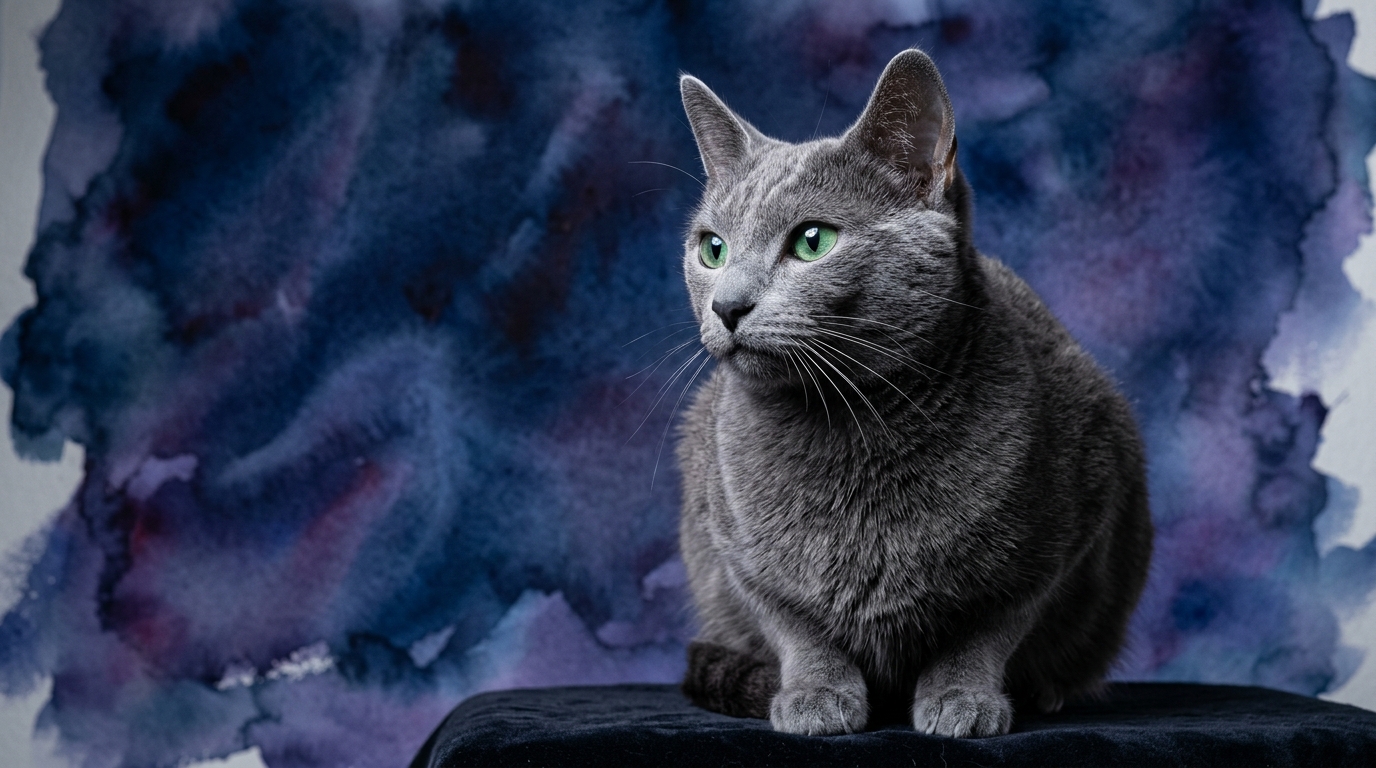
Russian Blue at a glance
| IQ Rank / Score | 19/25 |
|---|---|
| Trainability | ★★★☆☆ (3/5) |
| Social Intelligence | ★★★★☆ (4/5) |
| Lifespan | 12-16 years |
| Shedding | Low to moderate |
| Exercise Needs | Moderate (20-40 min play/day) |
| Origin | Russia (Archangel Islands) |
Beyond the Shimmering Coat: Understanding the Russian Blue Mind
Forget simple curiosity; the Russian Blue exhibits profound observational intelligence. These cats are masters of their environment, not through constant activity, but through meticulous attention to detail and unparalleled recall. Their impressive memory, scoring a top 5/5, fuels their capacity to understand complex patterns.
This deep memory combines with excellent problem-solving skills, rated at 4/5, allowing them to navigate and manipulate surroundings with surprising efficacy. They aren't just reacting; they're strategizing, anticipating outcomes. This innate ability makes them adept at learning household routines and understanding human intentions.
This breed's calm, analytical temperament, shaped by centuries of survival in a harsh environment, is intrinsically linked to its intelligence. Russian Blues have a double coat so dense it stands perpendicular to their body — originally to insulate against Arctic temperatures. This historical context suggests a lineage of felines thriving by being acutely aware, a trait persisting in their intelligent demeanor today.
The Observational Architect: How Russian Blues Learn
The Russian Blue’s primary intelligence angle lies in its observational prowess. They are the quiet architects of their domain, constantly watching, mapping, and remembering routines with breathtaking precision. This isn't passive viewing; it's active data collection, logging and analyzing every opened door, human gesture, and shifted object.
While appearing reserved, seeming to take a backseat in household activities, they are actually building complex spatial and temporal models of their surroundings. This internal mapping allows them to predict your movements, return times, or even how to open a specific cabinet. They learn by seeing and processing, often acting only after fully understanding a situation.
This detailed mapping extends to social dynamics. They learn their human companions' habits, understanding routines like mealtimes, playtime, and quiet moments. This leads to a cat that often seems to 'know' what you're about to do, appearing precisely when a particular activity is initiated, not out of demand, but because they've observed precursor cues.
More Than Just Pretty Paws: A Deeper Look at Russian Blue Cognition
Beyond extraordinary memory and problem-solving, Russian Blues exhibit strong social intelligence, rated 4/5. They are adept at reading human body language and vocal tones, adjusting their own behavior based on family members' moods. This sensitivity allows them to form incredibly close, often understated, bonds.
Their training speed, at 3/5, indicates they are certainly capable of learning tricks and commands, but often on their own terms. They respond best to positive reinforcement and patience, preferring to engage when genuinely interested. This is not a lack of ability, but a reflection of their independent and discerning nature.
Instinctive drive, also at 3/5, means they retain a healthy predatory instinct, enjoying interactive play that simulates hunting. However, this drive often channels into sophisticated games and puzzle toys rather than destructive behavior. Their intelligence makes them appreciate challenges engaging their mind and body, reinforcing their status as thoughtful companions.
3 At-Home Tests to Measure Your Russian Blue's IQ
These tests are adapted from peer-reviewed ethology research. No equipment is needed beyond items you have at home. Run each test 5–10 times for reliable results.
The Myth: "Russian Blues are cold and aloof because they lack the emotional intelligence of warmer breeds"
✅ While they may not greet you with effusive purrs at the door every time, Russian Blues form deep, loyal bonds with their families. Their emotional intelligence is high; they simply express it through subtle cues, a keen awareness of your moods, and a preference for quiet companionship over constant clamor. They are deeply attuned to their environment and the emotions within it, showing empathy through proximity and gentle nudges rather than boisterous displays.
Russian Blue vs. Similar Breeds
🧠 What's Your Cat's IQ Score?
Our full Pet IQ Lab assessment includes 12+ tests across 5 cognitive dimensions, calibrated for Russian Blues specifically.
Take the Full IQ Test →Frequently Asked Questions
How smart is a Russian Blue?
Our Pet IQ Lab framework scores cognition across five dimensions (max 25). The Russian Blue totals 19/25 — very high for a domestic cat. The full article breaks down each dimension with at-home tests.
Are Russian Blues easy to train?
Russian Blues can learn most cues, but expect to repeat lessons and keep sessions short. They score 3/5 on Training Speed in our breed profile.
Are Russian Blues good with children and other pets?
Yes — their Social Intelligence rates 4/5 in our Pet IQ Lab framework. With early socialization and supervised play, most Russian Blues integrate well into families with respectful children and other pets.
Do Russian Blues need a lot of mental stimulation?
Absolutely. With Problem Solving 4/5 and Instinctive Drive 3/5, Russian Blues need daily mental work — puzzle feeders, scent games, training sessions, or interactive wand toys — to avoid boredom.
How much exercise does a Russian Blue need?
Russian Blues do well with 20-40 minutes of interactive play plus a few short training moments.
How good is a Russian Blue's memory?
Russian Blues score 5/5 on memory. They remember routines, hiding spots, and learned cues for months, sometimes years.
What is the typical lifespan of a Russian Blue?
Most Russian Blues live 12-16 years with good veterinary care, quality diet, and indoor living.
The Russian Blue is far more than just a beautiful cat; they are insightful companions whose subtle brilliance enriches every interaction. Their deep observational intelligence offers a unique glimpse into the sophisticated minds of our feline friends, proving that true genius often works in quiet, elegant ways.