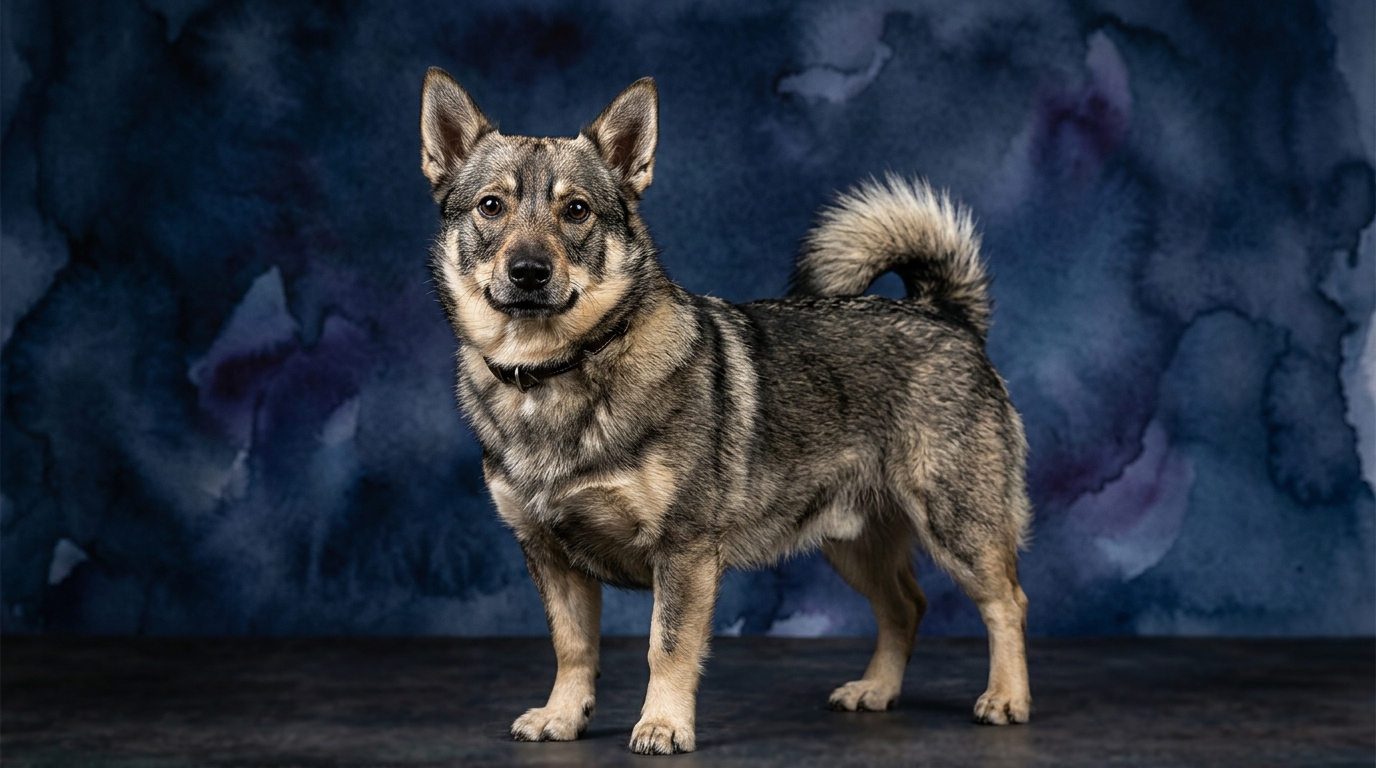

Side-by-Side IQ Profile
The Cosmic Pet Pet IQ Lab offers a lens through which to compare the cognitive landscapes of the Swedish Vallhund and the English Setter across five key dimensions. While both breeds are dogs, their historical roles have sculpted unique mental aptitudes.
The Swedish Vallhund, a robust herding dog, scores a consistent 3/5 across all categories. Its Problem Solving ability, rated at 3/5, reflects a practical intelligence geared towards managing livestock, requiring quick, on-the-spot decisions to direct animals rather than intricate puzzle-solving. For Training Speed at 3/5, the Vallhund demonstrates a moderate pace of learning new commands and routines; they are capable of absorbing instruction but may require consistent, engaging methods to maintain focus and enthusiasm. Their Social Intelligence, also 3/5, indicates a balanced capacity for understanding human cues and interacting appropriately within a family structure, showing awareness without being overly sensitive or overly independent. The Instinctive Drive of 3/5 points to a moderate but present drive for their ancestral herding tasks, which can manifest as a desire to "gather" family members or chase moving objects. Finally, their Memory at 3/5 suggests a solid ability to recall learned behaviors and past experiences, sufficient for retaining training and remembering routines over time.
In contrast, the English Setter, a refined sporting dog, generally presents a higher cognitive profile according to our metrics, also holding a Coren rank of #37. Its Problem Solving score of 4/5 indicates a more advanced capacity for navigating novel situations and figuring out solutions, likely stemming from the complex tasks involved in scenting, pointing, and retrieving game. This breed's Training Speed is also 4/5, suggesting they are quick studies, often picking up new commands with fewer repetitions and showing a keen desire to cooperate with their handler. Their Social Intelligence aligns with the Vallhund at 3/5, signifying a similar balanced understanding of social dynamics and human interactions, making them amiable companions who can read emotional cues effectively. The Instinctive Drive for the English Setter is 3/5, reflecting a pronounced drive for hunting-related activities, such as tracking scents and responding to prey movement, which can be channeled into various dog sports. Notably, their Memory scores 4/5, indicating a superior ability to retain complex sequences of commands, remember locations, and recall specific past events, crucial for intricate field work and obedience.
Where Swedish Vallhund Wins Cognitively
While the English Setter generally outscores the Vallhund in several IQ dimensions, the Swedish Vallhund’s specific cognitive strengths shine in areas demanding robust independence and situational awareness tailored to its herding heritage. Its 3/5 Problem Solving, though lower, is uniquely adapted for dynamic, fluid scenarios like managing livestock, where quick, reactive decisions are paramount and often made without direct handler commands. This breed demonstrates a self-reliance in navigating changing environments, a cognitive advantage when an owner needs a dog capable of making sensible, autonomous choices in less structured settings. Furthermore, its balanced 3/5 Social Intelligence, combined with its compact and durable build, allows for an unpretentious, adaptable companionship that isn't overly dependent on constant human validation, making it an excellent choice for owners who appreciate a dog with a solid sense of self.
Where English Setter Wins Cognitively
The English Setter's cognitive profile, particularly its 4/5 scores in Problem Solving, Training Speed, and Memory, positions it as a highly capable and adaptable learner. Its superior problem-solving acumen allows it to quickly grasp complex sequences and adapt strategies, whether it's navigating challenging terrain during a hunt or figuring out how to open a child-proof gate. The higher Training Speed means the English Setter is often more receptive to intricate multi-step commands and advanced obedience, making it a star pupil in dog sports like agility or competitive obedience. Moreover, its exceptional memory allows it to retain a vast repertoire of commands and routines over long periods, making reinforcement often quicker and less frequent once a behavior is established. This mental agility translates into a dog that can master sophisticated tasks and recall them with remarkable consistency.
Which is Easier to Train and Why
Based on the IQ Lab scores, the English Setter, with its 4/5 Training Speed, is generally easier to train compared to the Swedish Vallhund's 3/5. The Setter's deep-seated desire to work cooperatively with its handler, coupled with its historical role requiring precise responses to subtle cues in the field, contributes to its readiness to learn. They typically show a strong "will to please" and a focus on human direction, making them highly responsive to positive reinforcement and eager to master new commands. In contrast, the Swedish Vallhund, while trainable, possesses a more independent streak rooted in its herding work where it often had to make decisions autonomously. This independence means Vallhunds might require more engaging and varied training methods to prevent boredom and maintain their interest, potentially taking more repetitions to solidify new behaviors compared to the Setter. Their intelligence is more about practical, self-directed action than strict adherence to complex human-initiated routines.
Which Suits Active Owners vs. Relaxed Owners
Both breeds benefit from active engagement, but their energy levels and mental stimulation needs cater to slightly different owner lifestyles. The English Setter, with its strong instinctive drive (3/5) for sporting activities and higher problem-solving capacity, thrives with owners who can provide consistent, vigorous exercise, such as long runs, hiking, or field training, alongside mental challenges like advanced obedience or scent work. Their need for intellectual engagement matches their physical endurance, making them ideal for active individuals or families committed to extensive outdoor activities and structured learning. The Swedish Vallhund, while also possessing a 3/5 instinctive drive and needing regular exercise to manage its herding instincts, is often more content with varied daily activities rather than constant high-intensity work. They adapt well to owners who enjoy moderate daily walks, engaging in interactive games, or exploring new environments. While they certainly aren't couch potatoes, their cognitive profile suggests they might be a better fit for active owners who appreciate a dog that can participate in a range of activities without requiring the same level of sustained, high-octane mental and physical output as a Setter.
The Verdict
Opt for the Swedish Vallhund if you seek a self-reliant, adaptable companion capable of making independent decisions, thriving with varied daily activities and a family that appreciates its compact, robust nature.
Select the English Setter if you are an active owner dedicated to advanced training, field work, or dog sports, valuing a highly responsive, cooperative learner with exceptional memory and problem-solving skills.
🧠 Find Your Pet's IQ Score
Our Pet IQ Lab assessment covers 25+ tests across 5 cognitive dimensions — personalized to your breed.
Take the Full IQ Test →Frequently Asked Questions
Are Swedish Vallhunds good at dog sports?
Yes, Swedish Vallhunds can excel in dog sports like agility, obedience, and herding trials. Their moderate training speed and problem-solving abilities, coupled with their sturdy build and natural athleticism, make them capable competitors when provided with consistent and motivating training.
How much mental stimulation does an English Setter need daily?
English Setters require significant daily mental stimulation due to their high problem-solving and memory scores. This can include regular training sessions, puzzle toys, scent games, and opportunities to learn new tricks, ideally alongside vigorous physical exercise to keep their minds and bodies engaged.
Do these breeds get along well with other pets?
Both breeds generally possess a balanced social intelligence (3/5), suggesting they can coexist peacefully with other pets when properly socialized from a young age. However, the Vallhund's herding instinct might lead it to "herd" smaller pets, while the Setter's prey drive could be a factor with small animals, so careful introductions and supervision are always important.