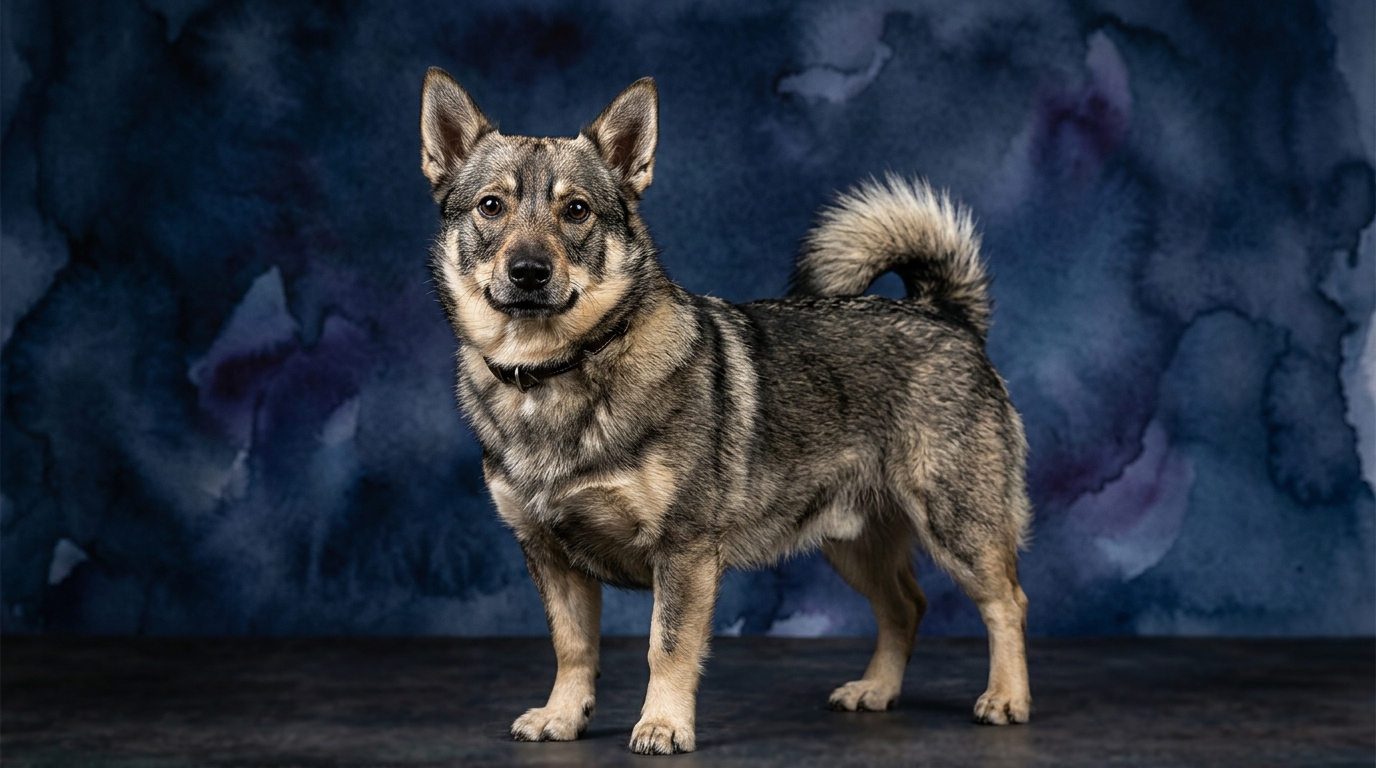
Swedish Vallhund at a glance
| IQ Rank / Score | 17/25 |
|---|---|
| Trainability | ★★★★☆ (4/5) |
| Social Intelligence | ★★★★☆ (4/5) |
| Lifespan | 12-16 years |
| Shedding | Low to moderate |
| Exercise Needs | High (60+ min/day + training) |
| Origin | Sweden |
The Viking Dog's Brain: A Legacy of Dynamic Herding
The primary angle of the Swedish Vallhund's intelligence lies in its 'Dynamic Rear-Flank Herding Acumen.' Unlike many herding breeds that use a wide sweep, Vallhunds specialize in controlling livestock by driving them from behind, often nipping at heels to guide them. This highly specialized task demands an exceptional suite of cognitive skills for efficient execution.
Their work requires rapid, on-the-spot decision-making, sophisticated spatial awareness to anticipate livestock movements, and unwavering focus amidst a chaotic environment. They must constantly adapt their strategy, maneuver around obstacles, and apply precise pressure without causing undue stress. This isn't just instinct; it's a dynamic problem-solving intelligence, honed over millennia to excel at a very specific, demanding job.
This unique herding style translates into a dog that is incredibly perceptive and adaptable in a domestic setting. They possess a keen observational intelligence, often 'herding' family members by gently nudging or positioning themselves strategically. This profound need for mental engagement, derived from their ancestral role, makes them thrive when given a purpose, whether it's learning complex tricks or participating in dog sports.
Ancient Roots, Modern Minds: A Surprising Cognitive Link
A surprising historical fact about the Swedish Vallhund's cognition is its remarkably direct lineage from the dogs brought by Vikings to Britain over 1,000 years ago. This ancient migratory link established a foundational cognitive blueprint for low-stature, agile herding dogs, predating and influencing the development of other similar breeds, such as the Welsh Corgi, despite centuries of geographical separation and distinct breeding programs.
This shared, ancient heritage highlights a deep-seated, resilient form of intelligence that has endured through millennia. The Vallhund's cognitive toolkit was essentially 'field-tested' by Viking farmers, proving its efficacy in diverse environments and under challenging conditions, ensuring only the most adaptable and intelligent dogs contributed to the lineage.
This robust, primal intelligence means Vallhunds aren't just intelligent by modern standards; they carry an ancestral wisdom. Their brains are wired for survival, observation, and effective action, allowing them to assess environments, react with inherent efficiency, and learn from experience with a swiftness that reflects their profound historical depth.
Debunking the Myth: More Than Just a Barking Dog
The most common myth about the Swedish Vallhund's intelligence is the misconception that they are simply stubborn, overly vocal, and therefore difficult to train due to their strong herding instincts. This often leads prospective owners to underestimate their profound cognitive capabilities and their capacity for partnership.
This myth often arises from a misinterpretation of their core traits. Their characteristic vocalizations – alert barks and excited 'chatters' – are a direct inheritance from their role as vigilant farm dogs, warning of intruders and communicating with livestock. Similarly, their strong-willed nature and persistence are not stubbornness but rather a deep-seated drive and independence crucial for making quick decisions in the field without constant human direction.
The truth is these 'problematic' traits are, in fact, indicators of high intelligence and a robust work ethic. Vallhunds are exceptionally trainable when their minds are engaged, and their instinctual behaviors are channeled constructively. Their vocalizations are often a form of intelligent communication, and their drive makes them eager participants in training, agility, and other mentally stimulating activities, proving them to be highly adaptable and responsive companions.
IQ Profile: Decoding the Swedish Vallhund's Cognitive Strengths
The Swedish Vallhund's intelligence profile reveals a balanced yet highly specialized cognitive architecture, perfectly suited for its historical role and modern companionship. Their scores reflect a dog that is both acutely perceptive and driven by ancient instincts.
**Problem-Solving (4/5):** Vallhunds exhibit excellent problem-solving skills, a direct legacy of their need to dynamically manage livestock and navigate complex farm environments. They excel at figuring out how to open gates, solve puzzle toys, and strategize during agility courses, demonstrating ingenuity and persistence. Their method of working livestock from the rear requires constant assessment and adaptation.
**Training Speed (4/5):** These 'Viking Dogs' are remarkably quick learners. Their eagerness to engage and their sharp minds allow them to grasp new commands and complex routines with impressive speed. Consistent, positive reinforcement training methods yield rapid results, making them a joy to teach and an excellent candidate for advanced obedience or trick training.
**Social Intelligence (4/5):** Swedish Vallhunds possess high social intelligence, forming deep bonds with their human families and exhibiting a strong ability to read human emotions and cues. They are perceptive companions, often anticipating needs and reacting to subtle changes in household dynamics, which contributes to their reputation as empathetic and communicative pets.
**Instinctive Drive (5/5):** The powerful herding instinct is the cornerstone of the Vallhund's cognitive makeup. This drive dictates many of their behaviors, from nipping at heels to circling family members, and requires consistent, appropriate outlets. It's a fundamental part of their intelligence, shaping their engagement with the world and their need for purposeful activity.
**Memory (4/5):** Their memory is robust, vital for retaining commands, remembering complex routines, and recalling past experiences. This strong recall ability aids significantly in long-term training, allowing them to build upon learned behaviors and adapt effectively to established rules and boundaries within their environment.
Tailored Intelligence Tests for Your Vallhund
To truly assess the unique cognitive profile of the Swedish Vallhund, the Pet IQ Lab recommends tests that challenge their herding instincts, problem-solving prowess, and adaptability. These selected tests move beyond generic assessments to highlight their specific strengths.
The **Barrier Navigation Test** is ideal for Vallhunds, directly measuring their physical problem-solving, agility, and spatial reasoning. It involves setting up a series of varied barriers (e.g., solid walls, low fences, gates) in an enclosed space. The dog must find the quickest and most efficient path through or around these obstacles to reach a desired reward (e.g., a favorite toy or a treat) on the other side. This test mimics the dynamic decision-making required when herding livestock through changing terrain.
The **Trick Acquisition Test** is perfect for evaluating their high trainability, willingness to learn, and cognitive flexibility. This test involves teaching the dog a novel, multi-step trick (e.g., 'play dead' or 'retrieve a specific item from a group') over several short sessions. The speed at which the Vallhund learns and reliably performs the new trick, along with its enthusiasm for the task, provides insight into its learning capacity and desire for mental engagement.
The **Puzzle Box Test** is an excellent measure of their persistence, abstract problem-solving, and ingenuity. A multi-chambered puzzle box with different mechanisms (e.g., latches, levers, sliding panels) is presented, with a high-value treat hidden inside. The Vallhund's ability to manipulate the various mechanisms to access the treat, their systematic approach, and their sustained effort reflect their innate resourcefulness and problem-solving drive, akin to finding solutions in a herding scenario.
3 At-Home Tests to Measure Your Swedish Vallhund's IQ
These tests are adapted from peer-reviewed ethology research. No equipment is needed beyond items you have at home. Run each test 5–10 times for reliable results.
The Myth: "Swedish Vallhunds are simply stubborn, overly vocal, and difficult to train due to their strong herding instincts."
✅ Vallhunds are exceptionally intelligent and highly trainable when given appropriate mental stimulation and clear direction; their vocalizations and drive are actually expressions of their cognitive engagement and ancestral purpose, making them eager learners when channeled constructively.
Swedish Vallhund vs. Similar Breeds
🧠 What's Your Dog's IQ Score?
Our full Pet IQ Lab assessment includes 12+ tests across 5 cognitive dimensions, calibrated for Swedish Vallhunds specifically.
Take the Full IQ Test →Frequently Asked Questions
How smart is a Swedish Vallhund?
Our Pet IQ Lab framework scores cognition across five dimensions (max 25). The Swedish Vallhund totals 17/25 — high for a domestic dog. The full article breaks down each dimension with at-home tests.
Are Swedish Vallhunds easy to train?
Swedish Vallhunds are generally easy to train when you use consistent, reward-based sessions. They score 4/5 on Training Speed in our breed profile.
Are Swedish Vallhunds good with children and other pets?
Yes — their Social Intelligence rates 4/5 in our Pet IQ Lab framework. With early socialization and supervised play, most Swedish Vallhunds integrate well into families with respectful children and other pets.
Do Swedish Vallhunds need a lot of mental stimulation?
Absolutely. With Problem Solving 2/5 and Instinctive Drive 4/5, Swedish Vallhunds need daily mental work — puzzle feeders, scent games, training sessions, or nose-work — to avoid boredom.
How much exercise does a Swedish Vallhund need?
Swedish Vallhunds need active engagement. Plan for 45-60 minutes of exercise and training per day, plus mental stimulation.
How good is a Swedish Vallhund's memory?
Swedish Vallhunds score 3/5 on memory. They remember high-value associations well; less-used cues fade without refresher sessions.
What is the typical lifespan of a Swedish Vallhund?
Swedish Vallhunds commonly live 12-16 years when kept at a healthy weight.
The Swedish Vallhund is far more than just a charming, low-slung dog; it is a compact powerhouse of ancient intelligence, agility, and unwavering drive. Understanding their unique cognitive profile allows us to appreciate their 'Viking Dog' legacy and unlock their full potential as brilliant, devoted companions.