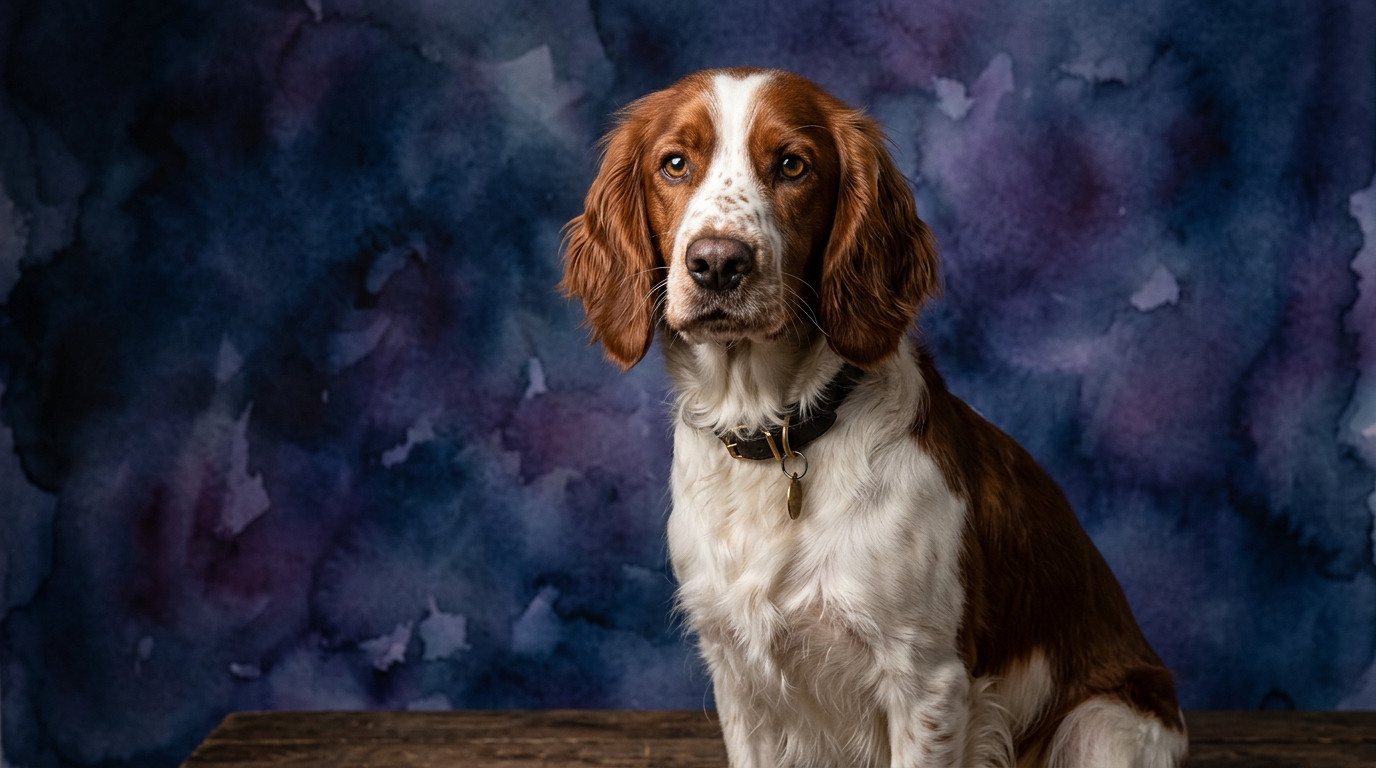

Side-by-Side Cognitive Profile
To understand the unique cognitive landscapes of the Welsh Springer Spaniel and the Redbone Coonhound, we evaluate them across five key dimensions:
**Welsh Springer Spaniel (Sporting):**
**Problem Solving (4/5):** This breed capably navigates novel situations, adept at understanding cause and effect to achieve desired outcomes. They strategize well, whether for complex retrieve scenarios or multi-step commands.
**Training Speed (4/5):** Welsh Springers absorb new behaviors quickly, their eagerness to please and focus on their handler contributing to rapid learning and responsiveness with consistent positive reinforcement.
**Social Intelligence (3/5):** Affectionate within their family, their social acumen is moderate. They grasp human cues and household dynamics but are less inclined towards intricate social manipulation or reading subtle emotional shifts in strangers.
**Instinctive Drive (3/5):** Their drive is geared towards flushing and retrieving game, involving a keen sense of smell and a collaborative work ethic. This manifests as a strong desire to work when engaged in tasks mimicking their historical role.
**Memory (4/5):** Possessing robust memory, Welsh Springers retain learned commands, routines, and specific locations over extended periods, aiding significantly in training retention and complex task performance.
**Redbone Coonhound (Hound):**
**Problem Solving (3/5):** Redbones approach problems with persistence, relying heavily on their senses, especially scent. Their "problem-solving" often involves relentlessly tracking a trail and navigating obstacles through determination rather than abstract reasoning.
**Training Speed (3/5):** Learning capacity is present, but their training speed is moderate. Their independence and profound scent focus mean they are easily distracted from human-centric commands if a compelling scent is nearby, requiring immense consistency.
**Social Intelligence (3/5):** Redbones exhibit moderate social intelligence, forming strong bonds with their families and understanding pack dynamics. They are generally amiable but may not excel in nuanced social interactions beyond their immediate circle.
**Instinctive Drive (3/5):** This score, numerically similar to the Welsh Springer, manifests as an intense, single-minded drive to follow a scent trail, often overriding other stimuli. This core purpose dictates much of their cognitive focus and behavior.
**Memory (3/5):** Redbones have a functional memory for recalling trails, locations, and learned commands. However, their memory for abstract concepts or complex sequences might be less developed than for sensory-based information, particularly scent.
Where the Welsh Springer Spaniel Excels Cognitively
The Welsh Springer Spaniel clearly demonstrates superior aptitude in areas requiring abstract thought and rapid adaptation to human-directed tasks. Their Problem Solving score of 4/5 indicates a quicker grasp of novel scenarios, like manipulating puzzle toys or understanding sequential commands. This cognitive flexibility allows them to generalize learned behaviors more readily to new contexts. Additionally, their Training Speed of 4/5 highlights an impressive ability to absorb and execute commands efficiently, often with fewer repetitions than the Redbone. This reflects a quicker processing of linguistic cues and a stronger desire for cooperative learning. Their Memory at 4/5 ensures long-term retention of these skills, making advanced training and complex routines, such as multi-step agility courses, highly attainable.
Where the Redbone Coonhound Excels Cognitively
While the Redbone Coonhound's general scores appear numerically lower, their cognitive strengths are profoundly specialized within their innate domain. Their Instinctive Drive, rated at 3/5, is a powerful, highly focused cognitive engine for scent work. This involves intricate olfactory processing, precise discrimination of faint trails, and the ability to filter distracting ambient scents – a unique form of problem-solving. When tracking, a Redbone exhibits incredible cognitive persistence and unwavering focus, demonstrating a profound, specialized memory for scent patterns. Within the context of trailing, they adeptly interpret subtle environmental cues and make strategic decisions about a quarry's direction, showcasing a deeply ingrained, highly effective specialized intelligence.
Which Is Easier to Train and Why
Between these two breeds, the Welsh Springer Spaniel is generally easier to train due to their higher Training Speed (4/5) and Problem Solving (4/5), combined with a cooperative nature. Welsh Springers keenly desire to work alongside their humans, making them highly responsive and eager to please. They process commands quickly and maintain focus on their handler even amidst distractions; for instance, teaching a "stay" in a busy park progresses faster. Conversely, the Redbone Coonhound, with a Training Speed of 3/5, presents more challenges. Their formidable instinctive drive for scent work often overrides other motivations. A Redbone might master "recall" in a quiet setting, but a compelling scent can make them "selectively deaf," illustrating a behavioral difference rooted in cognitive priorities. Training a Redbone demands immense patience, consistency, and an understanding of their deep-seated drive, often requiring the incorporation of scenting activities to maintain engagement.
Which Suits Active Owners vs. Relaxed Owners
Neither the Welsh Springer Spaniel nor the Redbone Coonhound suits truly "relaxed" owners; both demand significant physical and mental stimulation. However, the *type* of activity differs. The Welsh Springer Spaniel, with its Sporting background and higher problem-solving, suits active owners who enjoy structured activities like agility, obedience, or field trials, where their quick learning and cooperative spirit shine. They need consistent mental challenges and physical outlets involving human partnership, such as long hikes with training or complex retrieving games. For the Redbone Coonhound, active owners must appreciate and accommodate their powerful instinctive drive. These dogs require opportunities to use their nose, through dedicated scent work, tracking, or long, exploratory walks in varied terrain. Owners enjoying hunting or willing to engage in "nose work" activities will find the Redbone thrives. While calm indoors after sufficient exercise, their daily need for mentally stimulating, physically demanding activities, particularly scent-based, is non-negotiable.
The Verdict
If you seek a highly trainable, cooperative companion eager to engage in structured activities and learn complex tasks, the Welsh Springer Spaniel is likely your ideal match.
For owners who value an independent, persistent tracker with an unparalleled dedication to scent work and are prepared to channel that powerful drive, the Redbone Coonhound will prove to be an incredibly rewarding partner.
🧠 Find Your Pet's IQ Score
Our Pet IQ Lab assessment covers 25+ tests across 5 cognitive dimensions — personalized to your breed.
Take the Full IQ Test →Frequently Asked Questions
Can a Redbone Coonhound be trained for obedience like a Welsh Springer Spaniel?
Yes, Redbone Coonhounds can be trained for obedience, but it typically requires more patience and creative strategies than with a Welsh Springer. Their strong scent drive means training often needs to compete with powerful natural instincts, so incorporating nose work into their training can be highly effective for engagement.
Do Welsh Springer Spaniels require a lot of mental stimulation?
Absolutely. With their higher problem-solving and memory scores, Welsh Springer Spaniels thrive on mental challenges and structured learning. Without adequate mental engagement, they can become bored and potentially develop undesirable behaviors, so puzzle toys and training sessions are crucial.
Is one breed more affectionate than the other?
Both breeds score similarly in social intelligence and are known to form strong, affectionate bonds with their families. While the Welsh Springer might express affection more overtly through cooperative play, the Redbone's devotion often manifests in a calm, loyal presence after their work is done.