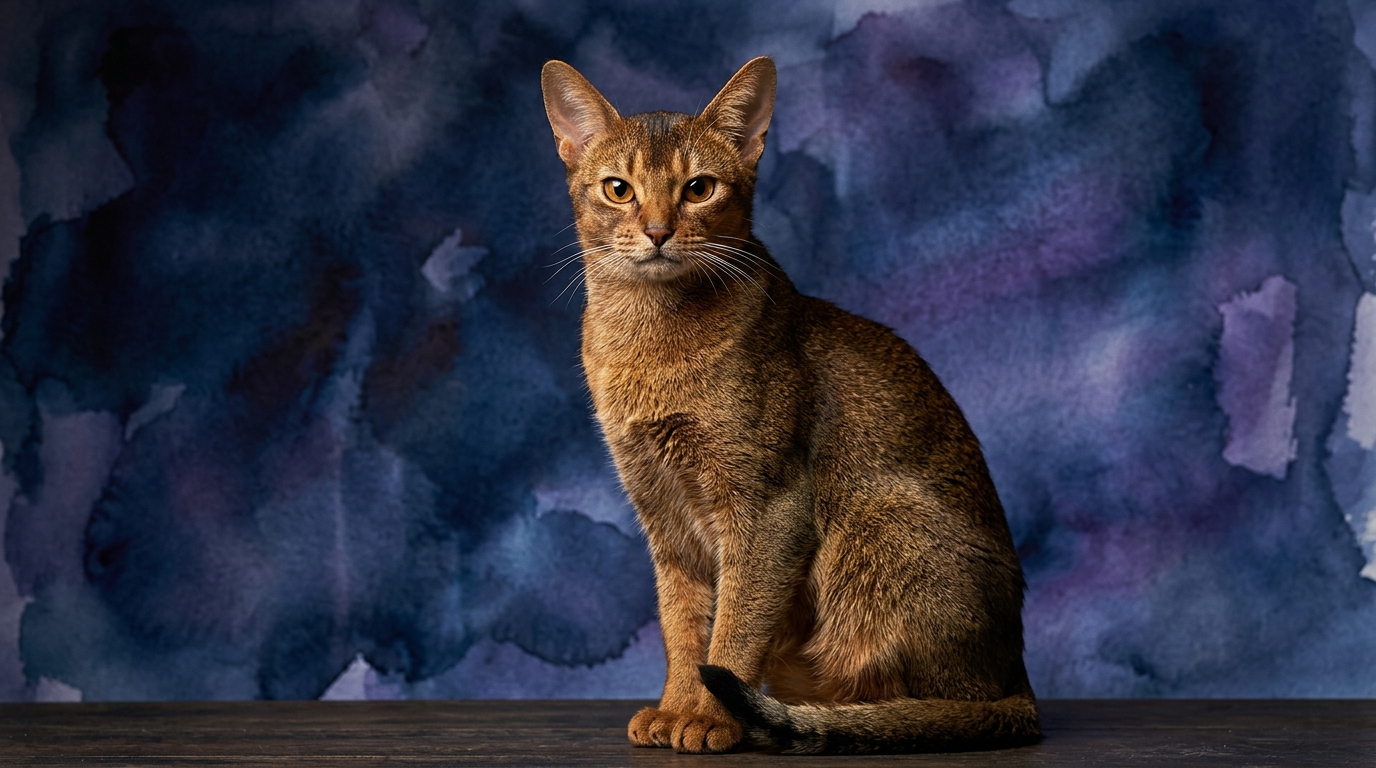
Abyssinian at a glance
| IQ Rank / Score | 24/25 |
|---|---|
| Trainability | ★★★★★ (5/5) |
| Social Intelligence | ★★★★☆ (4/5) |
| Lifespan | 12-16 years |
| Shedding | Low to moderate |
| Exercise Needs | Needs active play (45-60 min/day) |
| Origin | Ethiopia (or SE Asia — disputed) |
The Abyssinian: Feline Athletics Meets Cognition
Originating from what is believed to be Ethiopia, or perhaps Southeast Asia, the medium-sized Abyssinian cat captivates with its striking ticked coat and boundless energy. They aren't just beautiful; Abyssinians possess a cognitive profile that places them among the most interactive and problem-solving felines you'll encounter. While cats were not formally included in Stanley Coren's obedience studies, if they had been, the Abyssinian would undoubtedly stand out for its remarkable cognitive flexibility.
Often dubbed the 'Border Collie of cats,' Abyssinians are characterized by an exceptional need for constant mental stimulation. Without engaging outlets for their keen minds, these inventive cats are prone to creating their own entertainment, which can sometimes involve exploring forbidden cupboards or orchestrating elaborate games of 'fetch-the-unsupervised-item.' This isn't naughtiness; it's a clear signal of an unmet cognitive demand.
Their intelligence isn't merely anecdotal; it's deeply rooted in observable behaviors. Abyssinians demonstrate a profound capacity for understanding cause and effect, quickly learning routines, and even manipulating their environment to achieve desired outcomes. For an Abyssinian owner, providing complex enrichment isn't a luxury; it's a fundamental part of their pet's well-being.
Unpacking the Abyssinian Intelligence Profile
At The Cosmic Pet's Pet IQ Lab, we evaluate feline cognition across several key dimensions. The Abyssinian consistently scores at the top of the charts in areas critical for complex learning and interaction. Their Problem Solving is rated a perfect 5/5, indicating an exceptional ability to navigate novel situations and overcome obstacles to reach a goal. This manifests as quickly learning how to open tricky puzzle feeders or devising strategies to access high shelves.
Their Training Speed, also a 5/5, highlights how rapidly Abyssinians grasp new commands and routines. This isn't just about repetition; it's about making connections and understanding associations quickly. Paired with a Memory score of 5/5, they not only learn fast but retain that knowledge for extended periods, making complex sequential tasks possible.
Social Intelligence, rated 4/5, means Abyssinians are highly attuned to human cues and social interactions, allowing for a deeper bond and more cooperative learning experiences. They often seek out human companionship for play and problem-solving, rather than merely tolerating it. Finally, their Instinctive Drive, a robust 5/5, fuels their relentless curiosity and physical prowess, ensuring they have the motivation to explore and engage with their environment continually.
Beyond the Stereotype: Trainability and Attention Span
The notion that cats are untrainable is a common misconception, particularly when it comes to breeds like the Abyssinian. Owners often find these cats eager to engage in structured play and learn new commands, challenging the traditional view of feline independence. Abyssinians can be leash-trained and taught to retrieve — behaviors almost never seen in other cat breeds. Their attention span during structured play exceeds most cats by a factor of three, making them exceptional candidates for positive reinforcement training.
This extended attention span is a game-changer for owners seeking to teach more than just basic manners. From agility courses designed for cats to learning complex trick sequences, the Abyssinian thrives on the mental challenge and focused interaction. They don't just 'do what they want'; they often want to engage with you in meaningful, stimulating ways.
Leveraging their innate drives for hunting and exploration in structured play environments is key. Interactive toys, puzzle feeders that require thought, and regular training sessions are not just good for their physical health but are crucial for their mental well-being. A well-stimulated Abyssinian is a happy, well-adjusted companion, channeling their energy into productive rather than destructive pursuits.
The Cosmic Pet's At-Home IQ Lab: Testing Your Abyssinian
Ready to see your Abyssinian's brainpower in action? These simple, fun tests allow you to observe their problem-solving skills, cooperative behaviors, and recognition abilities firsthand. Remember, these are designed for insight and enjoyment, not to replace professional veterinary or behavioral assessments. Always ensure a calm, safe environment for your feline participant.
Comparing Cognitive Prowess: Abyssinian vs. Other Breeds
While the Abyssinian stands out, it's helpful to see where their unique intelligence fits in the broader feline spectrum. Comparing them to other highly interactive breeds highlights their distinct cognitive strengths and what makes them such compelling companions.
3 At-Home Tests to Measure Your Abyssinian's IQ
These tests are adapted from peer-reviewed ethology research. No equipment is needed beyond items you have at home. Run each test 5–10 times for reliable results.
The Myth: "Cats can't be trained meaningfully — they just do what they want."
✅ While cats certainly possess an independent spirit, breeds like the Abyssinian demonstrate remarkable trainability and a desire to interact. Their capacity for learning tricks, leash training, and even retrieving objects proves that with positive reinforcement and understanding their motivations, cats can be meaningfully trained, often exceeding expectations.
Abyssinian vs. Similar Breeds
🧠 What's Your Cat's IQ Score?
Our full Pet IQ Lab assessment includes 12+ tests across 5 cognitive dimensions, calibrated for Abyssinians specifically.
Take the Full IQ Test →Frequently Asked Questions
How smart is a Abyssinian?
Our Pet IQ Lab framework scores cognition across five dimensions (max 25). The Abyssinian totals 24/25 — exceptionally high for a domestic cat. The full article breaks down each dimension with at-home tests.
Are Abyssinians easy to train?
Abyssinians learn new cues very quickly — often in 5-15 repetitions. They score 5/5 on Training Speed in our breed profile.
Are Abyssinians good with children and other pets?
Yes — their Social Intelligence rates 4/5 in our Pet IQ Lab framework. With early socialization and supervised play, most Abyssinians integrate well into families with respectful children and other pets.
Do Abyssinians need a lot of mental stimulation?
Absolutely. With Problem Solving 5/5 and Instinctive Drive 5/5, Abyssinians need daily mental work — puzzle feeders, scent games, training sessions, or interactive wand toys — to avoid boredom.
How much exercise does a Abyssinian need?
Abyssinians need active engagement. Plan for 45-60 minutes of play and climbing per day, plus mental stimulation.
How good is a Abyssinian's memory?
Abyssinians score 5/5 on memory. They remember routines, hiding spots, and learned cues for months, sometimes years.
What is the typical lifespan of a Abyssinian?
Most Abyssinians live 12-16 years with good veterinary care, quality diet, and indoor living.
The Abyssinian cat shatters stereotypes, proving that felines can be not just independent companions but highly trainable, problem-solving partners. By understanding and nurturing their unique cognitive strengths, you'll unlock a world of engaging interaction with this truly extraordinary breed.